
AMD's EPYC 'Venice' CPUs: A New Contender in AI and HPC
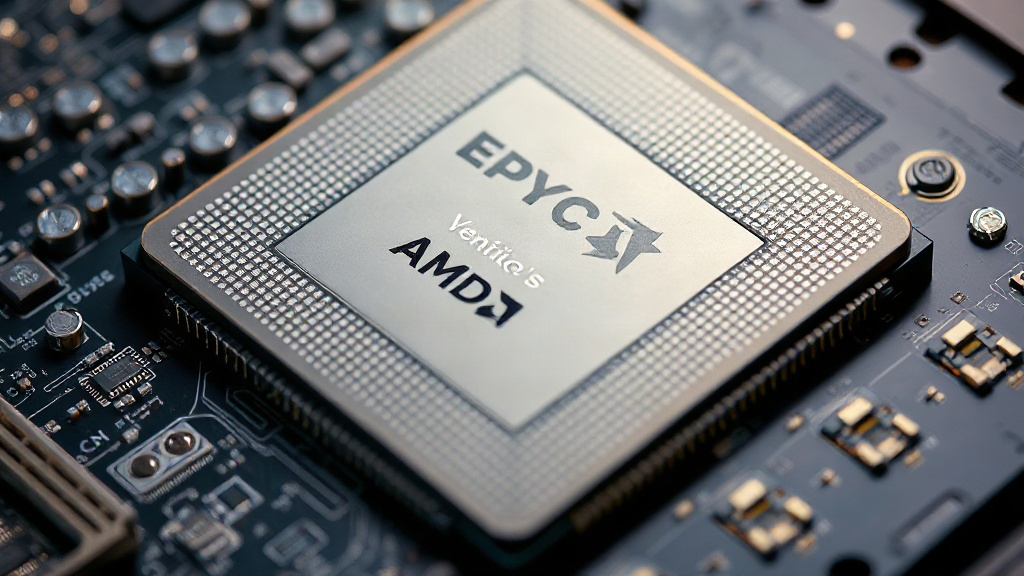
AMD has released the first official benchmarks for its upcoming EPYC 'Venice' processors, positioning them as a formidable challenger in the high-performance computing (HPC) and artificial intelligence (AI) markets, directly targeting Nvidia's Grace Hopper Superchip. The company's claims suggest a substantial leap in performance, particularly for AI inference and training workloads, areas where Nvidia has long held a dominant position. The benchmarks, shared by AMD, highlight two key configurations: a 256-core variant and a 96-core model, both designed to push the boundaries of computational power for data-intensive applications.
The headline-grabbing claim is that the 256-core EPYC 'Venice' chip is more than twice as fast as Nvidia's Grace Hopper Superchip (referred to as 'Vera' in AMD's presentation). This is a bold assertion, as Nvidia's offering is a highly integrated solution combining ARM CPU cores with its Hopper GPU architecture, specifically engineered for AI and HPC. AMD's approach with EPYC 'Venice' appears to be a more CPU-centric strategy, leveraging its high core counts and architectural improvements to deliver performance that can rival or surpass specialized AI accelerators in certain scenarios. This suggests a potential shift in how AI and HPC workloads are architected, with powerful CPUs playing an even more critical role.
Performance Claims and Benchmarking Details
AMD's benchmark data, presented in a recent webinar, focuses on specific AI and HPC applications. The 256-core 'Venice' processor reportedly achieves over twice the performance of Nvidia's Grace Hopper Superchip in workloads like large language model (LLM) inference and certain scientific simulations. This performance uplift is attributed to a combination of factors, including increased core count, architectural enhancements, and potentially improved memory bandwidth and cache hierarchy within the new EPYC generation. The specific benchmarks used by AMD are not yet fully detailed publicly, but the company emphasized their relevance to real-world AI deployments.
Beyond the flagship 256-core chip, AMD also highlighted the performance of a 96-core 'Venice' model. This configuration is claimed to offer 20% faster per-core performance compared to Nvidia's Grace Hopper Superchip. This per-core advantage is significant, as it indicates efficiency gains and architectural improvements that benefit individual processing units, not just raw throughput from sheer numbers. Such a claim suggests that even in scenarios where the full 256 cores are not utilized, or where per-thread performance is critical, the 'Venice' architecture offers a competitive edge.
Targeting Nvidia's Dominance
Nvidia's Grace Hopper Superchip, a combination of the Grace CPU and Hopper GPU, is a powerful integrated system designed for massive AI and HPC tasks. It offers a unified memory architecture and high-speed interconnects, making it a compelling choice for cutting-edge research and deployment. AMD's direct challenge with EPYC 'Venice' is noteworthy. It signals AMD's intent to capture a larger share of the lucrative AI and HPC server market, which has been heavily influenced by Nvidia's GPU dominance. By emphasizing CPU-based performance, AMD might be targeting workloads that are not exclusively GPU-bound or where the TCO (Total Cost of Ownership) of a CPU-centric solution is more favorable.
The implications of these benchmarks, if validated by independent testing, could be substantial. For AI developers and researchers, it opens up new possibilities for hardware configurations and potentially lower costs for achieving high performance. It also introduces a new competitive dynamic, which could spur further innovation from both AMD and Nvidia. The market for AI accelerators and high-performance CPUs is fiercely competitive, with companies like Intel also vying for market share. AMD's 'Venice' CPUs could provide a much-needed alternative for organizations looking to diversify their hardware infrastructure and avoid vendor lock-in.
Architectural Innovations and Future Prospects
While specific technical details about the 'Venice' architecture are still emerging, AMD's performance claims suggest advancements in areas such as core design, interconnect technology, and cache coherency. The company has a history of pushing core counts with its EPYC line, but 'Venice' appears to represent a more significant architectural evolution, possibly incorporating new instruction sets or optimizations for AI workloads. The ability of a CPU to achieve such performance levels in AI tasks, often considered the exclusive domain of GPUs, is a testament to the evolving capabilities of modern processor designs.
What remains to be seen is how these benchmarks translate to a broader range of AI and HPC applications. AMD's presented data likely focuses on scenarios where its architecture excels. Independent verification and real-world deployments will be crucial in assessing the true competitive standing of EPYC 'Venice' against Nvidia's integrated solutions. The success of 'Venice' will hinge not only on its raw performance but also on its ecosystem support, power efficiency, and overall cost-effectiveness for enterprise deployments. If AMD can deliver on these promises, it could significantly disrupt the landscape of AI and HPC hardware, forcing a re-evaluation of optimal system architectures for these critical workloads.