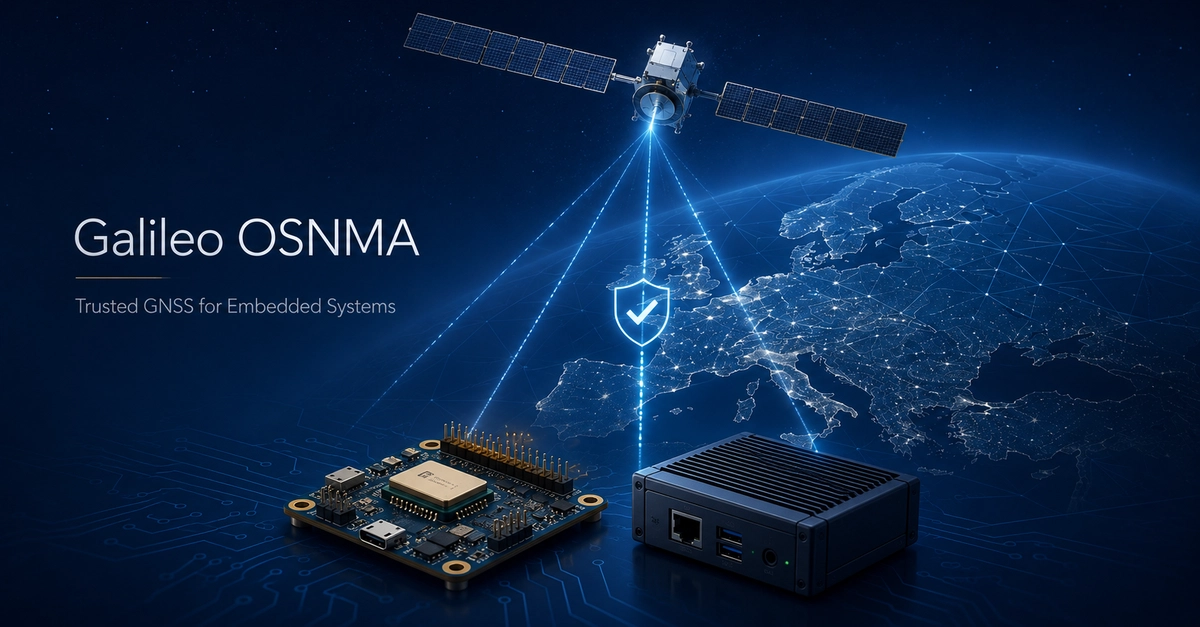
Galileo's Evolution: Beyond Coordinates
When people casually say “GPS,” they often mean a multi-constellation GNSS receiver. GPS is the United States system, while Galileo is the European Union's Global Navigation Satellite System. Modern receivers typically combine these and other global or regional constellations to improve availability and solution quality. Galileo provides Europe with its own infrastructure for Positioning, Navigation and Timing (PNT). Its value extends beyond the constellation itself; services like OSNMA (Open Service Navigation Message Authentication) and HAS (High Accuracy Service) are fundamentally changing how embedded systems can leverage satellite navigation.
Historically, the primary function of a GNSS receiver in an embedded system was to calculate coordinates: latitude, longitude, and altitude. This remains a core capability, but the landscape is rapidly evolving. Galileo's OSNMA and HAS services introduce two critical advancements: message authentication and high-accuracy corrections. This transforms a receiver's role from merely providing location data to verifying the integrity of that data and offering precision previously requiring specialized, often proprietary, equipment.
The Imperative of Authenticity: OSNMA Explained
The introduction of OSNMA addresses a fundamental vulnerability in traditional GNSS: the lack of inherent message authentication. Without it, a receiver cannot distinguish between genuine navigation signals from satellites and spoofed signals transmitted by an adversary. This is particularly concerning for safety-critical applications like autonomous vehicles, drones, and industrial automation systems, where inaccurate or manipulated location data can have severe consequences.
OSNMA works by digitally signing the navigation messages broadcast by Galileo satellites. A compatible receiver can then use public keys, distributed through a secure channel, to verify the digital signature. If the signature is valid, the receiver can be confident that the navigation data – including ephemeris (satellite orbital data) and clock corrections – has not been tampered with. This is akin to a digital watermark on every piece of information the satellite sends, ensuring its origin and integrity.
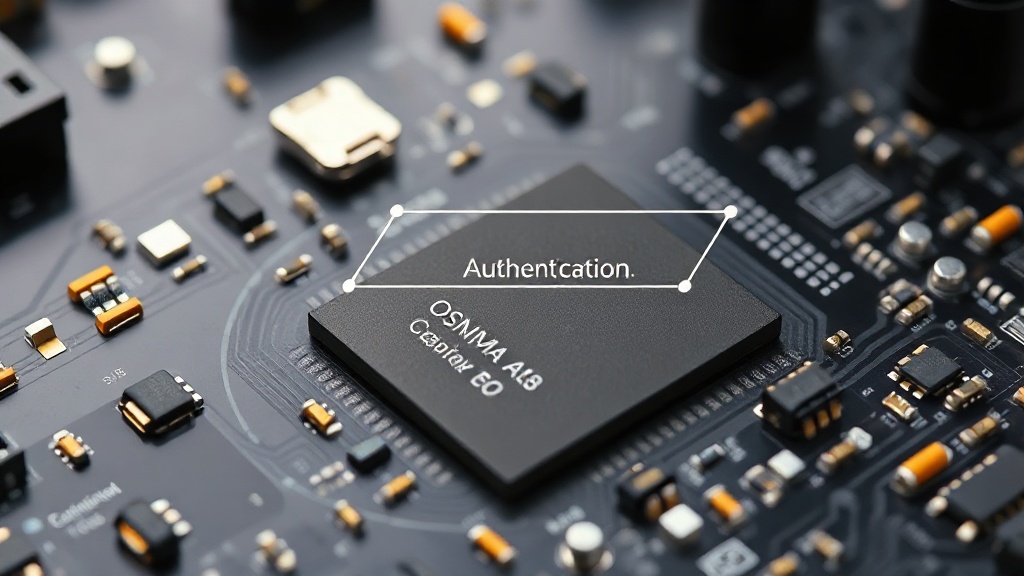
The implications for embedded systems are profound. For instance, a drone operating autonomously could use OSNMA to ensure its navigation commands are not being spoofed, preventing it from being steered off course or into dangerous areas. Similarly, robots in a warehouse or automated agricultural machinery can rely on authenticated PNT data, enhancing operational reliability and safety. This adds a crucial layer of trust to PNT services, making them more resilient against interference and malicious attacks.
Precision Unleashed: The Galileo HAS Service
Complementing OSNMA is the Galileo High Accuracy Service (HAS). While standard GNSS signals typically offer accuracy in the meter range, many advanced applications demand centimeter-level precision. HAS provides these high-accuracy corrections, significantly enhancing the positioning capabilities available to embedded systems.
HAS delivers corrections through two primary channels: the Galileo E6 signal itself and the internet. This dual-delivery mechanism ensures broad availability. The corrections are designed to compensate for various error sources, including atmospheric delays and satellite clock/orbit inaccuracies, which are the primary limitations to achieving high precision with standard GNSS signals. By applying these real-time corrections, receivers can achieve accuracy levels that were once the exclusive domain of expensive, ground-based augmentation systems or complex post-processing techniques.
The integration of HAS into embedded systems opens doors for a new generation of applications. Precision agriculture can benefit from sub-meter or even centimeter-level guidance for planting, spraying, and harvesting. Construction and surveying equipment can achieve unprecedented accuracy in positioning and grading. Advanced driver-assistance systems (ADAS) and future autonomous driving systems can leverage HAS for more reliable lane-keeping and precise maneuvering, especially in challenging urban environments or tunnels where traditional GPS can struggle.
Synergy for a Resilient PNT Architecture
The true power of OSNMA and HAS lies in their synergy. OSNMA ensures that the navigation data received is trustworthy, preventing attacks that could compromise safety or operations. HAS then provides the high-accuracy corrections to that trusted data, enabling sophisticated applications that demand precise positioning. Together, they form the backbone of a more resilient and capable PNT architecture for the modern embedded world.
Consider a fleet of delivery robots operating in a busy urban environment. OSNMA would ensure that each robot is receiving authentic positioning data, preventing it from being tricked into believing it is somewhere it is not. HAS would then provide the high-accuracy corrections needed for the robots to navigate crowded sidewalks, avoid obstacles with millimeter precision, and dock accurately at charging stations or delivery points. This combination is not just about knowing where you are; it's about knowing where you are with certainty and precision.
The availability of these services via the Galileo constellation is a significant step for Europe in establishing an independent, robust PNT ecosystem. It moves beyond providing a competitive alternative to GPS and offers distinct advantages in security and accuracy, tailored for the evolving needs of embedded intelligence. The European Union's commitment to these services underscores the strategic importance of PNT for critical infrastructure, autonomous systems, and the digital economy.
The Embedded System Advantage
For developers and manufacturers of embedded systems, integrating Galileo OSNMA and HAS is becoming increasingly feasible. Many new multi-constellation GNSS chipsets are being designed with support for these Galileo-specific services. The challenge now lies in the software stack and the integration of the necessary cryptographic components for OSNMA verification and the processing algorithms for HAS corrections.
The benefits are clear: enhanced reliability, improved safety, and the ability to unlock new, high-precision applications. This is not merely an upgrade to existing GNSS capabilities; it represents a fundamental shift towards secure and accurate PNT as a foundational service for embedded intelligence. As the adoption of autonomous systems and IoT devices continues to accelerate, the demand for trustworthy and precise navigation data will only grow, positioning Galileo's advanced services as a critical enabler.