Anthropic's Strategic Shift to Custom Silicon
Anthropic, the AI company behind the Claude family of large language models, is embarking on a significant strategic initiative: the co-design of custom AI inference chips. This move signals a deep commitment to controlling its own compute destiny and optimizing performance for its specific AI workloads. By developing bespoke silicon, Anthropic aims to bypass the escalating costs and supply chain constraints associated with high-end GPUs, particularly those from Nvidia, which currently dominate the AI hardware market.
The decision to co-design custom chips is not merely about cost savings; it's about architectural alignment. AI models, especially large language models like Claude, have unique computational demands for inference – the process of using a trained model to generate outputs. General-purpose GPUs, while powerful, are not always optimally tailored for these specific inference tasks. Custom ASICs (Application-Specific Integrated Circuits) can be designed from the ground up to accelerate the precise operations that Anthropic's models perform most frequently, leading to substantial gains in energy efficiency and speed.
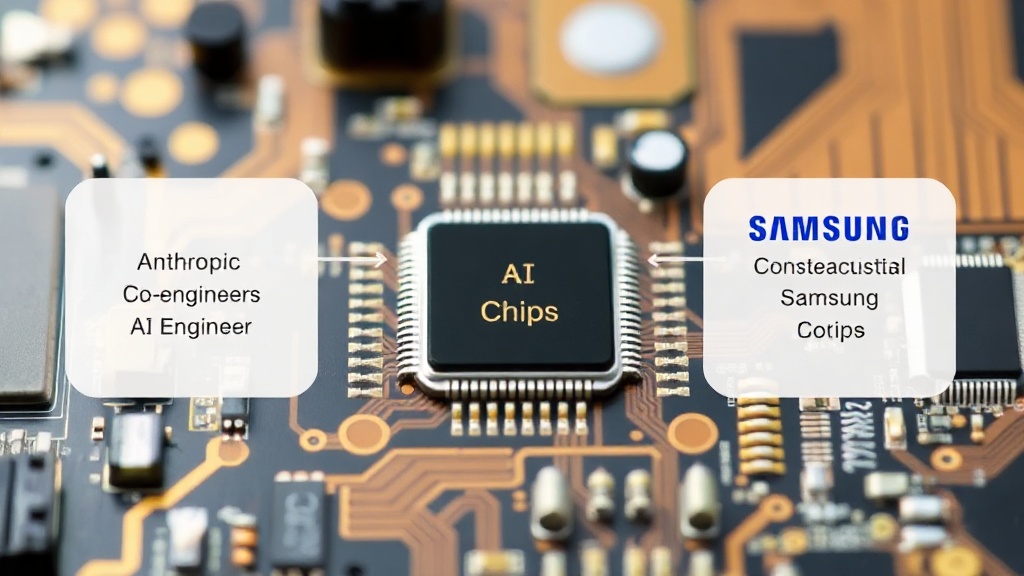
Samsung has reportedly been tapped as the manufacturing partner for these custom chips. This partnership is critical. Manufacturing advanced semiconductors, especially for AI workloads, requires immense capital investment, cutting-edge fabrication technology, and deep expertise. Samsung, with its extensive foundry capabilities and experience in producing complex chips, is one of the few companies globally capable of meeting these demands. The collaboration suggests a long-term vision for Anthropic, moving beyond simply renting compute power to owning a foundational piece of its AI infrastructure.
The Economics and Efficiency Imperative
The current AI landscape is heavily reliant on Nvidia's A100 and H100 GPUs. These chips are exceptionally capable but come with a premium price tag and often face long lead times due to intense global demand. For companies like Anthropic, which are investing heavily in training and deploying increasingly sophisticated AI models, the cost of compute is a major operational expenditure. Estimates suggest that the cost of GPUs alone can run into billions of dollars for leading AI labs.
Developing custom inference chips offers a pathway to significantly reduce this cost over time. While the initial investment in design and development is substantial, the per-unit cost of a custom ASIC for inference can be considerably lower than a high-end GPU, especially at scale. Furthermore, optimizing the chip design for specific inference tasks can lead to dramatic improvements in energy efficiency. This is crucial for both environmental sustainability and operational cost reduction, as data centers consume vast amounts of power.
Think of it less like buying a powerful, general-purpose sports car for every errand, and more like designing a highly efficient, custom-built electric scooter specifically for your daily commute. The scooter might not be good for long road trips, but for its intended purpose, it's faster, cheaper, and uses far less energy than the sports car. Anthropic is building its scooter.
Strategic Control and Future-Proofing
Beyond cost and efficiency, co-designing custom silicon provides Anthropic with unprecedented control over its hardware roadmap. Relying on external vendors, even powerful ones like Nvidia, means adhering to their product cycles, architectural choices, and supply availability. By designing its own chips, Anthropic can tailor hardware evolution directly to the evolving needs of its AI models. This allows for tighter integration between software and hardware, potentially unlocking performance gains that are impossible with off-the-shelf components.
This move also serves as a strategic hedge against potential future market shifts or supply disruptions. The concentration of AI hardware manufacturing in a few key players creates a point of vulnerability. By diversifying its hardware strategy and investing in its own silicon capabilities, Anthropic reduces its systemic risk.
The implications for the broader AI ecosystem are significant. If successful, Anthropic's approach could inspire other AI developers and enterprises to pursue similar custom silicon strategies. This could lead to a more fragmented, yet potentially more efficient and specialized, AI hardware market. It challenges the current paradigm where a few dominant GPU manufacturers dictate the underlying compute infrastructure for most AI development.
The Role of Samsung
Samsung's involvement is pivotal. As a leading semiconductor foundry, Samsung possesses the advanced manufacturing nodes and expertise necessary to produce these complex chips. The company has been actively seeking to expand its foundry business, competing with TSMC for high-profile clients. Partnering with a leading AI company like Anthropic provides Samsung with a significant design win and validates its capabilities in producing next-generation AI accelerators.
The co-design aspect implies a close working relationship. Anthropic's AI researchers and engineers will likely work hand-in-hand with Samsung's chip architects to define the specifications, architecture, and functionalities of the new ASICs. This collaborative approach is essential for ensuring that the final silicon is perfectly tuned for Anthropic's specific inference requirements, maximizing performance and efficiency.
The success of this venture hinges on several factors: the accuracy of Anthropic's performance projections, the efficiency of the co-design process, Samsung's manufacturing yields, and the ability to scale production. However, the strategic intent is clear: Anthropic is investing in a foundational capability that could provide a significant competitive advantage in the rapidly advancing field of artificial intelligence.
What remains to be seen is the timeline for these custom chips to reach production and deployment, and the precise performance uplift Anthropic expects to achieve. The journey from co-design to high-volume manufacturing is complex and lengthy, often taking years. However, the commitment to this path signals Anthropic's long-term vision and its determination to innovate across the entire AI stack, from model architecture to the underlying silicon.