What is an E2B Sandbox and Why Agents Need Them
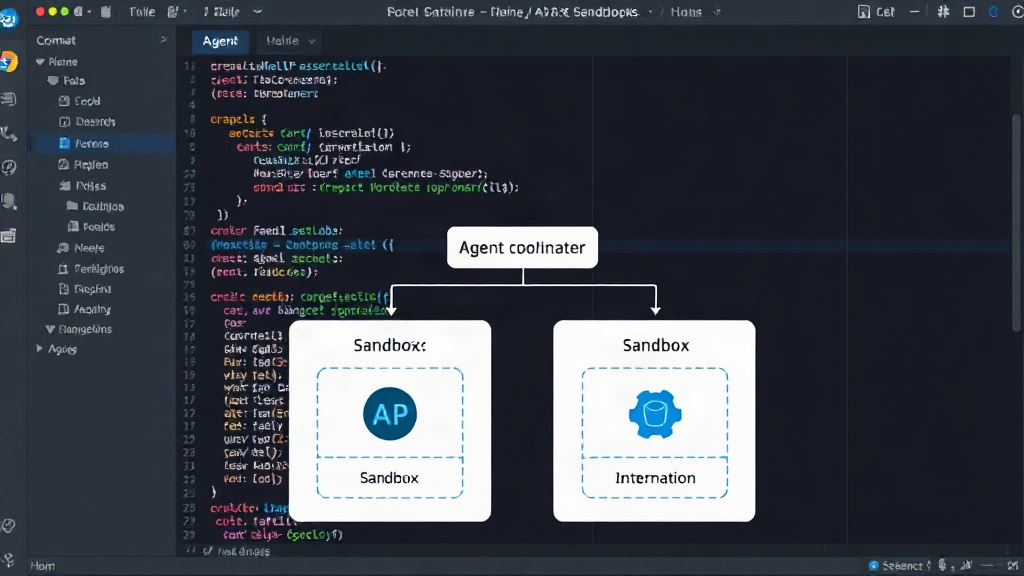
An E2B sandbox provides a crucial remote environment for applications to execute code and handle files securely. For agents, which can generate programs or commands, a sandbox is not just a convenience but a necessity. It offers an isolated execution environment, separate from the main application that coordinates the agent's actions. This separation is vital for managing complexity and ensuring safety. The coordinator's role involves sending code or commands to the sandbox, collecting any output or generated files, and then deciding on the next steps. This process must also account for potential failures, such as a command timing out or the sandbox session ending unexpectedly. Isolation is key to preventing unintended side effects on the host system.
Think of an agent as a chef who can devise complex recipes (code) but has no kitchen to cook in. The sandbox is that kitchen – a controlled space with all the necessary tools (execution environment) and safety measures (isolation) to prepare the dish without burning down the restaurant (the host application). Without it, the chef’s brilliant recipe might never be tasted, or worse, it could cause a fire.
Understanding the Sandbox Lifecycle
The lifecycle of an E2B sandbox involves several distinct stages, each critical for efficient and cost-effective operation. It typically begins with the creation of a new sandbox session. This is where the environment is provisioned and prepared for the agent's tasks. Following creation, the session enters an active state, during which the agent can send code, commands, and files for execution. This is the core operational phase. During this time, the coordinator monitors the execution, collects results, and manages any errors or timeouts. Once the agent has completed its tasks, or if the session is no longer needed, it enters a cleanup phase. This involves terminating the execution environment, disposing of any temporary files, and releasing resources. Proper lifecycle management ensures that resources are not held unnecessarily, which can significantly impact costs and system performance.
A key consideration within the lifecycle is session lifetime. Providers offer varying durations for how long a sandbox session can remain active. This can range from a few minutes for short, one-off tasks to hours or even days for more complex, multi-stage processes. The choice of session lifetime directly influences how agents can be designed and what types of tasks they can reliably perform. For instance, an agent designed for rapid data analysis might only need a short-lived sandbox, while one performing extensive software compilation might require a much longer one.
Key Factors in Sandbox Pricing
When evaluating sandbox providers, pricing is a critical differentiator. It’s rarely a simple matter of a single, all-inclusive fee. Instead, costs are typically influenced by a combination of factors, reflecting the resources consumed and the service level provided. A low CPU rate alone does not tell the whole story; understanding the nuances is crucial for accurate cost calculation and budget management.
Several key components contribute to the total cost:
- Execution API Usage: The number of times you invoke the API to run code or commands. Some providers may charge per execution, while others might bundle a certain number of executions into a monthly fee.
- Session Lifetime: The duration for which a sandbox session is active. Longer-lived sessions consume resources for extended periods and are therefore usually more expensive. Providers often have tiered pricing based on session duration limits.
- Concurrency: The number of sandbox sessions that can run simultaneously. If your application requires many agents to operate in parallel, you will need to ensure sufficient concurrency, which often comes at a higher price point.
- Network Controls: The level of control you have over the sandbox's network access. Sandboxes that offer granular network policies, such as restricted outbound connections or access to specific internal resources, may incur additional costs due to the complexity of their implementation and management.
- Retained State: The ability to preserve data and configurations between sandbox sessions. If you need a sandbox to remember specific settings or files from one run to the next, this 'stateful' capability usually adds to the cost, as it requires persistent storage and more complex environment management.
- CPU and Memory Allocation: While not always explicitly itemized, the underlying compute resources allocated to the sandbox directly impact performance and cost. Higher CPU or memory allocations will naturally lead to higher prices.
An illustrative calculation might involve estimating the number of daily code executions, the average session duration needed for those tasks, and the maximum concurrent sessions required during peak load. Multiplying these estimates by the provider's corresponding rates provides a baseline cost. However, it's essential to also factor in potential overages, support costs, and any premium features.
Comparing Alternatives to E2B Sandboxes
While E2B sandboxes offer a robust solution for agent execution, several alternatives exist, each with its own strengths and weaknesses. The best choice depends on specific requirements related to isolation, cost, complexity, and performance.
1. Containerization Platforms (e.g., Docker, Kubernetes)
Containerization provides a highly flexible and widely adopted method for isolating applications and their dependencies. Docker, in particular, allows developers to package applications into portable containers that can run consistently across different environments. Kubernetes takes this further by orchestrating these containers at scale, enabling automated deployment, scaling, and management of containerized applications. For agent execution, a container could be spun up on demand to run specific code. This offers deep customization but requires significant infrastructure management. You manage the container images, the orchestration, and the underlying compute resources.
2. Serverless Functions (e.g., AWS Lambda, Google Cloud Functions)
Serverless functions abstract away the underlying infrastructure, allowing developers to run code in response to events without managing servers. This model is excellent for ephemeral tasks and can be very cost-effective, as you typically only pay for the compute time consumed. For agents, a serverless function could be invoked to execute a piece of code. The primary limitation is often execution time limits and state management, which can be challenging for long-running or complex agent tasks that require persistent data or extensive inter-process communication.
3. Virtual Machines (VMs)
Virtual machines offer a higher degree of isolation than containers, as they virtualize an entire operating system. This makes them suitable for running complex software stacks or when strong security boundaries are paramount. However, VMs are generally heavier, slower to provision, and more resource-intensive than containers. Using VMs for agent execution would typically involve provisioning a VM, running the code, and then decommissioning it, which can be inefficient for high-frequency, short-duration tasks.
4. Managed Sandbox Services
Beyond E2B, other companies offer managed sandbox environments specifically designed for code execution and testing. These services often provide APIs and SDKs similar to E2B, abstracting away the infrastructure management. They may focus on specific use cases like automated testing, CI/CD pipelines, or secure code analysis. Evaluating these services involves comparing their execution capabilities, pricing models, supported languages, and integration options against your specific agent needs.
When choosing a sandbox provider or alternative, consider the execution API, session lifetime, concurrency requirements, network control needs, and the importance of retained state. A low CPU rate alone is not a sufficient metric; the ability of the agent to reliably complete its tasks within the chosen environment is paramount. The total cost, encompassing all these factors, should guide your decision.