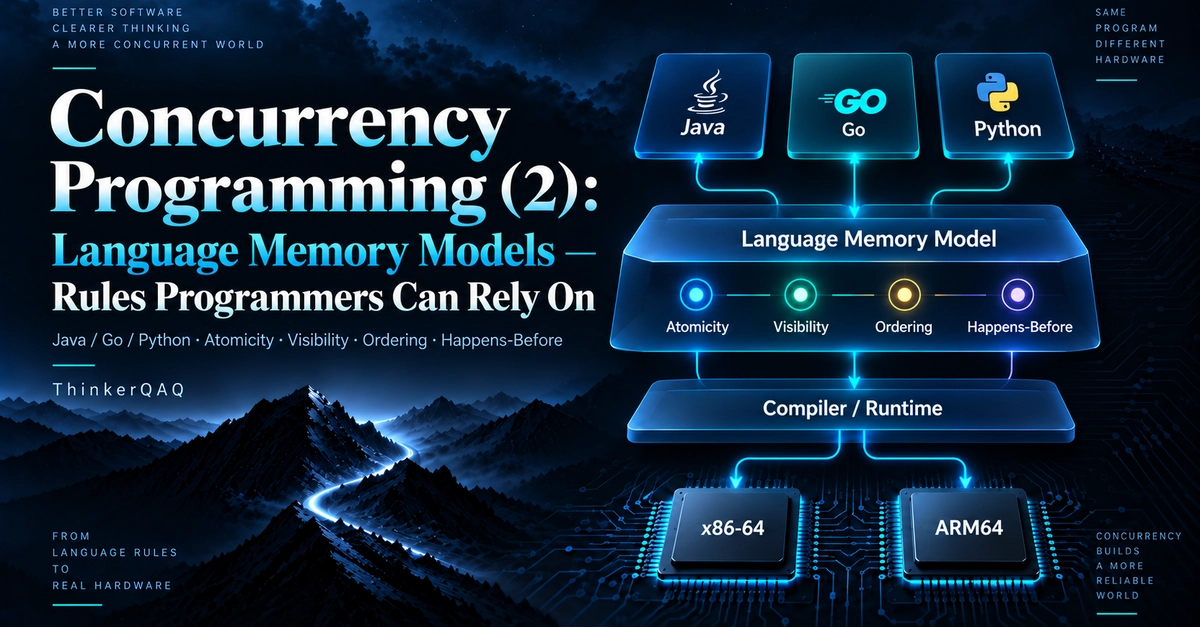
The Need for a Language Memory Model Layer
When programmers write code, it doesn't run directly on the CPU. It first passes through a compiler, which optimizes the code, and then a runtime environment. After that, it finally executes on a processor like an x86-64 or ARM64. The critical issue is that these components—compilers and processors—don't guarantee the same memory-access orderings. Without a defined language memory model, programmers would need to understand the intricate, often contradictory, reordering rules of every possible compiler, runtime, and CPU architecture. This is an untenable burden. A language memory model acts as a crucial abstraction layer, providing a consistent set of rules that programmers can rely on, regardless of the underlying hardware or specific compiler implementation.
Think of it like traffic laws. Each city has its own specific road layouts, traffic light timings, and local ordinances. If you had to learn all of that for every single street in every city you visited, driving would be impossible. Instead, we have a set of general traffic laws (like stopping at red lights, yielding to pedestrians) that apply broadly. A language memory model provides these general laws for concurrent memory access, abstracting away the complex, hardware-specific details. It defines how memory operations (reads and writes) are ordered and become visible to other threads.
Understanding Memory Model Rules: Java, Go, and Python
Different programming languages implement their memory models with varying degrees of strictness and specific semantics. Understanding these differences is vital for writing correct concurrent programs.
Java: The Java Memory Model (JMM)
Java's memory model is designed to provide a high degree of portability and predictability across different hardware architectures and JVM implementations. The JMM defines a set of rules for how threads interact with shared memory. Key concepts include happens-before relationships, which establish a global ordering of memory operations. For instance, a write to a volatile variable happens-before any subsequent read of that same variable. This ensures that changes made by one thread are visible to another thread that reads the volatile variable. Synchronized blocks also establish happens-before relationships, ensuring that all memory writes within a synchronized block are visible to other threads entering a synchronized block on the same lock. The JMM aims to prevent unexpected behavior arising from compiler or CPU reordering by defining clear visibility and ordering guarantees for specific constructs.
Go: The Go Memory Model
Go's memory model is simpler than Java's, focusing on specific synchronization primitives. It guarantees that writes to a shared variable are not reordered with respect to other writes or reads that happen before or after them within the same goroutine, provided they are protected by synchronization primitives like mutexes or channels. Specifically, Go guarantees that:
- Writes to a channel happen before the corresponding receive on that channel.
- If a channel is closed, then all writes before the close happen before the receive that detects the closure.
- For unbuffered channels, the send and receive happen in the same order.
- For buffered channels, if the capacity is N, then the i-th send happens before the (i+N)-th receive.
Go's model emphasizes that concurrent operations must be explicitly synchronized. Without synchronization, there are no guarantees about the visibility or ordering of memory accesses between goroutines. This contrasts with Java's more pervasive `volatile` and `synchronized` keywords that offer broader guarantees.
CPython Concurrency Semantics
CPython, the most common implementation of Python, has a more complex story regarding concurrency due to its Global Interpreter Lock (GIL).
GIL Mode
In the default GIL mode, only one thread can execute Python bytecode at a time, even on multi-core processors. The GIL is a mutex that protects access to Python objects, preventing multiple threads from executing Python bytecode simultaneously. This effectively serializes the execution of Python code across threads, simplifying some concurrency concerns by eliminating true parallelism for CPU-bound tasks. However, it means that CPU-bound Python threads cannot leverage multiple cores. I/O-bound tasks, which spend most of their time waiting for external operations (like network requests or disk reads), can still benefit from threading because the GIL is released during these wait periods, allowing other threads to run.
Free-threaded Mode
Python also supports a free-threaded mode, where the GIL is removed. This mode allows multiple threads to execute Python bytecode concurrently on different cores. However, enabling free-threading requires careful management of shared memory. Without the GIL, developers must rely on traditional synchronization primitives like locks, semaphores, and condition variables to prevent race conditions and ensure memory consistency. This mode offers true parallelism for CPU-bound tasks but introduces the full complexity of managing shared state in a concurrent environment, similar to languages like Java or Go without a GIL.
So What Should Python Programs Rely On?
For most Python developers, the practical reality is that they operate within the GIL-constrained world of CPython. Therefore, relying on true thread-level parallelism for CPU-bound tasks is not feasible. Instead, concurrency in Python is often achieved through:
- Multiprocessing: Using separate processes, each with its own Python interpreter and memory space, to achieve parallelism. This bypasses the GIL entirely.
- Asynchronous Programming (`asyncio`): For I/O-bound tasks, `asyncio` provides an event-driven, single-threaded concurrency model that is highly efficient for managing many concurrent I/O operations without the overhead of traditional threads.
- Careful use of threading for I/O-bound tasks: Threads can still be useful for I/O-bound operations, as the GIL is released during I/O waits.
When using threads in Python, especially if interacting with C extensions that might release the GIL or if attempting to use free-threaded mode, programmers must be aware of potential memory visibility issues. Relying solely on the default CPython behavior means that thread-based concurrency is primarily about managing I/O concurrency, not CPU parallelism.
Next: Mutexes
The next logical step in understanding concurrency programming is to delve into synchronization primitives, with mutexes being a fundamental building block. Mutexes provide a mechanism for exclusive access to shared resources, preventing race conditions by ensuring only one thread can hold the lock at a time. This directly addresses the problems of shared memory visibility and ordering that language memory models attempt to abstract.