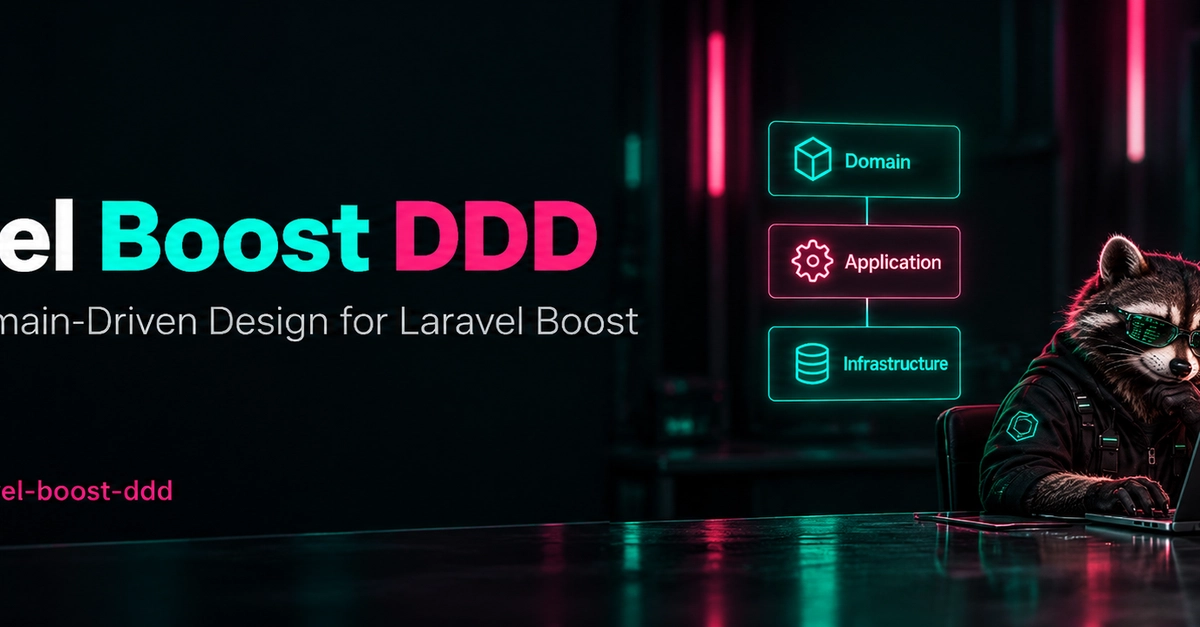
Guiding Laravel Towards Domain-Driven Design
Domain-Driven Design (DDD) principles can be challenging to implement, especially within established frameworks like Laravel. Traditionally, adopting DDD might involve significant architectural shifts, often requiring developers to move away from framework-specific conventions. However, a new open-source package, Laravel Boost DDD, offers a pragmatic approach. It leverages the capabilities of Laravel Boost, a tool widely used to provide coding agents with context about Laravel projects, to guide applications toward DDD without forcing developers to abandon core Laravel components.
The core idea behind Laravel Boost DDD is not to replace existing Laravel structures like Eloquent models, policies, events, queues, or service providers. Instead, it aims to enhance how these components are used and organized to better align with DDD. The package provides a set of guidelines and task-specific skills for coding agents, helping them understand and implement DDD patterns within the familiar Laravel ecosystem. This approach allows developers to benefit from DDD's focus on business logic and domain complexity while retaining the productivity and features of Laravel.
The Importance of Boundaries
A central tenet of DDD is the concept of bounded contexts and clear domain boundaries. These boundaries define where specific domain models and logic apply, preventing the entanglements that often plague large, monolithic applications. Laravel Boost DDD emphasizes this by focusing on the logical separation of concerns rather than strict folder naming conventions. The package's guidelines are designed to help coding agents identify and enforce these boundaries, ensuring that behavior is placed in the most appropriate location within the application's architecture.
This focus on boundaries means that developers can start applying DDD principles incrementally. They don't need to undertake a complete refactor from day one. Instead, they can begin by identifying key domains and ensuring that their logic resides within well-defined areas. Laravel Boost DDD assists in this process by providing agents with the knowledge to recognize and structure these domains effectively. The aim is to make DDD accessible to a wider range of Laravel developers, enabling them to build more maintainable and scalable applications.
Beyond Folder Names: Pragmatic Implementation
The creator of Laravel Boost DDD, Maio Barbero, sought to create a solution that wouldn't require a drastic departure from how developers typically build in Laravel. The package addresses the common friction point where DDD's theoretical purity clashes with the practicalities of framework development. By integrating with Laravel Boost, the package ensures that AI coding assistants can understand the nuances of a Laravel project and apply DDD concepts accordingly. This is crucial because AI agents need clear context to generate effective code, and DDD provides a structured way to define that context.
The package equips agents with skills related to identifying domain entities, value objects, aggregates, and domain services. It guides them on where to place business logic – whether it belongs within an Eloquent model, a dedicated service class, or another appropriate domain construct. This pragmatic approach ensures that the benefits of DDD, such as improved code organization, better testability, and clearer business alignment, can be realized without the steep learning curve or disruptive changes often associated with traditional DDD implementations.
Potential and Future Directions
The release of Laravel Boost DDD opens up interesting possibilities for the evolution of development tools and practices in the Laravel community. By bridging the gap between AI-assisted coding and DDD principles, it democratizes access to more sophisticated architectural patterns. Developers can now more easily leverage AI to help them build applications that are not only functional but also architecturally sound and aligned with business domains.
What remains to be seen is how widely this pragmatic DDD approach will be adopted. While it offers a less disruptive path, the success of DDD in any context often hinges on a deep understanding of its core concepts and a commitment to applying them consistently. The effectiveness of Laravel Boost DDD will ultimately depend on how well it empowers developers to not just follow AI-generated guidance but to truly internalize and apply DDD principles in their daily work. The package's ability to guide agents in identifying and enforcing domain boundaries is a strong start, but the human element of understanding and strategic domain modeling remains paramount.