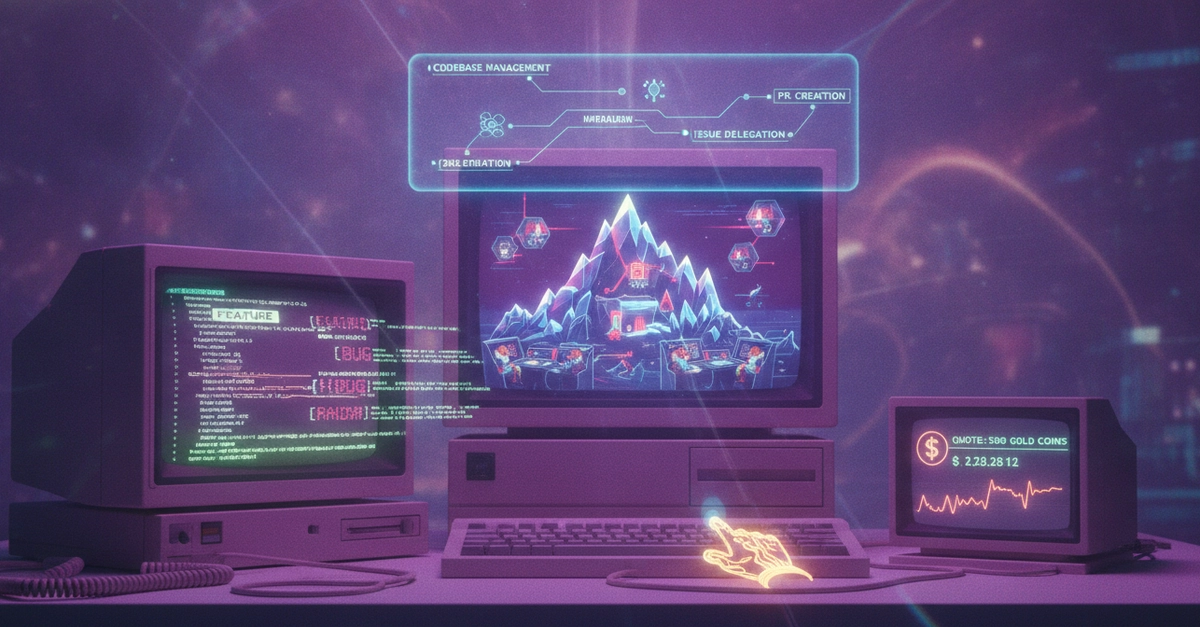
The "AMA- Do it" Concept: Automating Code Contributions via AI
A developer on Dev.to, under the username unitbuilds, has proposed a fascinating concept dubbed "AMA- Do it." The core idea is to leverage an AI system to manage and contribute to software repositories based on natural language requests embedded within comment sections. This isn't a traditional feature launch but rather a conceptual stress-test of an AI's capability to act as a distributed development team.
The initial vision was more ambitious: an IDE feature that could point to an entire repository, analyze its issues and pull requests, and then delegate tasks to an AI-generated team. This team would consist of AI agents qualified for specific tasks, with a 'team head' responsible for reviewing implementations before a pull request is created. However, the sheer scale of applying this to a large, active repository like Forem (the platform powering Dev.to) was deemed too resource-intensive, potentially leading to exorbitant costs and unmanageable complexity.
A Scaled-Down Approach: From Issues to Comments
Recognizing the practical limitations of full-scale repo management, unitbuilds has refined the concept into a more accessible and testable form. The proposed system would instead monitor the comments on a specific post. Users could tag their comments with categories like `[feature]`, `[bug]`, or `[random]`. The AI would then interpret these comments as requests to implement a feature, fix a bug, or handle a general task. Upon receiving such a request, the system would initiate a job to create a pull request (PR) directly addressing the user's comment. The AI would then respond to the original comment, providing a link to the generated PR.
This approach aims to demonstrate the AI's ability to maintain a repository by generating actionable code changes based on informal, user-generated input. The challenge lies in translating the intent behind a comment into concrete code modifications. While private repositories might lack structured issue boards, this comment-driven system bypasses that limitation by using a direct communication channel.
The Technical Underpinnings and Potential Challenges
The underlying technology would likely involve a sophisticated natural language processing (NLP) model capable of understanding intent, identifying required code changes, and potentially generating code snippets. This would need to be coupled with a system that can interact with version control systems (like Git) to create branches, stage changes, and commit them as a PR. The "team" aspect, while simplified in this model, still implies an AI that can make decisions about how to best implement a requested change, perhaps by consulting existing code patterns or documentation.
Several challenges emerge with this concept. First, the accuracy and reliability of the AI's interpretation of comments are paramount. Ambiguous requests could lead to incorrect or nonsensical PRs. Second, the AI would need to understand the context of the repository it's operating within – its architecture, coding standards, and existing dependencies. Without this, generated code might be incompatible or introduce regressions. Third, the review process, even if automated by a 'team head' AI, needs to be robust to prevent the introduction of faulty code. The current proposal relies on the AI generating a PR and responding, implying the human element might still be involved in the final merge, but the initial implementation is automated.
Broader Implications for Open Source and Development Workflows
If successful, this concept could significantly alter how open-source projects are contributed to and maintained. It lowers the barrier to entry for contributions, allowing users to suggest changes simply by commenting. This could foster more dynamic community involvement and accelerate development cycles. For maintainers, it could offload the task of triaging simple bugs or implementing minor features, freeing them up for more complex architectural decisions or critical bug fixes.
The idea also touches upon the future of AI in software development. Instead of just assisting developers with code completion or bug detection, AI could become an active participant in the development process itself, generating substantial portions of code. This moves beyond the current paradigm of AI as a tool to AI as a collaborator or even a junior developer. The surprising detail here is not the ambition of the AI, but the proposed mechanism for interaction – using the often-unstructured world of comment threads as a structured input for code generation.
What nobody has addressed yet is the potential for this system to be gamed or misused. Malicious actors could flood comment sections with requests designed to disrupt the repository or introduce vulnerabilities. Robust filtering and moderation, both by AI and humans, would be essential to prevent such scenarios. The success of "AMA- Do it" hinges on its ability to reliably distinguish genuine requests from noise and malicious intent, while also producing high-quality, contextually relevant code.