Benchmarking LLM Tool Usage: The WebMCP Question
The proliferation of LLM agents capable of using external tools presents a critical question for developers and businesses: does providing these structured capabilities actually improve efficiency? Simply registering a tool with a language model proves its availability, not its effective use or the net benefit it provides. DeepDeck, an MIT-licensed macOS desktop project built on DeepSeek Harness, now includes a WebMCP (Web Model-Centric Programming) benchmark designed to answer this. The experiment aims to quantify whether exposing structured browser tools reduces the time and tokens an LLM requires to complete a task correctly.
The core hypothesis is that by offering a well-defined interface to browser functionalities, LLMs can bypass lengthy, token-intensive searches and reasoning cycles. Instead of generating natural language queries that might be ambiguous or require multiple refinement steps, the LLM can directly invoke specific browser actions. This should, in theory, lead to faster task completion and a lower token count per task, directly impacting operational costs and user experience.
Setting Up the Local Runner
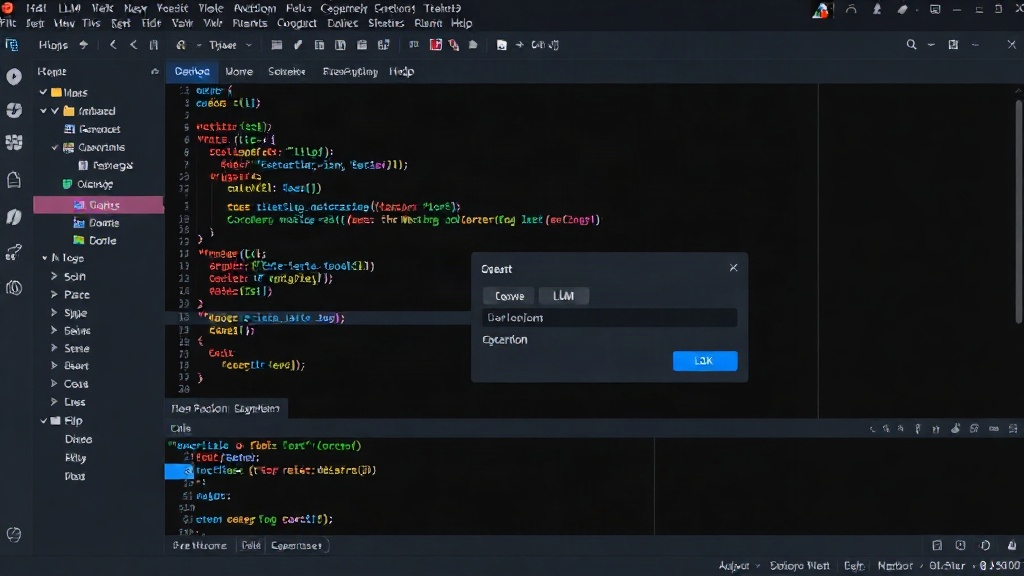
To replicate this experiment, users can leverage the DeepDeck project. The setup involves cloning the repository and installing its Node.js dependencies using pnpm. The command sequence is straightforward:
pnpm install
pnpm build:desktop
Before running the benchmark, users must configure a working language model within DeepDeck. The runner operates using an isolated snapshot of the model's environment, ensuring that the benchmark results are not influenced by external factors or previous interactions. This isolation is crucial for obtaining reliable data on tool usage efficiency. The experiment compares two scenarios: one where the LLM has access to the WebMCP tools, and another where it does not. By logging the time taken and tokens consumed for identical tasks in both configurations, DeepDeck can provide quantitative data on the impact of these structured tools.
The WebMCP Experiment Design
The benchmark is designed to measure two primary metrics: task completion time and token consumption. For each task, two runs are performed: one with the WebMCP tools enabled and one with them disabled. The tasks themselves are representative of common LLM interactions that could potentially benefit from browser automation, such as information retrieval, data summarization from web pages, or form filling.
Consider a task like summarizing the latest news on a specific technology from a given URL. Without tool access, the LLM might try to 'browse' the page by generating queries for paragraphs, headings, and links, consuming tokens for each step and potentially struggling to synthesize the information coherently. With WebMCP tools, the LLM could directly invoke a 'fetch_page_content' function, receive the raw HTML or rendered text, and then use its internal reasoning capabilities to summarize it. The difference in token count and time between these two approaches is the key data point.
The DeepDeck benchmark logs detailed information for each run, including the start and end times, the total number of input and output tokens, and whether the task was completed successfully. The success metric is vital; an LLM might complete a task faster without tools but produce an incorrect or incomplete answer. The benchmark must account for accuracy to provide a holistic view of efficiency. The project's use of an MIT license makes it freely available for developers to experiment with and adapt for their own LLM applications.
Interpreting the Results: What Does It Mean?
The results of this experiment can significantly influence how developers design LLM-powered applications. If the data shows a consistent reduction in time and tokens when WebMCP tools are available, it validates the approach of exposing structured functionalities. This suggests that investing in tool development and integration can yield tangible cost savings and performance improvements. For instance, a customer support bot that can directly access and parse knowledge base articles via tools would likely respond faster and more accurately than one that relies solely on its training data or a broad web search.
Conversely, if the experiment shows minimal or even negative impact (e.g., increased token usage due to the overhead of tool descriptions and API calls), it prompts a re-evaluation. Perhaps the current tool interfaces are not sufficiently optimized, or the LLM's ability to effectively utilize them is limited. It could also indicate that for certain types of tasks, the added complexity of tool integration outweighs the benefits. This would encourage developers to be more selective about which tools they expose and to refine the prompts and instructions given to the LLM regarding tool usage.
The experiment also implicitly touches upon the trade-off between model complexity and the utility of external tools. A highly capable, large-context model might already perform well on many tasks without explicit tools. However, for specialized or repetitive tasks, a smaller, more focused model augmented with precise tools could be more cost-effective and performant. This benchmark provides a framework for making informed decisions about model selection and system architecture.
The Unanswered Question: Scalability and Generalization
While this experiment provides a valuable method for evaluating specific tool integrations, a broader question remains: how well do these findings generalize across different LLMs, different tool sets, and more complex, multi-step tasks? The efficiency gains observed with WebMCP might be specific to the particular LLM architecture and the nature of the browser tools. What happens when tasks require chaining multiple tools, or when tools interact with dynamic web content that is prone to change? Understanding the scalability and robustness of tool-augmented LLMs across a wider range of scenarios is the next frontier.
Furthermore, the cost of developing and maintaining these structured tools is a factor that this benchmark, in its current form, does not directly address. While the experiment focuses on the operational efficiency gains of tool usage, the upfront investment in creating reliable APIs and robust tool descriptions needs to be weighed against the projected savings. Future iterations of such benchmarks might need to incorporate a Total Cost of Ownership (TCO) model to provide a complete picture for businesses considering large-scale LLM deployments.
Ultimately, the DeepDeck WebMCP benchmark offers a practical, reproducible method for developers to empirically validate the efficiency claims of LLM tool usage. By running these ON/OFF experiments, teams can move beyond theoretical benefits and gather concrete data to optimize their LLM agents for speed and cost-effectiveness.