The Inevitable Bottleneck: Why a Single Database Fails
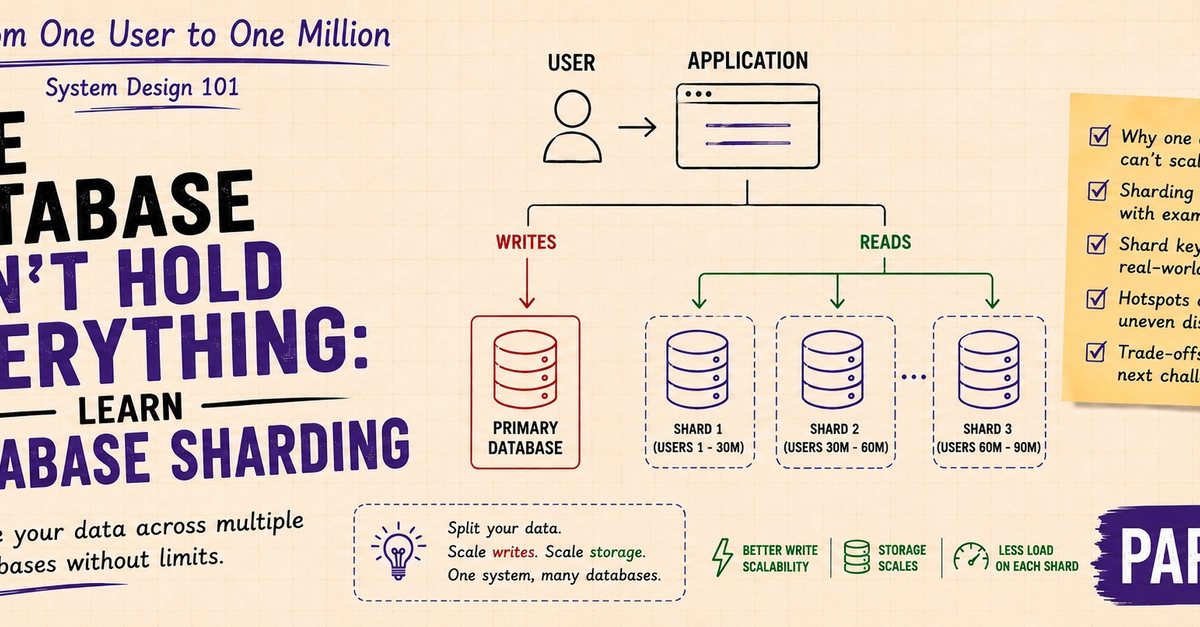
Building for scale means anticipating bottlenecks. We've all seen it: a single application server buckles under load, so we add more, distributing traffic. A database, however, is often the central nervous system of an application. While read replicas can distribute read traffic, the primary database still handles all writes, becoming the ultimate bottleneck. This is where database sharding becomes not just an optimization, but a necessity for applications serving millions.
Sharding is the practice of breaking down a large database into smaller, more manageable pieces called shards. Each shard is an independent database that holds a subset of the total data. The core idea is to distribute data and, critically, the workload across multiple database instances. Instead of one massive database server struggling with every query, you have many smaller servers, each handling a fraction of the requests.
Think of it like a sprawling library. Initially, one librarian can manage all the books. But as the collection grows and patrons increase, that librarian becomes overwhelmed. Sharding is akin to dividing the library into specialized sections (fiction, non-fiction, history, science), each managed by its own librarian. Patrons looking for a specific genre go directly to that section, and the workload is distributed. This makes finding books faster and allows the library to house vastly more volumes.
This approach directly addresses the limitations of traditional scaling methods. Vertical scaling (upgrading the server hardware) has physical and financial limits. Horizontal scaling (adding more application servers) helps with application load but doesn't inherently solve the database write bottleneck. Read replicas distribute reads but leave writes concentrated. Sharding tackles the write problem by distributing data and therefore write operations across multiple database instances.
How Database Sharding Works
The fundamental challenge in sharding is deciding how to partition the data. This is typically done using a shard key. The shard key is a column or set of columns in your database whose values determine which shard a particular record belongs to. Choosing the right shard key is paramount, as it directly impacts performance and scalability.
Several common strategies exist for sharding:
- Range-Based Sharding: Data is partitioned based on a range of values in the shard key. For example, user IDs 1-1000 might go to Shard A, 1001-2000 to Shard B, and so on. This is simple to implement but can lead to uneven data distribution if certain ranges become disproportionately popular.
- Hash-Based Sharding: A hash function is applied to the shard key, and the resulting hash value determines the shard. For instance, `hash(user_id) % number_of_shards`. This generally leads to a more even distribution of data and load across shards. However, it can make range queries more complex, as data for a given range might be spread across multiple shards.
- Directory-Based Sharding: A lookup service or directory maintains the mapping between shard keys and their corresponding shards. When a query comes in, the application first consults the directory to find the correct shard, then queries that shard. This offers flexibility but adds an extra hop (the lookup service), potentially increasing latency.
The application logic (or a proxy layer) must be aware of the sharding scheme. When an application needs to read or write data, it first determines which shard contains the relevant data based on the shard key. It then directs the query to that specific shard. For queries that might span multiple shards (e.g., aggregating data across all users), the application or a query router must coordinate requests to multiple shards and then combine the results.
Challenges and Considerations in Sharding
While sharding offers significant scalability benefits, it introduces complexity. Implementing and managing a sharded database system is not trivial.
Data Distribution: Uneven data distribution (hotspots) can occur if the shard key is not chosen carefully or if the workload is not uniform. A hotspot shard can become a bottleneck, negating the benefits of sharding. Rebalancing shards – moving data between them to restore even distribution – is a complex operation that can require downtime or careful planning.
Cross-Shard Queries: Performing operations that require data from multiple shards (like JOINs or aggregations) becomes significantly more complex and potentially slower. These operations require a query router or application logic to query multiple shards and aggregate the results, increasing latency and resource consumption.
Schema Changes: Modifying the database schema across all shards simultaneously can be challenging. Ensuring consistency and managing the deployment of schema changes across a distributed system requires robust tooling and processes.
Replication and Consistency: While sharding distributes data, each shard itself might still benefit from replication for high availability and read scaling within that shard. Managing replication, failover, and consistency across multiple shards adds another layer of complexity.
Operational Overhead: Managing, monitoring, and maintaining multiple database instances instead of one is inherently more complex. This includes backups, monitoring performance, handling failures, and applying updates.
When to Consider Sharding
Sharding is not a solution for every application. It introduces significant complexity, so it should be considered when simpler scaling methods are no longer sufficient. Key indicators that your application might need sharding include:
- Your primary database is experiencing write contention and becoming a bottleneck, even with read replicas.
- Your dataset has grown so large that it no longer fits efficiently on a single server, impacting query performance and maintenance operations like backups.
- You are experiencing performance degradation due to the sheer volume of data, even for read operations that cannot be fully offloaded to replicas.
- Your application architecture is designed for massive horizontal scalability, and the database is the last remaining single point of failure or performance limitation.
Many modern database systems and cloud providers offer managed sharding solutions or tools that abstract away some of this complexity. However, understanding the underlying principles of how and why sharding works is crucial for effectively designing and operating large-scale systems.