The Instability Problem: A Single Decision Tree
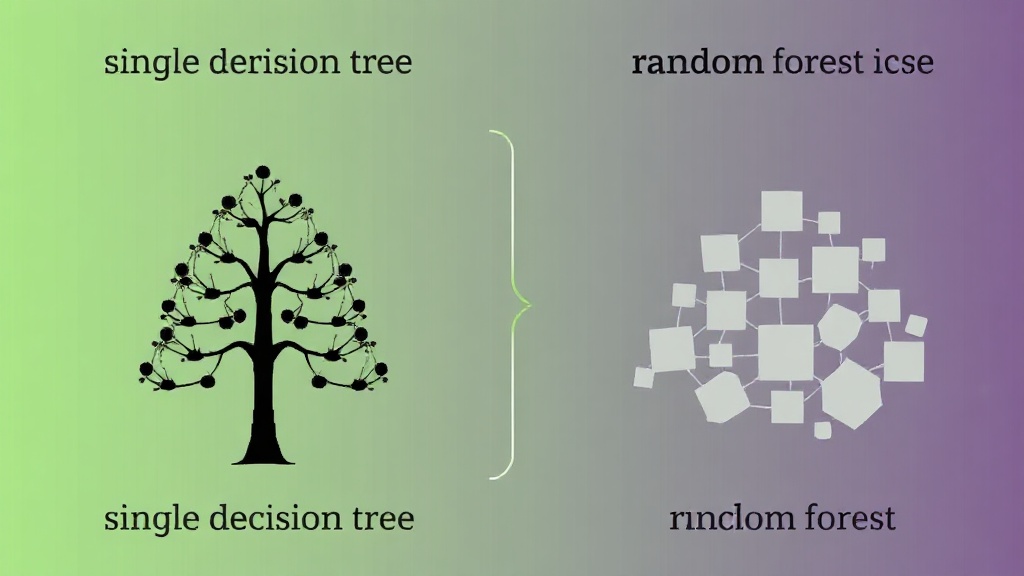
Machine learning, particularly at the intersection of classic algorithms and site reliability engineering (SRE), often reveals familiar patterns in new guises. The random forest algorithm, at its core, is one such example. It addresses a fundamental problem: the inherent instability of a single decision tree. While a single decision tree is conceptually simple and interpretable – you can trace a path from root to leaf to understand a prediction – it suffers from high variance. This means that even minor changes in the training data can lead to drastically different tree structures and, consequently, completely different predictions. Imagine explaining a complex decision to a stakeholder, only to have your explanation entirely change because one data point was added or removed. This fragility makes a single decision tree unreliable for production systems where consistent, stable outputs are paramount.
This instability, known as variance, is precisely what makes individual decision trees a poor choice for critical production environments. The goal of robust ML in production is not just accuracy, but also stability and resilience. A system that can't consistently provide similar answers for similar inputs is a system that erodes trust and becomes difficult to manage.
The Random Forest Solution: Ensemble Power
The random forest algorithm tackles this instability by embracing an SRE philosophy: redundancy and distributed consensus. Instead of relying on a single, potentially brittle decision tree, it grows hundreds or even thousands of them. This ensemble approach is the key to its robustness. But it's not just about having many trees; it's about how those trees are grown and how their outputs are combined.
Two critical randomization techniques are employed:
- Bootstrap Aggregating (Bagging): Each individual decision tree in the forest is trained on a random subsample of the training data, drawn with replacement. This means some data points might appear multiple times in a single tree's training set, while others might be omitted entirely. This process, known as bootstrapping, ensures that each tree sees a slightly different view of the data, further reducing correlation between trees.
- Feature Randomness: At each split point in the tree-building process, only a random subset of the available features is considered for determining the best split. This constraint prevents a few dominant features from overwhelming the decision-making process in every tree, forcing each tree to explore different feature combinations and relationships.
These two randomization steps work in concert. The bagging ensures diversity in the data each tree sees, while feature randomness ensures diversity in the decision rules each tree learns. This prevents all trees from becoming too similar and overfitting to the same aspects of the training data. It's akin to having a diverse team of experts, each with a slightly different background and perspective, analyze a problem. No single expert's bias dominates the final decision.
Horizontal Scaling for Predictions: The SRE Analogy
The true brilliance of the random forest, from an SRE perspective, is how it mirrors the principles of horizontal scaling and fault tolerance. Think of each individual decision tree as an independent worker or microservice. Each worker is tasked with making a prediction based on its training. Importantly, these workers are largely independent; growing one tree doesn't directly impact the growth of another beyond the shared training data pool and the random feature selection constraint.
When a new data point needs a prediction, it's passed to every (or a significant subset of) tree in the forest. Each tree makes its own prediction. For classification tasks, the final prediction of the forest is determined by a majority vote among all the individual trees. For regression tasks, it's typically the average of the predictions from all trees.
This is horizontal scaling for predictions. Instead of trying to make a single prediction engine infinitely powerful (vertical scaling), we deploy many smaller, independent prediction engines (the trees) and aggregate their results. If one tree is poorly trained or makes an outlier prediction due to the inherent instability of a single tree, its impact is diluted by the sheer number of other trees providing more stable, representative predictions. The fleet absorbs the anomaly.
This