The Silent Betrayal: Documentation Drift
Code documentation is a developer's best friend, but it's also a notorious liar. README files, often the first point of contact for new users or contributors, frequently contain code examples that are no longer accurate. This phenomenon, known as "documentation drift," can lead to frustration, wasted time, and a damaged perception of a project's quality. Imagine a junior engineer trying to run a simple example from a README, only to be met with cryptic error messages because the code snippet is out of sync with the current codebase. This isn't a hypothetical scenario; it's a common, silent problem in software development.
SunnyDachs, a developer, has built a solution: doc-drift. This command-line interface (CLI) tool is designed to specifically combat this issue by automatically detecting when code examples embedded within Markdown files diverge from the actual code in a repository. Crucially, doc-drift achieves this without relying on large language models (LLMs), offering a more deterministic and potentially faster approach.
The problem is simple: as code evolves, documentation often lags behind. Manual checks are tedious and easily forgotten, especially in fast-paced development environments. A single forgotten update to a function signature or a removed class can render an entire example useless. This isn't just an inconvenience; it's a breakdown in the contract between the project maintainers and its users. The goal of doc-drift is to re-establish that trust by providing an automated way to verify the integrity of documentation examples.
How doc-drift Works: AST Over LLMs
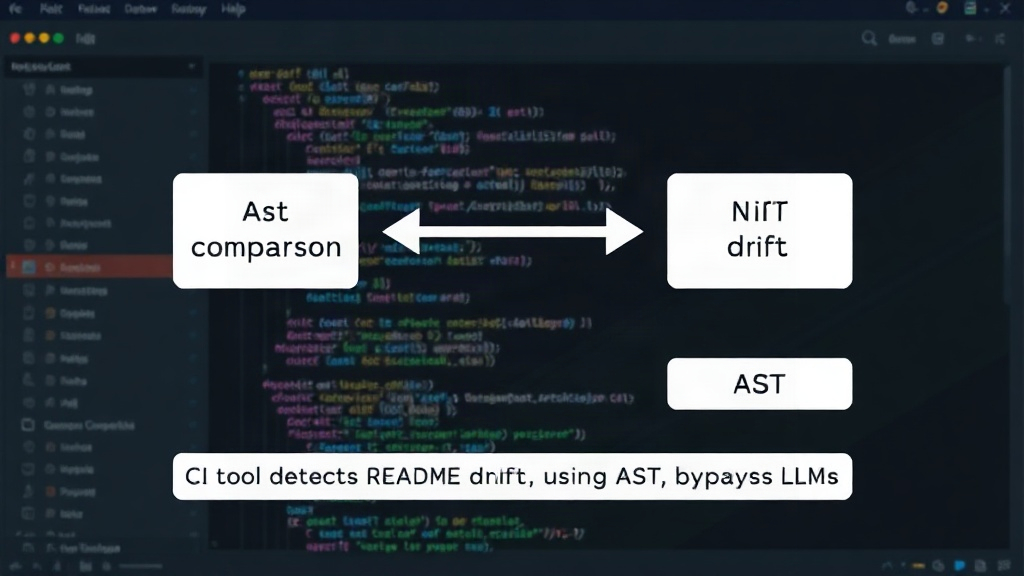
At its core, doc-drift operates by leveraging Abstract Syntax Trees (ASTs). Instead of attempting to understand code semantically like an LLM, which can be prone to hallucination or misinterpretation, doc-drift parses code into a structured tree representation. This allows for precise analysis of code elements such as functions, classes, and their definitions.
The process begins when you point the CLI at a specific repository. doc-drift then systematically scans all Markdown files within that repository. For each Markdown file, it identifies fenced code blocks, which are typically used to present code snippets. Within these blocks, it extracts the definitions of functions and classes.
Once these definitions are extracted, doc-drift compares them against the actual code present in the repository's source files. This comparison is not a fuzzy text match. By using ASTs, the tool can accurately determine if a function name has changed, if parameters have been added or removed, or if a class has been refactored or deleted. The result is a definitive yes or no: does the code example in the README accurately reflect the current state of the codebase?
The decision to forgo LLMs is significant. LLMs are powerful for understanding natural language and generating human-like text, but their application to code verification can be complex. They might 'understand' a function's purpose but fail to catch subtle syntax errors or signature mismatches that a compiler or an AST parser would immediately flag. Furthermore, LLMs can be computationally expensive and require significant resources. By using ASTs, doc-drift offers a lightweight, efficient, and highly accurate method for detecting documentation drift. This approach ensures that the checks are deterministic: if an example is out of sync, doc-drift will identify it reliably.
The Implementation and Future
The current iteration of doc-drift is available on GitHub, allowing developers to integrate it into their workflows. The project is open-source, inviting contributions and improvements from the community. The choice of AST parsing means that the tool can be adapted to various programming languages, provided there are robust AST parsers available for them. This adaptability is a key strength, as documentation drift is a universal problem across different tech stacks.
The implications for developers are clear: doc-drift provides a tangible tool to ensure the accuracy and reliability of project documentation. For maintainers, it offers a way to automate a critical but often overlooked aspect of code quality. For users, it means more trustworthy examples and a smoother onboarding experience.
What remains to be seen is how broadly this tool will be adopted and whether it can become a standard part of CI/CD pipelines for open-source projects and internal developer documentation. The potential for it to save countless hours of debugging and developer frustration is immense. As the complexity of software projects grows, maintaining accurate documentation becomes even more challenging, making tools like doc-drift not just useful, but essential.
If you manage a project with public-facing code examples, integrating doc-drift into your pre-commit hooks or CI process is a straightforward step to significantly improve your project's professional polish and usability. It's a small change that addresses a pervasive, silent lie in developer documentation.