CISA Issues Urgent Warning on Linux Kernel Exploitation
The U.S. Cybersecurity and Infrastructure Security Agency (CISA) has issued a stern warning regarding the active exploitation of three critical vulnerabilities within the Linux kernel. One of these flaws, designated as critical, is being actively targeted by malicious actors. This alert underscores the persistent threat landscape faced by Linux systems, which form the backbone of much of the internet's infrastructure, cloud computing, and a vast array of devices.
CISA has added these vulnerabilities to its Known Exploited Vulnerabilities (KEV) catalog, mandating that U.S. federal civilian executive branch agencies must apply patches by specific deadlines. This action signals the severity and immediate threat posed by these flaws, as CISA typically reserves KEV catalog inclusion for vulnerabilities that are demonstrably being used in the wild by adversaries.
The Linux kernel, being the core of the operating system, provides essential services for hardware management, process scheduling, and memory management. Exploiting vulnerabilities in the kernel can grant attackers elevated privileges, allowing them to gain complete control over a compromised system. This could lead to data theft, system disruption, ransomware deployment, or the use of the compromised machine as a pivot point for further network attacks.
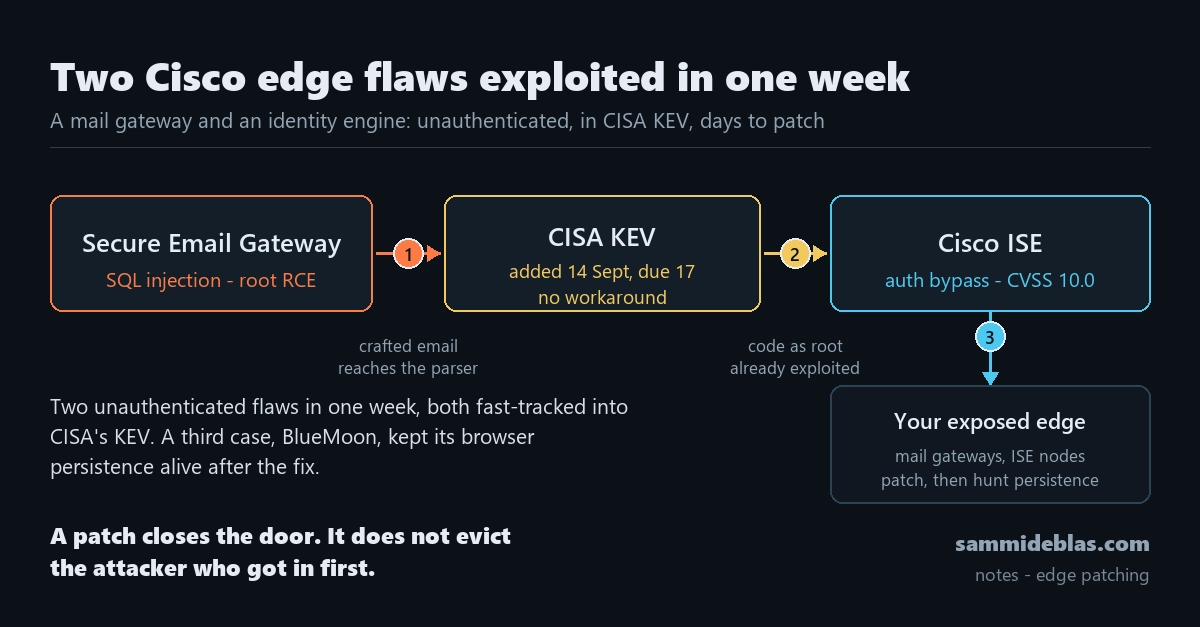
While Source 1 mentions CISA's alert, it does not provide specific CVE identifiers for the three Linux kernel flaws. Source 2, however, details a separate Cisco vulnerability (CVE-2026-76461) and CISA's rapid response to it, illustrating CISA's approach to known exploited vulnerabilities. The Linux kernel vulnerabilities highlighted by CISA are distinct from the Cisco issue but demonstrate a broader trend of active exploitation of foundational software components.
Understanding the Threat: Linux Kernel Vulnerabilities
The Linux kernel is a complex piece of software that has evolved over decades. Its open-source nature allows for widespread scrutiny, which often leads to rapid discovery and patching of vulnerabilities. However, this also means that once a vulnerability is discovered and a patch is available, it can be reverse-engineered by attackers to create exploits targeting unpatched systems.
The fact that CISA has identified three distinct Linux kernel flaws being actively exploited is a significant concern. These are not theoretical weaknesses; they are actively being weaponized by attackers. The implications for organizations running Linux servers, cloud instances, or even embedded devices powered by Linux are substantial. Attackers can leverage these flaws to escalate privileges, bypass security controls, and achieve deep system compromise.
The urgency conveyed by CISA's inclusion in the KEV catalog cannot be overstated. For federal agencies, the mandate to patch within a strict timeframe is a direct order to mitigate an active threat. For other organizations, while not legally binding in the same way, it serves as a critical indicator of the prevailing threat intelligence. It means that if these vulnerabilities are being exploited against government systems, they are almost certainly being exploited against private sector systems as well.
The CISA KEV Catalog and Patch Deadlines
CISA's Known Exploited Vulnerabilities (KEV) catalog serves as a prioritized list of vulnerabilities that pose a significant risk to the Nation's networks. Inclusion in this catalog signifies that a vulnerability has been confirmed as actively exploited in the wild. Agencies are directed to prioritize the remediation of these vulnerabilities to reduce their attack surface.
The typical deadline for federal agencies to patch vulnerabilities added to the KEV catalog is relatively short, often measured in days or weeks, depending on the severity and exploitability of the flaw. This rapid response mechanism is designed to prevent widespread compromise by ensuring that known attack vectors are closed off quickly.
While Source 1 does not specify the exact deadlines for these three Linux kernel flaws, the inclusion in the KEV catalog implies that such deadlines have been set and are likely stringent. Organizations that rely on Linux systems should treat this alert with the utmost seriousness and verify their patch status for any known affected kernel versions.
Broader Implications and Mitigation Strategies
The active exploitation of Linux kernel vulnerabilities highlights a critical truth: no software is entirely immune to attack, and even foundational components require constant vigilance. The attackers are sophisticated and are not shying away from targeting the core of operating systems.
For system administrators and security professionals, this situation demands immediate action. The primary mitigation strategy is, of course, to update the Linux kernel to a patched version as soon as possible. However, this can be a complex undertaking in large, distributed environments. Administrators must:
- Identify Affected Systems: Determine which systems are running vulnerable kernel versions. This requires robust asset inventory and configuration management.
- Prioritize Patching: Focus on systems that are internet-facing, host sensitive data, or are considered critical infrastructure.
- Test Patches: Before deploying patches across production environments, test them in a staging environment to ensure compatibility and stability. Kernel updates can sometimes introduce regressions.
- Implement Runtime Security: Consider host-based intrusion detection/prevention systems (HIDS/HIPS) and kernel integrity monitoring tools that can detect or block exploitation attempts even if patching is delayed.
- Review Access Controls: Ensure that the principle of least privilege is strictly enforced to limit the impact if a system is compromised.
The specific CVEs for these Linux kernel vulnerabilities are crucial for precise identification and patching. While not provided in the excerpts, system administrators should monitor CISA's KEV catalog and official Linux distribution security advisories for these details. The continued targeting of core system components like the Linux kernel emphasizes the need for a layered security approach and proactive vulnerability management.