High-Level Summary
Chesso stands as a testament to modern web development, offering a full-stack, real-time multiplayer chess experience engineered for low-latency online gameplay. The platform delivers seamless real-time move synchronization, ensuring that every move is reflected instantly for both players. A critical component is its authoritative backend match clock, which prevents any discrepancies or client-side manipulation of game time. Security is paramount, with robust authentication handled via JWT and Google OAuth, safeguarding user accounts and game integrity. The system also incorporates comprehensive chess rule validation, ensuring all gameplay adheres strictly to the rules of chess. The technical foundation for Chesso is the MERN stack: MongoDB for database management, Express.js for server-side logic, React for an interactive user interface, and Node.js for the runtime environment. Communication is powered by Socket.IO, enabling efficient bi-directional WebSocket communication essential for real-time updates. For the core chess logic, including move validation and managing game states via FEN (Forsyth–Edwards Notation), the library Chess.js is utilized. A significant engineering challenge overcome was the development of a server-authoritative state and clock synchronization mechanism. This design choice is crucial for preventing clients from tampering with game states or clocks and ensures graceful handling of mid-game reconnections, maintaining a stable and fair playing environment.
Tech Stack & Architectural Overview
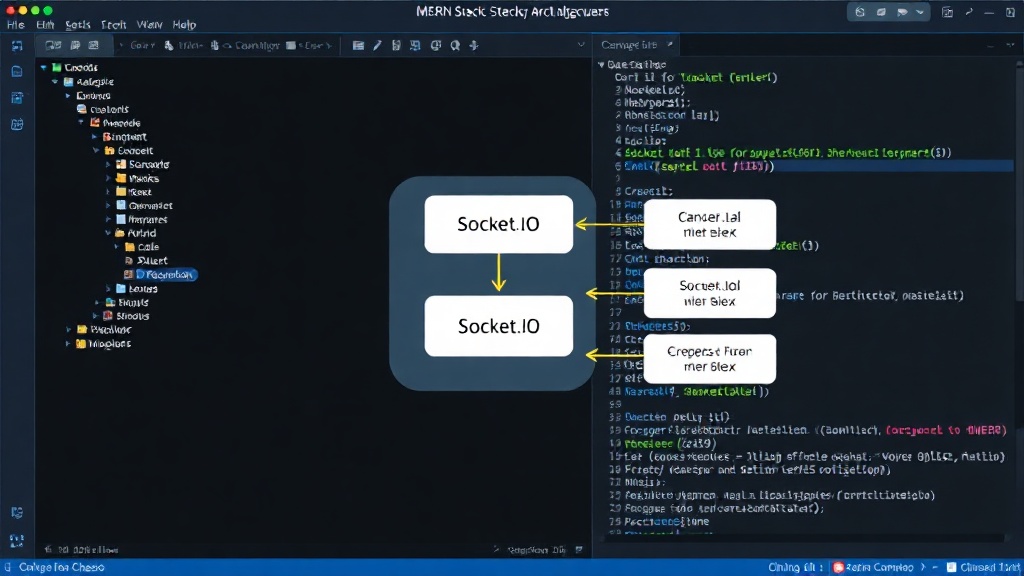
The Chesso application leverages a carefully selected suite of technologies to achieve its real-time, secure, and robust multiplayer experience. On the frontend, React is the framework of choice for building a dynamic and declarative user interface. Vite is employed for its exceptionally fast build times, significantly accelerating the development workflow. React's component-based architecture is perfectly suited for handling the real-time updates pushed from the backend via WebSockets; UI elements update declaratively as new game states or events arrive.
The backend is built using Node.js, a powerful JavaScript runtime, and Express.js, a minimalist and flexible Node.js web application framework. This combination provides a scalable and efficient server environment. For data persistence, MongoDB, a NoSQL document database, is used. Its flexible schema is well-suited for storing game states, user profiles, and match history. The critical real-time communication layer is implemented using Socket.IO. This library abstracts away much of the complexity of WebSockets, providing reliable bi-directional, event-based communication between the server and all connected clients. This is fundamental for synchronizing moves, game clocks, and player status in real-time.
The core chess logic is managed by the Chess.js library. This library provides robust functionality for validating moves, determining checkmate or stalemate conditions, and managing the game state, notably through its support for FEN strings. FEN is an industry standard for representing a particular board position of a chess game, making it easy to save, load, and share game states.
The architectural approach emphasizes a server-authoritative model. This means the backend server is the single source of truth for the game state and clock. Clients send their intended moves to the server. The server, using Chess.js, validates the move against the current authoritative game state. If valid, the server updates its state, updates the match clock, and then broadcasts the validated move and new state to all connected clients. This approach is vital for preventing cheating, as clients cannot unilaterally declare moves or alter the clock. Furthermore, the server-authoritative design simplifies handling disconnections and reconnections. When a client reconnects, it can request the latest authoritative game state from the server, ensuring it's always in sync without needing to replay the entire game from scratch.
Key Features & Implementation Details
Real-time Move Synchronization
Achieving low-latency move synchronization is at the heart of Chesso's multiplayer functionality. When a player makes a move on their client, the move is first sent to the server. The server receives the move, validates it using Chess.js against the current game state, and if valid, updates its internal representation of the board and the match clock. This validated move and the updated game state (often represented as a FEN string) are then immediately broadcasted to all connected clients, including the opponent. React on the frontend efficiently processes these updates, re-rendering the board and game information to reflect the opponent's move. This rapid server-client-server-client loop ensures that both players see the game progressing in near real-time, creating an experience comparable to playing in person.
Authoritative Backend Match Clocks
Traditional online games often suffer from clock desynchronization or client-side manipulation. Chesso mitigates this by implementing match clocks exclusively on the server. The server maintains the authoritative countdown for each player. When a move is validated and accepted by the server, it deducts the time taken for that move from the player's clock and updates the remaining time. This time is then broadcast to all clients. This server-authoritative approach ensures that the clock is fair and cannot be tampered with by either player. It also simplifies the logic for handling time-outs and game-ending conditions, as the server is the definitive source for all time-related information.
Secure Authentication (JWT & Google OAuth)
User security and identity management are handled through a combination of JSON Web Tokens (JWT) and Google OAuth. When a user logs in, either through their Google account or another method, the server authenticates them. Upon successful authentication, the server generates a JWT, which is a cryptographically signed token containing user information. This token is sent back to the client and stored securely. For subsequent requests to protected server resources (like starting a new game or retrieving match history), the client includes this JWT. The server verifies the token's signature and expiry to ensure the user is authenticated and authorized. Google OAuth integration provides a convenient and secure way for users to sign up and log in using their existing Google credentials, reducing friction and enhancing security by leveraging Google's robust authentication infrastructure.
Full Chess Rule Validation
The integrity of the game is maintained through comprehensive rule validation, primarily handled by the Chess.js library on the backend. Before any move is accepted and broadcast, the server uses Chess.js to check if the move is legal according to the current board state, piece positions, and standard chess rules. This includes checks for illegal moves (e.g., moving a piece in a way it cannot move), moving into check, or failing to get out of check. The library also handles complex scenarios like castling, en passant, and pawn promotion. By performing validation on the server, Chesso ensures that no illegal moves can ever be made, regardless of potential exploits or errors on the client-side. This server-side validation is a cornerstone of the platform's reliability and fairness.
Handling Mid-Game Reconnections
A common pain point in online multiplayer applications is managing player disconnections and reconnections. Chesso's server-authoritative architecture simplifies this process significantly. If a player's connection drops mid-game, the server continues to maintain the game state and clock. When the player reconnects, their client establishes a new connection with the server. The server can then provide the client with the complete, up-to-date game state (including the current board position, whose turn it is, and the remaining clock times). The client can then seamlessly rejoin the game without losing progress or disrupting the opponent's experience. This robust handling of reconnections contributes to a smoother and more reliable user experience, even in the face of intermittent network issues.
Development Challenges and Solutions
The development of Chesso presented several intricate challenges, primarily centered around maintaining state consistency and real-time synchronization in a distributed environment. The most significant hurdle was building the server-authoritative state and clock synchronization mechanism. This required careful design of the communication protocol between the client and server, ensuring that all critical game logic and state changes were managed centrally on the backend. The solution involved implementing a strict validation pipeline on the server for every incoming move and periodically broadcasting the authoritative game state and clock times to all connected clients. This prevented clients from dictating game states or manipulating clocks, effectively closing potential avenues for cheating and ensuring fairness.
Another challenge was gracefully handling mid-game reconnections. The initial thought might be to simply resend the last known state, but this can be problematic if the server has advanced the game state during the disconnection. The adopted solution was to ensure that upon reconnection, the client always requests and receives the absolute latest authoritative state directly from the server. This is efficient because the server only needs to send the current FEN string and clock times, rather than replaying moves. This approach guarantees that the reconnecting player is immediately synchronized with the current reality of the game, ensuring a seamless transition back into play without impacting the opponent’s gameplay.
The choice of technologies also played a role. While the MERN stack is powerful, integrating Socket.IO effectively for real-time bidirectional communication required understanding event patterns and managing potential race conditions. For instance, ensuring that move validation and clock updates were atomic operations on the server was crucial. By leveraging libraries like Chess.js for its well-tested rule engine and structuring the server logic to handle events sequentially for each game, these complexities were managed effectively. The use of Vite for frontend builds also proved invaluable, offering rapid iteration cycles that are essential when developing complex interactive applications.