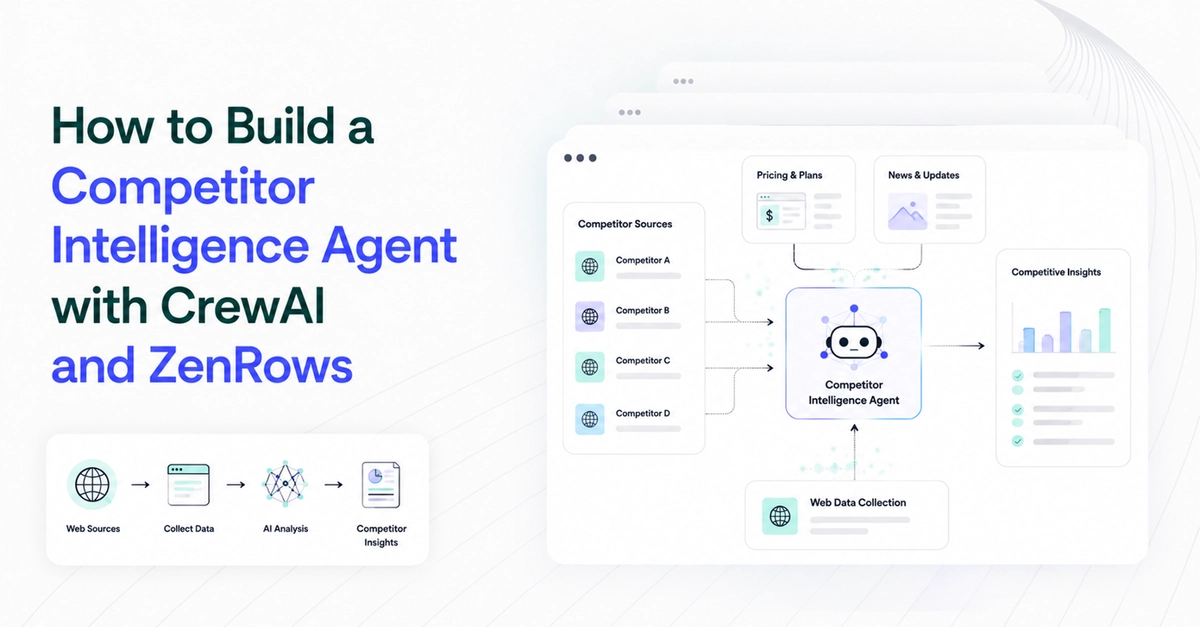
The Need for Automated Competitor Intelligence
In today's rapidly evolving digital landscape, staying ahead of the competition is paramount for any business. Manual competitor research is time-consuming, error-prone, and often fails to keep pace with market shifts. This is where automated competitor intelligence agents become invaluable. These agents can provide real-time pricing visibility, track positioning changes, and generate structured competitor briefs, freeing up valuable human resources for strategic analysis rather than data gathering.
At the core of such an agent are two primary components: a researcher agent responsible for gathering data from the web and an analysis agent responsible for synthesizing this data into actionable insights. However, the trustworthiness of the entire workflow hinges on the researcher agent's ability to reliably retrieve accurate information. If the researcher agent encounters blocked content, CAPTCHAs, or empty responses from target websites, the subsequent analysis becomes questionable, rendering the entire intelligence system unreliable.
This is precisely the challenge that ZenRows addresses. With a reported 99.93% success rate on protected websites, ZenRows acts as a robust retrieval layer, ensuring that the researcher agent can consistently access the data it needs. This reliability is crucial for making automated competitor intelligence workflows practical and effective in production environments.
Leveraging CrewAI for Agent Orchestration
CrewAI is an open-source framework that simplifies the creation and management of autonomous AI agents. It allows developers to define agents with specific roles, goals, and tools, and then orchestrate their collaboration to achieve complex tasks. For competitor intelligence, CrewAI is an ideal choice for building the multi-agent system required.
A typical setup involves defining a Researcher Agent and an Analyst Agent. The Researcher Agent's primary role is to navigate the web, extract relevant data points such as product features, pricing, customer reviews, and marketing strategies from competitor websites. The Analyst Agent then takes this raw data and processes it to identify trends, generate comparative reports, and highlight key strategic shifts or opportunities.
The power of CrewAI lies in its ability to define custom tools for these agents. For web scraping, the Researcher Agent needs access to a reliable scraping tool. This is where ZenRows integrates seamlessly. By configuring the Researcher Agent to use ZenRows as its primary tool for website access, developers can overcome common anti-scraping measures that would otherwise halt the agent's progress.
Integrating ZenRows for Robust Data Retrieval
ZenRows is a powerful web scraping solution designed to bypass sophisticated anti-bot systems. It offers features like headless browser rendering, IP rotation, and CAPTCHA solving, which are essential for accessing data from websites that actively try to block automated scrapers. When integrated with a CrewAI agent, ZenRows acts as the agent's gateway to the internet.
The integration typically involves configuring the Researcher Agent's tools. Instead of a generic web browsing tool, you would configure a custom tool that makes requests through the ZenRows API. This tool would take a URL as input, send it to ZenRows for processing, and return the clean, rendered HTML content to the agent. This ensures that even if a competitor's website employs advanced detection mechanisms, the ZenRows-powered agent can still retrieve the necessary data.
Consider the scenario where a competitor updates its pricing or launches a new product. A manually configured scraper might be blocked the moment it attempts to access the updated page. However, an agent equipped with ZenRows would likely succeed, providing the Researcher Agent with the latest information. This real-time data is critical for maintaining accurate competitor intelligence.
Building the Competitor Intelligence Agent: A Step-by-Step Approach
To build this agent, you would start by setting up your Python environment and installing the necessary libraries: CrewAI and ZenRows. The core of the implementation involves defining the agents and their respective tasks.
Defining the Agents
1. Researcher Agent:
- Role: Web Data Extractor
- Goal: To find and extract specific data points (e.g., pricing, features, reviews) from competitor websites, using ZenRows for reliable access.
- Tools: A custom tool that interfaces with ZenRows API.
2. Analyst Agent:
- Role: Market Insights Synthesizer
- Goal: To analyze the data provided by the Researcher Agent, identify key trends, and generate a comprehensive competitor brief.
- Tools: Standard LLM capabilities for text analysis and summarization.
Configuring the ZenRows Tool
This is a crucial step. You'll need to create a Python function that takes a URL, your ZenRows API key, and potentially other parameters (like desired proxy type or browser emulation settings), sends a request to the ZenRows API, and returns the resulting HTML. This function then becomes a tool callable by the Researcher Agent.
Defining the Tasks
Researcher Tasks:
- Scrape product pricing from specific competitor URLs.
- Extract feature lists from competitor product pages.
- Gather customer sentiment from review sections.
Analyst Tasks:
- Compare pricing across competitors.
- Summarize key differentiating features.
- Identify emerging trends in competitor strategies.
- Generate a structured competitor brief report.
Orchestrating the Crew
Finally, you instantiate the agents and tasks within a CrewAI `Crew` object. You define the sequence of execution, ensuring the Researcher Agent completes its tasks before the Analyst Agent begins processing the output. The output of the Researcher Agent will serve as the input for the Analyst Agent.
The outcome is an autonomous agent capable of continuously monitoring competitors, providing up-to-date market intelligence that would otherwise require significant manual effort. This system is not just about scraping; it's about building an intelligent agent that understands its objective and reliably executes it.
The Unanswered Question: Scalability and Adaptation
While this setup provides a robust framework for competitor intelligence, a critical question remains: How effectively can these agents adapt to the constant evolution of anti-bot technologies and website structures? ZenRows offers a high success rate, but as websites become more sophisticated in their defenses, the agents will need mechanisms for continuous learning and adaptation. This might involve dynamic adjustments to scraping strategies, proactive monitoring of website changes, or even fallback mechanisms when ZenRows encounters new, unhandled defenses. The long-term viability of such agents will depend on their ability to evolve as rapidly as the systems they interact with.
Conclusion: Empowering Strategic Decision-Making
By combining the orchestration capabilities of CrewAI with the powerful, reliable web scraping of ZenRows, businesses can build sophisticated competitor intelligence agents. These agents automate the tedious process of data collection and analysis, providing timely, accurate, and actionable insights. This empowers teams to make more informed strategic decisions, identify market opportunities, and maintain a competitive edge in their respective industries. The future of market analysis is intelligent, automated, and accessible.