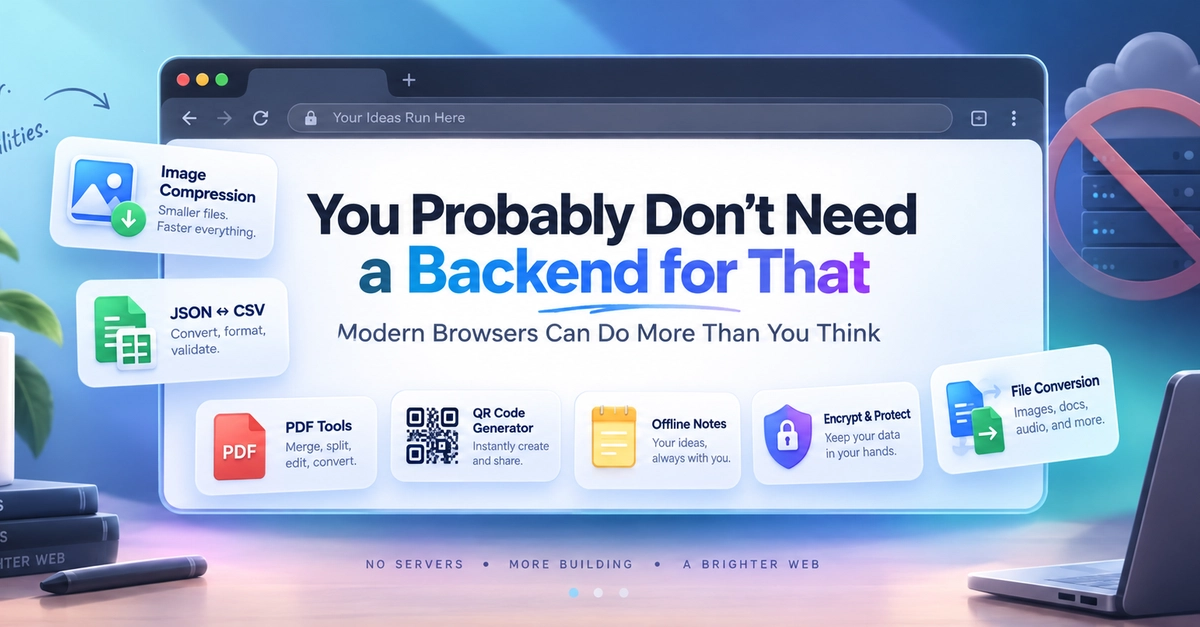
Developers often default to building backends for applications, incorporating APIs, databases, authentication, servers, queues, and cloud functions out of habit. However, this approach is increasingly unnecessary. Modern web browsers possess capabilities far exceeding what many developers realize, allowing for the construction of entire functional tools directly within the browser environment. This shift eliminates the need for traditional server infrastructure, databases, APIs, and associated backend costs, often resulting in applications that are faster, simpler, and offer enhanced user privacy.
When a Backend Remains Essential
Despite the growing power of browser-based development, backends are still critical for applications requiring specific functionalities. These include scenarios where shared data storage is paramount, such as collaborative tools or applications requiring persistent user accounts across sessions and devices. User authentication is another core area where a secure backend is indispensable for managing identities and access controls. Similarly, syncing application state or data across multiple devices necessitates a central server to reconcile changes. Payment processing, a sensitive operation involving financial transactions, must be handled server-side for security and compliance. Protecting sensitive API keys or secrets that should never be exposed to the client is also a definitive backend requirement. Furthermore, executing trusted business logic, especially for critical operations or calculations that must be verifiable and tamper-proof, demands a server environment. Finally, functionalities like sending emails, push notifications, or processing large, computationally intensive workloads are inherently server-bound tasks that cannot be performed effectively or securely within the browser.
Leveraging Browser Capabilities for Full-Stack Functionality
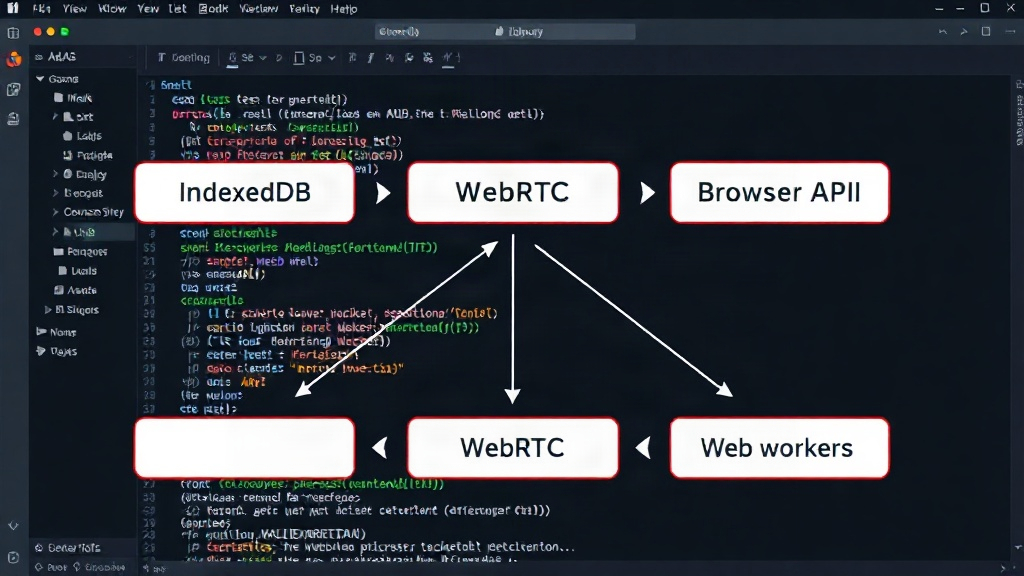
The web platform has evolved significantly, providing developers with powerful tools that can replace many traditional backend services. For applications that do not fall into the essential backend categories listed above, a browser-native approach can be remarkably effective. Consider data storage: modern browsers offer robust solutions like IndexedDB, a transactional database system that allows for storing significant amounts of structured data directly on the user's machine. This is ideal for offline-first applications, local caching, or tools where data persistence is needed per user, per device, without cross-device synchronization. For simpler state management or smaller datasets, localStorage and sessionStorage provide key-value pair storage, suitable for user preferences, session tokens, or temporary data.
Authentication can be streamlined using client-side libraries and services that abstract away direct server interaction for certain use cases. For instance, services like Firebase Authentication or Auth0 offer SDKs that handle much of the authentication flow on the client, relying on secure token exchange mechanisms. While sensitive credential storage is a backend concern, managing logged-in states and user sessions can often be handled client-side after initial authentication. Similarly, peer-to-peer communication technologies like WebRTC enable direct communication between browsers, bypassing a central server for real-time features such as video conferencing, chat, or collaborative editing, provided the initial connection can be established. This removes the need for costly real-time messaging infrastructure.
Complex calculations and data processing, when not excessively large, can be offloaded to the browser's JavaScript engine. Web Workers provide a way to run scripts in background threads, preventing the main UI thread from freezing and improving application responsiveness. This allows for tasks like image manipulation, data filtering, or complex form validations to occur locally. For applications requiring external data, browser-native Fetch API and XMLHttpRequest are standard tools for making HTTP requests. When interacting with third-party APIs that don't require secret keys, direct client-side calls are straightforward. Even for APIs that do require keys, techniques like using a serverless function as a proxy can circumvent the need for a full-fledged backend server, keeping the operational overhead minimal.
The Advantages of Going Backend-Free
The benefits of adopting a browser-native development model are substantial. Speed is a primary advantage; eliminating network latency associated with server requests and responses means applications can feel snappier. Data stored locally is immediately accessible. Simplicity in development and deployment is another major draw. Developers can focus on frontend technologies and user experience without managing server configurations, database administration, or infrastructure scaling. Deployment often boils down to serving static assets, which can be done through content delivery networks (CDNs) or simple static hosting services, drastically reducing complexity.
Cost savings are significant. The operational expenses associated with running servers, databases, and managing cloud infrastructure can be entirely avoided. This makes it particularly attractive for startups, solo developers, or projects with limited budgets. Privacy is often enhanced because sensitive user data can remain on the user's device, reducing the attack surface and compliance burdens associated with handling personal information centrally. For applications where user data is ephemeral or personal in nature, this client-side approach offers a strong privacy posture.
When to Reconsider the Backend
While the trend towards client-side capabilities is powerful, it's crucial to recognize its limitations. The core reasons for needing a backend—shared data, user authentication, cross-device sync, payments, secret key management, trusted business logic, and notifications—remain valid. If your application's core value proposition relies on any of these, a backend is unavoidable. For example, a social media platform, an e-commerce store, or a SaaS application with user accounts and collaborative features will invariably require server-side infrastructure.
Consider the 'trusted business logic' point carefully. If your application involves critical calculations, financial models, or proprietary algorithms that must be protected from reverse-engineering or tampering, that logic belongs on a server. Similarly, if your application needs to perform actions on behalf of the user that require high levels of trust and security, such as processing payments or sending verified communications, the backend is the only secure place for these operations. The decision hinges on whether the application's core functionality can be achieved securely and effectively using only the tools available in the browser. If not, a backend is not just beneficial; it's essential.