
From English to Executable Neural Code
The ProgramAsWeights (PAW) project, developed at the University of Waterloo, introduces a novel approach to translating natural language descriptions of functions into executable neural programs. This research aims to bridge the gap between human-readable intent and machine-executable code, allowing for local execution, including on standard CPUs. This moves beyond cloud-based APIs and offers a more accessible and private way to leverage AI-driven functionalities.
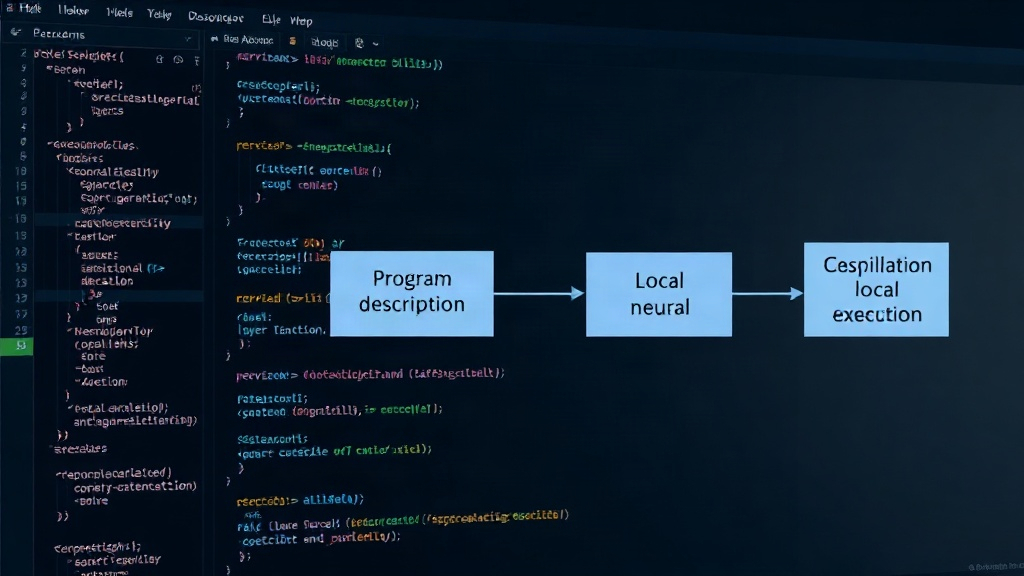
The core concept is to take an English description of a desired function, such as "Classify urgent emails," and compile it into a reusable neural program. This compiled program can then be invoked with specific inputs, returning the desired output. For instance, after compiling the "Classify urgent emails" function, a user can pass the string "Need this today" to the compiled program, which would then return "urgent" as the classification.
This capability has significant implications for how developers and users interact with AI. Instead of relying on external services or complex API integrations, users can define and run custom AI functions directly within their local environment. This not only enhances privacy by keeping data local but also reduces latency and dependency on network connectivity.
The Compilation Process and Local Execution
The compilation process within ProgramAsWeights involves transforming the English function description into a series of weights that constitute a neural network. This neural network is specifically trained or configured to perform the described task. The key innovation is that these compiled weights are not tied to a specific cloud infrastructure; they are designed to be loaded and executed locally.
Consider the example of creating a function to summarize text. A user could describe this function in English: "Summarize the following text into three bullet points." ProgramAsWeights would then compile this description into a set of weights. Once loaded, this neural program could be called with any block of text, and it would return a concise three-bullet-point summary. The ability to run this locally means that sensitive documents can be summarized without ever leaving the user's machine.
The project emphasizes local execution, including on CPUs. This is a critical differentiator from many existing AI services that require powerful GPUs and cloud infrastructure. By enabling CPU execution, ProgramAsWeights democratizes access to AI-powered functions, making them feasible for a wider range of hardware and applications. This is akin to how traditional programming languages compile down to machine code that can run on virtually any computer, but applied to the domain of neural computation.
Implications for Developers and AI Integration
For developers, ProgramAsWeights offers a new paradigm for integrating AI capabilities into applications. It abstracts away the complexities of model training, deployment, and inference management. Instead of managing large model files or complex API endpoints, developers can define functions using natural language and integrate them as lightweight, executable components.
This approach could lead to the development of highly customized and context-aware AI tools. Imagine building an application where users can define specific data validation rules or text formatting preferences simply by describing them in English. These descriptions are compiled into neural programs that the application then uses. This makes software development more intuitive and adaptive, allowing for rapid iteration on AI-driven features.
The potential for local execution also opens doors for offline AI applications. Whether it's a mobile app that needs to perform complex text analysis without an internet connection or a desktop application for sensitive data processing, ProgramAsWeights provides a pathway. The research is still in its early stages, but the foundational idea of compiling high-level natural language intent into self-contained, locally runnable neural programs is a significant step forward.
The Future of Local, Accessible AI
While tools like Jev have explored compiling code to neural networks, ProgramAsWeights focuses on the reverse: compiling natural language descriptions directly into neural programs. This distinction is crucial. It suggests a future where the barrier to creating and deploying AI functionalities is lowered, moving from code-centric to intent-centric development. The project's emphasis on local execution, including CPU support, is particularly noteworthy. It addresses concerns about data privacy, cost, and accessibility that often accompany cloud-based AI solutions.
The research raises an interesting question: as neural programs become more composable and executable locally, how will this impact the development of traditional software? Will we see hybrid applications that seamlessly blend traditional code with these compiled neural functions? The ability to define complex behaviors through simple English descriptions, execute them efficiently on everyday hardware, and integrate them into existing workflows suggests a significant shift in the software development landscape.
ProgramAsWeights is an open-source research project, indicating a commitment to community involvement and further development. Its success could pave the way for a new generation of AI tools that are more user-friendly, private, and universally accessible, moving AI from specialized cloud services into the fabric of local computing.