
The SOLID Foundation is Not Enough
Many developers, after mastering Object-Oriented Design and the SOLID principles, ask a critical question: why bother with design patterns? It’s a valid query. SOLID principles guide us in creating well-structured, maintainable, and flexible classes. They teach us to identify responsibilities, manage dependencies, and promote loose coupling. We learn to model domains effectively, choose appropriate data structures, and approach Low-Level Design from a problem-solving standpoint. This foundation is robust. It equips us to write better code at the class level.
However, software architecture operates at a higher altitude than individual class design. While SOLID principles help us build better individual components, they don't provide ready-made blueprints for integrating these components into larger, cohesive systems. This is where design patterns enter the picture. They are not simply “advanced OOP”; they are distilled wisdom, representing proven solutions to recurring problems in software design that span multiple classes and objects.
Think of it this way: SOLID principles are like learning the rules of grammar and sentence construction. They allow you to write grammatically correct and clear sentences. Design patterns, on the other hand, are like learning established literary forms – sonnets, haikus, or narrative structures. They provide frameworks for organizing multiple sentences into a coherent and impactful whole, addressing larger compositional challenges.
The Genesis of Design Patterns
To understand the necessity of design patterns, we must first consider their origin. Before patterns were formally documented, software engineers grappled with similar problems repeatedly across different projects. They would devise solutions, test them, refine them, and pass them on through experience or documentation. Over time, certain solutions proved exceptionally effective and reusable. These recurring, effective solutions were eventually identified, categorized, and named by pioneers like the “Gang of Four” (GoF) – Erich Gamma, Richard Helm, Ralph Johnson, and John Vlissides – in their seminal book, 'Design Patterns: Elements of Reusable Object-Oriented Software'.
The GoF identified 23 core patterns, but their work was not about inventing new techniques. It was about observing and articulating best practices that had emerged organically from decades of software development. They codified these solutions, giving them a common vocabulary and a shared understanding, which significantly accelerated the learning curve for new developers and improved collaboration among experienced ones. The patterns weren't arbitrary rules; they were empirical solutions to common architectural dilemmas.
Bridging the Gap: From Classes to Systems
SOLID principles primarily focus on the internal structure and responsibilities of a single class or a small, tightly coupled group of classes. They are concerned with single responsibilities, open/closed principles, substitutability, interface segregation, and dependency inversion at a granular level. For instance, the Single Responsibility Principle (SRP) ensures a class has only one reason to change. The Open/Closed Principle (OCP) suggests that software entities should be open for extension but closed for modification.
Design patterns, however, address the relationships and interactions between multiple objects and classes. They provide high-level structural, creational, or behavioral solutions. A creational pattern like the Factory Method or Abstract Factory helps manage object instantiation across a system. A structural pattern like Adapter or Facade simplifies complex interfaces or connects incompatible ones. A behavioral pattern like Observer or Strategy defines how objects communicate and collaborate.
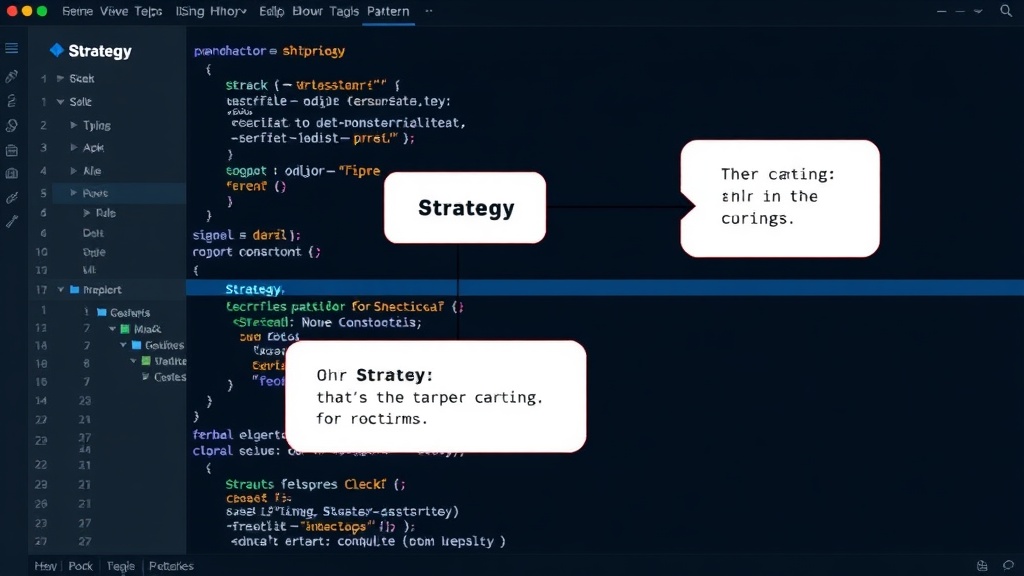
Consider a scenario where you need to manage multiple types of payment gateways in an e-commerce application. SOLID principles would guide you in creating a clean `PaymentGateway` interface and implementing specific gateways (e.g., `CreditCardGateway`, `PayPalGateway`) adhering to SRP and OCP. However, a pattern like the Strategy pattern would provide a clear way to define a family of algorithms (payment processing logic), encapsulate each one, and make them interchangeable. This allows the payment processing logic to vary independently from the clients that use it, enabling easy addition of new payment methods without modifying existing code that initiates the payment.
The Power of a Shared Vocabulary
One of the most significant benefits of design patterns is the establishment of a common language. When you say “This section uses the Observer pattern,” a seasoned developer immediately understands the communication mechanism between objects. They grasp that one object (the subject) maintains a list of dependents (observers) and notifies them automatically of any state changes. This shared vocabulary prevents lengthy, verbose explanations and reduces ambiguity. It allows teams to discuss complex architectural decisions efficiently and precisely.
Without this shared vocabulary, describing system interactions can become cumbersome. Instead of saying “We implemented a publish-subscribe mechanism where components can register to receive updates from a central event bus without direct coupling,” you can simply state, “We’re using the Observer pattern here.” This conciseness is invaluable in design discussions, code reviews, and documentation. It allows developers to leverage collective knowledge and avoid reinventing solutions that have already been proven effective.
When Patterns Become Problems
It’s crucial to acknowledge that design patterns are not a silver bullet. Misapplying patterns or using them excessively can lead to over-engineering, increased complexity, and code that is harder to understand and maintain – the very problems they aim to solve. This is often referred to as “patternitis.”
A common pitfall is forcing a pattern into a situation where it doesn’t naturally fit, simply because it's a known pattern. For example, implementing a complex factory hierarchy when a simple conditional statement or a builder pattern would suffice for object creation. Or using the Decorator pattern when simple inheritance would be more straightforward. The key is to use patterns judiciously, understanding the problem they solve and ensuring they genuinely simplify the design rather than complicating it.
SOLID principles, when applied correctly, often lead to designs that are more amenable to patterns. A system built with clean, single-responsibility classes that are open for extension is easier to apply patterns to. The patterns then provide the architectural glue and interaction models. It's not a question of SOLID versus patterns, but rather how SOLID principles enable the effective application of design patterns.
The Continuing Relevance of Patterns
In an era dominated by microservices, functional programming, and rapidly evolving frameworks, some might question the relevance of classic object-oriented design patterns. Yet, the fundamental problems of managing complexity, ensuring flexibility, promoting reusability, and facilitating collaboration remain. While the implementation details might change, the underlying architectural challenges persist.
For instance, patterns like Command can be useful in asynchronous task processing within microservices. The Facade pattern is frequently employed to simplify interactions with complex internal services. The Observer pattern remains a cornerstone for event-driven architectures. Even in functional programming, concepts analogous to patterns like Strategy (higher-order functions) and Decorator (function composition) are evident.
The enduring value of design patterns lies in their ability to encapsulate decades of collective experience. They offer a proven toolkit for tackling common architectural quandaries. While SOLID principles build the sturdy bricks and mortar of individual software components, design patterns provide the architectural blueprints for assembling those components into robust, scalable, and maintainable systems. Understanding both is essential for any serious software engineer aiming to build high-quality software that stands the test of time.