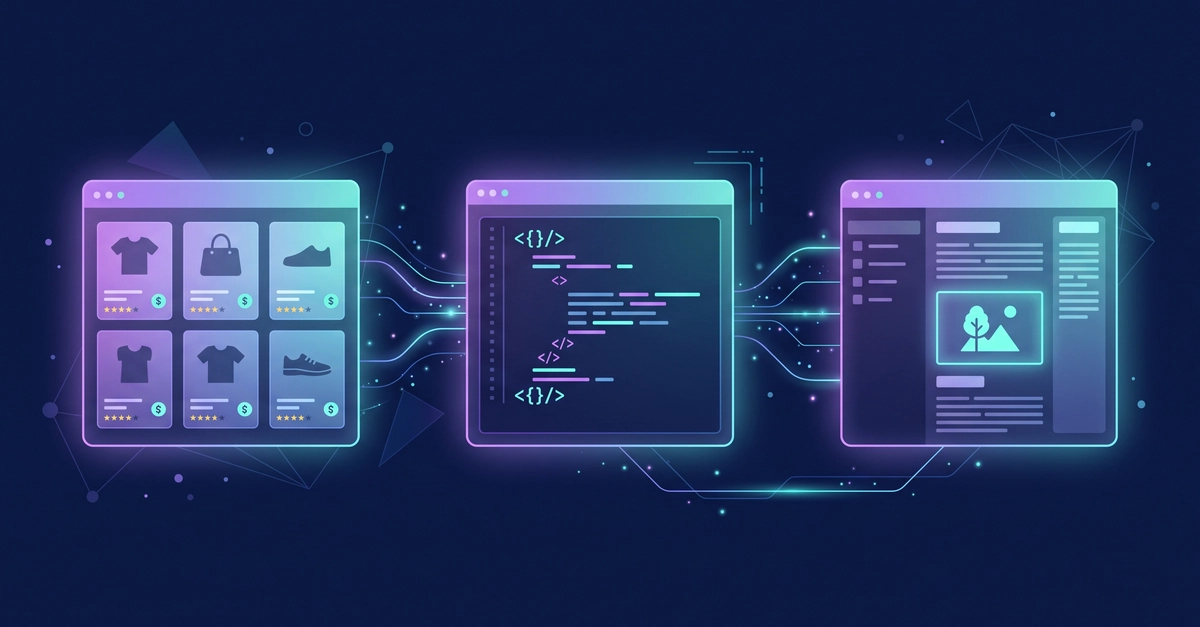
The Challenge: Bridging Commerce and Content
Medusa.js provides a robust commerce engine, handling essential e-commerce functions like products, variants, pricing, inventory, carts, orders, and fulfillment through a clean Store API. When running the Next.js Starter Storefront, the core commerce functionality is largely addressed. However, modern e-commerce requires more than just transactions. Marketing teams need to deploy buying guides on category pages, founder stories on product detail pages, time-sensitive landing pages, and dynamic FAQ sections. These editorial content elements do not belong in a transactional commerce database and should not necessitate a full code deploy to update.
The core problem is integrating this dynamic editorial content with the structured product data managed by Medusa. Storing content directly within Medusa's product metadata, for instance, is a suboptimal approach. While Medusa allows arbitrary metadata attachments, this field is not designed for rich, structured content like buying guides or blog posts. It quickly becomes unwieldy, difficult to manage, and lacks the features of a dedicated content management system (CMS). This leads to a fragmented authoring experience and limits the flexibility required for effective digital marketing and customer engagement.
The Solution: A Dual-Source Strategy
The most effective pattern for building content-rich e-commerce storefronts with Medusa.js and Next.js involves a dual-source strategy. Medusa remains the definitive source of truth for all commerce-related data. Simultaneously, a headless CMS is introduced as the definitive source of truth for all editorial and marketing content. The key to unifying these two distinct data sources lies within the Next.js application layer. Here, a shared identifier – typically a product slug or SKU – is used to join and display both commerce and content data cohesively on the storefront.
This approach decouples content management from e-commerce operations. Marketing teams can manage landing pages, buying guides, and other editorial content within their preferred headless CMS without impacting the core commerce infrastructure. Developers can leverage the Medusa Store API for product data and the headless CMS API for content, orchestrating the combined data within Next.js components. This separation of concerns leads to a more scalable, maintainable, and flexible e-commerce architecture.
Choosing the Right Headless CMS
The selection of a headless CMS is critical. The CMS must offer a robust API for content retrieval and a flexible content modeling system to accommodate diverse content types. Popular choices include Contentful, Sanity, Strapi, and Prismic. Each offers different strengths in terms of features, pricing, developer experience, and ease of use for content editors.
For example, Contentful is known for its enterprise-grade features and scalability, while Sanity offers a highly customizable editing environment and a powerful real-time API. Strapi, being open-source, provides greater control and flexibility. Prismic is often praised for its user-friendly interface and visual editing tools.
When evaluating a CMS, consider:
- API Capabilities: Does it offer a GraphQL or REST API that is performant and easy to integrate with Next.js?
- Content Modeling: Can you easily define custom content types (e.g., buying guides, founder stories, landing pages) with rich field types?
- Developer Experience: Are there well-documented SDKs or client libraries for Node.js/JavaScript?
- Editor Experience: Is the content editing interface intuitive for marketing teams?
- Performance: How quickly can content be fetched and delivered to the frontend?
Implementation in Next.js
The integration process in Next.js typically involves fetching data from both Medusa and the chosen headless CMS within your page or component logic. Using Next.js's data fetching methods (like getStaticProps, getServerSideProps, or client-side fetching with SWR or React Query) is essential for optimal performance.
A common pattern is to fetch product data from Medusa and, using the product's slug, fetch associated content from the headless CMS. For instance, on a product detail page:
- Fetch product details (name, price, description, images) from the Medusa Store API using the product slug.
- If a corresponding content entry exists in the headless CMS (e.g., a buying guide for that specific product slug), fetch that content as well.
- Pass both sets of data to your React component for rendering.
Consider this simplified example for fetching data in Next.js:
// Example using getStaticProps for a product detail page
export async function getStaticProps(context) {
  const { slug } = context.params;

  // Fetch product data from Medusa
  const productResponse = await fetch(`https://your-medusa-api.com/store/products?handle=${slug}`);
  const productData = await productResponse.json();
  const product = productData.products[0];

  // Fetch associated content from Headless CMS
  // Assuming your CMS has an endpoint to fetch content by slug
  const contentResponse = await fetch(`https://your-cms-api.com/api/content?slug=${slug}`);
  const contentData = await contentResponse.json();
  const editorialContent = contentData.items[0] || null;

  return {
    props: {
      product,
      editorialContent,
    },
    revalidate: 60, // Re-generate page every 60 seconds
  };
}
The key here is the slug, which serves as the shared identifier. This allows you to dynamically associate rich content with specific products, categories, or even landing pages without modifying the core commerce data structure.
Benefits of This Architecture
Adopting this dual-source architecture offers several significant advantages:
- Flexibility: Easily update and manage marketing content independently of product data and code deployments.
- Scalability: Medusa handles commerce scaling, while the headless CMS handles content scaling.
- Performance: Leverage Next.js's static generation and API routes for fast content delivery.
- Authoring Experience: Provide marketing and content teams with user-friendly tools in a dedicated CMS.
- Maintainability: Clear separation of concerns simplifies development and reduces technical debt.
By treating Medusa as the source of truth for commerce and a headless CMS as the source of truth for editorial content, and joining them in the Next.js layer, you create a powerful, flexible, and content-rich e-commerce storefront capable of meeting complex marketing and business needs.