
The Problem: Information Overload and Signal Loss
The modern digital landscape bombards users with an unrelenting stream of information. For many, mornings begin with a ritualistic opening of multiple browser tabs, newsletters, and news aggregators like Hacker News. This approach, however, is not only time-consuming but also inefficient. The core issue isn't the sheer volume of content, but the prevalence of 'noise' – information that lacks significant signal or relevance to the individual. Manually sifting through numerous sources incurs a cognitive 'attention tax,' where users expend mental energy on content that ultimately doesn't matter. This leads to a feeling of missing crucial information despite the effort, a common symptom of digital information overload.
The Solution: A Three-Stage Automated Pipeline
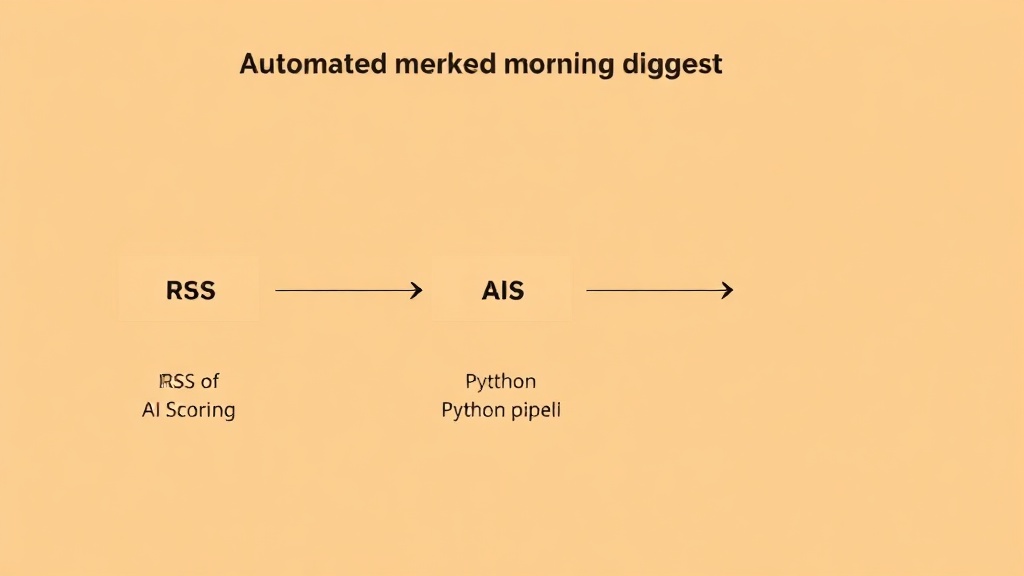
To combat this, a practical solution has been developed: a compact, approximately 300-line Python pipeline designed to automate the information gathering and filtering process. This pipeline runs efficiently on a cron schedule, incurring minimal daily operational costs, often just pennies. It operates in three distinct stages, each addressing a specific aspect of information processing to deliver a curated, actionable digest.
Stage 1: Collection via RSS Aggregation
The first stage focuses on consolidating relevant content from a user's preferred sources. Instead of relying on browser tabs or individual website visits, the pipeline leverages RSS feeds. This method ensures that only new or updated content from subscribed sources is considered, drastically reducing the scope of information to be processed. The feedparser Python library is instrumental here, enabling a straightforward loop that iterates through each configured RSS feed. New items identified from these feeds are then added to a central queue, preparing them for the subsequent stages of processing. This systematic collection method forms the foundation of the automated digest, ensuring that the input data is relevant and manageable.
Stage 2: AI-Powered Content Scoring
Once content is collected, the second stage introduces intelligence to filter and prioritize it. This is where Artificial Intelligence plays a crucial role. Each collected item, typically an article or post, is subjected to an AI scoring mechanism. The objective is to assign a relevance score based on predefined criteria or learned user preferences. While the specifics of the AI model are not detailed, common approaches involve natural language processing (NLP) techniques to analyze the content's text, identify keywords, assess sentiment, or compare it against a user's defined interest profile. This scoring process allows the pipeline to distinguish between high-signal and low-signal content. Items that meet a certain score threshold are deemed important enough to be included in the final digest, while others are discarded. This stage is critical for transforming a raw feed of information into a prioritized list of potentially valuable content.
Stage 3: Digest Generation
The final stage synthesizes the high-scoring content into a digestible format. After the AI has scored and filtered the collected items, the pipeline compiles the top-ranked content into a single, coherent digest. This digest is designed to be concise and actionable, providing users with the essential information without the burden of sifting through multiple sources. The format of the digest can vary, potentially including summaries, key takeaways, or direct links to the original content. The goal is to present the most important information in a way that can be quickly consumed, typically within minutes. This stage effectively concludes the automated process, delivering value by saving the user significant time and mental effort each morning.
Implementation Details and Cost-Effectiveness
The entire pipeline, comprising around 300 lines of Python code, is designed for simplicity and efficiency. Its low line count suggests a focused implementation, likely avoiding overly complex frameworks or libraries where simpler solutions suffice. Running this on a cron schedule ensures that the process is automated and requires minimal manual intervention. The operational cost is remarkably low, estimated at mere pennies per day. This cost-effectiveness is a significant advantage, making the solution accessible and sustainable for individual users. The choice of Python as the programming language is well-suited for this task, given its extensive libraries for web scraping (like feedparser), AI/ML (though not heavily detailed here, libraries like NLTK, spaCy, or even transformer models could be integrated), and general scripting.
The Outcome: Reclaimed Mornings
The tangible benefit of this automated system is a significant reduction in morning time spent on information consumption. By eliminating the need to manually check multiple sources and filter out irrelevant content, users can reclaim valuable minutes, or even hours, each day. The author reports saving approximately 30 minutes per morning. This reclaimed time can be redirected to more productive or enjoyable activities. The system effectively kills 'tab sprawl' – the overwhelming proliferation of open browser tabs – by providing a curated feed of what matters most. This shift from reactive information consumption to a proactive, filtered approach transforms the morning routine from a chore into an efficient information intake process.
Broader Implications and Future Directions
While this solution is presented as a personal automation project, it highlights broader trends in information management and the application of AI for personalization. As the volume of digital content continues to grow, tools that can intelligently filter and synthesize information will become increasingly valuable. The success of this ~300-line pipeline suggests that sophisticated solutions don't always require massive infrastructure or complex architectures. The key lies in understanding the core problem – signal-to-noise ratio – and applying appropriate tools, like RSS and AI scoring, effectively. Future directions could involve more sophisticated AI models for scoring, integration with other productivity tools, or even a more generalized service for others to use. The surprising detail here is how effectively a relatively small amount of code, focused on specific tasks, can solve a pervasive problem like information overload.
What remains to be seen is how such personalized aggregation systems can scale or be integrated into broader professional workflows without sacrificing their individual relevance. As AI models become more capable, the potential for truly intelligent, adaptive digests that anticipate user needs will only grow.