
The Event Loop: Python's Concurrency Conductor
Python's asyncio library provides a powerful framework for writing concurrent code using the async/await syntax. While the public API—defining coroutines with async def, suspending them with await, and managing tasks with create_task() or gather()—is sufficient for many applications, it obscures the underlying mechanics. Understanding how asyncio truly operates requires looking beneath this surface to grasp its core execution model.
At the heart of asyncio lies the event loop. This is not a separate thread or process, but rather a single-threaded mechanism that orchestrates the execution of multiple tasks. Think of it as a diligent manager who has a list of jobs to do. Instead of working on one job until it's fully complete, the manager juggles them. When a job needs to wait for something—like network data to arrive or a timer to expire—the manager sets it aside and immediately moves to the next job that is ready to make progress. This is the essence of cooperative multitasking.
The event loop continuously checks for events. These events can be anything from I/O operations completing, timers firing, or callbacks scheduled to run. When an event occurs that a waiting coroutine is interested in, the event loop will resume that coroutine's execution. Conversely, when a coroutine encounters an await expression, it signals to the event loop that it is yielding control. It doesn't truly block the thread; instead, it returns control to the event loop, allowing other tasks to run.
This model is fundamentally different from traditional threading. In threading, operating system schedulers preemptively switch between threads, which can lead to race conditions and requires complex locking mechanisms. In asyncio, tasks voluntarily yield control. This cooperative nature means that a single long-running, CPU-bound operation without any await points can indeed stall the entire event loop, preventing other coroutines from executing. This is why asyncio is best suited for I/O-bound tasks, where the program spends most of its time waiting for external resources, rather than CPU-bound tasks that require continuous computation.
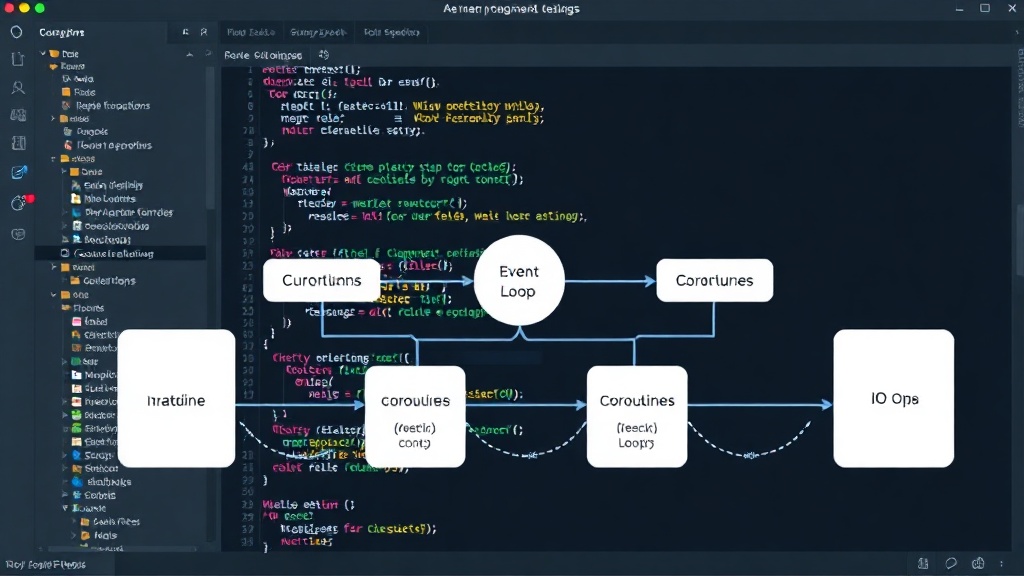
Coroutines and Task Management
Coroutines, defined with async def, are the fundamental building blocks of asyncio applications. When a coroutine is called, it doesn't execute immediately; instead, it returns a coroutine object. This object represents the potential for execution. To actually run a coroutine, it must be scheduled on the event loop. This is typically done using asyncio.create_task().
asyncio.create_task() takes a coroutine object and wraps it in a Task object. A Task is a future-like object that represents the execution of a coroutine. The event loop manages these Task objects. When a coroutine is running and hits an await, it yields control back to the event loop. The event loop then looks for other ready tasks to run. If the awaited operation (e.g., reading from a socket) completes, the event loop will schedule the original coroutine to resume from where it left off.
The await keyword is crucial here. It's not a blocking call. When a coroutine awaits another coroutine or an awaitable object (like a Task or a Future), it signals its willingness to pause. The event loop then takes over. It can run other tasks, process I/O, or execute callbacks. When the awaited operation is ready, the event loop will resume the paused coroutine, passing any returned result back to it. This is how concurrency is achieved on a single thread: the program rapidly switches between tasks whenever one yields control.
Cancellation: A Cooperative Endeavor
Cancellation in asyncio is cooperative, not immediate. When you request to cancel a task (e.g., using task.cancel()), asyncio doesn't forcibly terminate it. Instead, it injects a CancelledError exception into the coroutine at the next possible `await` point. The coroutine then has the opportunity to catch this exception, perform cleanup operations, and then re-raise it to signal that it has indeed been cancelled.
This cooperative model is vital for maintaining the integrity of the event loop and preventing resource leaks. If cancellation were immediate, a task might be terminated mid-operation, leaving resources like open file handles or network connections in an inconsistent state. By making cancellation cooperative, developers can ensure that their coroutines handle shutdown gracefully. This also means that a task can, in principle, ignore a cancellation request and continue running, although this is generally discouraged and can lead to unexpected behavior.
Scaling with Thousands of Connections
The ability of a single thread to manage thousands of network connections stems directly from the event loop's non-blocking I/O model. Traditional blocking I/O requires a separate thread for each connection to avoid stalling the entire application. In contrast, asyncio uses asynchronous I/O primitives, often implemented via system calls like epoll (Linux), kqueue (macOS/BSD), or IOCP (Windows). These mechanisms allow a single thread to monitor many file descriptors (sockets, pipes, etc.) simultaneously.
When a network operation is initiated (e.g., sending data), the system call returns immediately, indicating that the operation has been scheduled but might not be complete. The event loop is then notified by the operating system when the socket is ready for further operations (e.g., ready to receive data). Because the thread is not blocked waiting for each individual operation, it can efficiently handle a large number of concurrent connections. Each connection is essentially a state machine managed by the event loop, progressing only when its associated I/O is ready.
The Peril of CPU-Bound Loops
The primary vulnerability in an asyncio application's responsiveness lies in its single-threaded, cooperative nature. If a coroutine enters a tight, infinite, or very long-running loop that performs computation without hitting any await expressions, it will monopolize the event loop's thread. During this time, no other coroutines can run, no I/O events can be processed, and no other tasks can be scheduled. The entire application appears frozen or unresponsive to the outside world.
This is why CPU-bound work should typically be offloaded to separate processes or threads using mechanisms like asyncio.to_thread() or multiprocessing. The event loop should be kept free to manage I/O and coordinate asynchronous operations. Understanding this limitation is key to building robust and scalable asyncio applications that remain responsive under load.