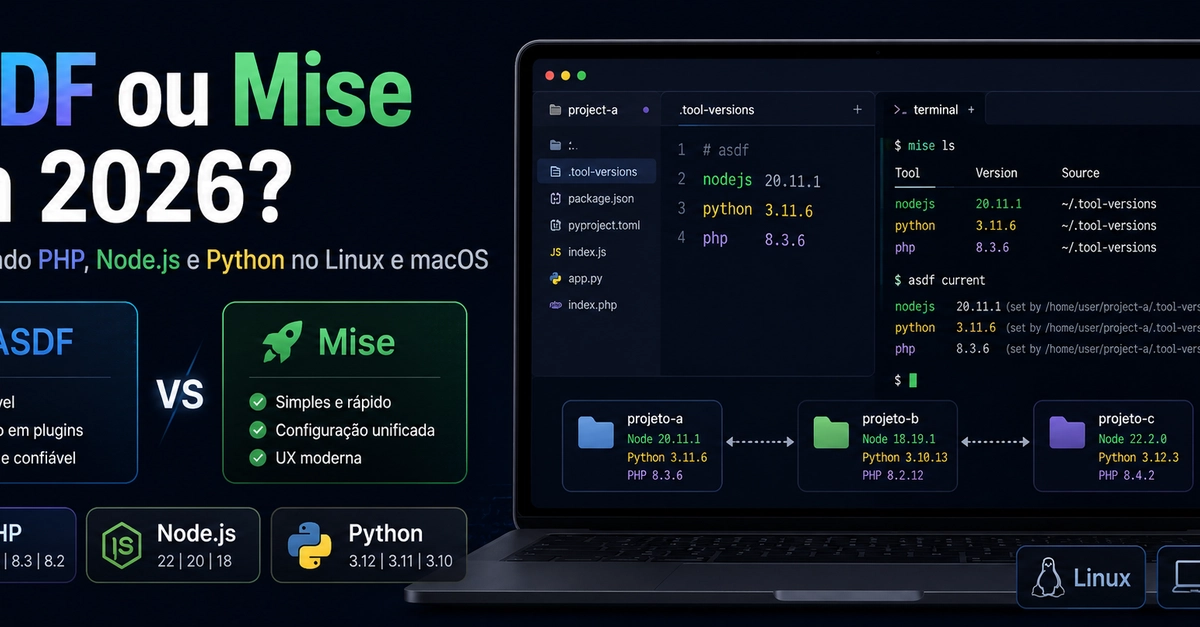
The Polyglot Developer's Versioning Headache
Working with multiple projects often means wrestling with a tangled mess of language versions. Imagine project A requiring PHP 8.5, Node.js 24, and Python 3.14, while a legacy project demands PHP 7.4, Node.js 20, and Python 3.11. The challenge isn't just installing these versions; it's managing them concurrently, switching between them seamlessly, and ensuring every team member uses an identical development environment. Traditionally, this meant adopting a separate tool for each language: NVM for Node.js, Pyenv for Python, RVM or rbenv for Ruby, and bespoke solutions for PHP. This fragmentation complicates setup, increases cognitive load, and introduces potential inconsistencies across developer machines.
This is where unified version managers like ASDF and Mise come into play. They aim to consolidate the management of multiple programming language runtimes and tools under a single, consistent interface. Instead of learning and configuring NVM, Pyenv, and a PHP version manager separately, developers can leverage one tool to handle them all. This article explores the benefits of this approach and contrasts two leading solutions: ASDF and Mise.
Introducing ASDF: The Extensible Ecosystem
ASDF is an extensible version manager that supports numerous languages through plugins. Its core philosophy is to provide a single command-line interface for installing, managing, and switching between versions of various tools. The strength of ASDF lies in its plugin architecture. For every language or tool you want to manage, you add a corresponding plugin. These plugins abstract the installation and management details, allowing ASDF to handle them uniformly. For instance, to manage Node.js, Python, and PHP, you would add the respective ASDF plugins. Once installed, you can set global, local (per-project), or shell-specific versions of these languages.
ASDF uses configuration files, typically `.tool-versions`, placed in project directories. This file explicitly lists the desired versions for each tool, ensuring that anyone checking out the project can quickly set up the correct environment. The commands are straightforward: `asdf install
Mise: A Modern, Fast Alternative
Mise is a newer entrant in the unified version management space, built with performance and developer experience in mind. It aims to be a drop-in replacement for many existing single-language managers, offering a unified CLI for languages like Node.js, Python, Ruby, Go, Java, and more. Mise supports various languages through its built-in plugins and can also leverage ASDF's plugin ecosystem, providing a bridge for existing ASDF users. Its design emphasizes speed and efficiency, often outperforming other managers in installation and switching times.
Like ASDF, Mise uses configuration files, typically named `.mise.toml` or `.tool-versions`, to define project-specific versions. This allows for reproducible build environments. Mise's command structure is similar to ASDF's, with commands like `mise install
Comparing ASDF and Mise
Both ASDF and Mise solve the same fundamental problem: managing multiple language versions efficiently. However, they differ in their approach and feature set.
Extensibility vs. Integrated Tools
ASDF's primary strength is its vast and mature plugin ecosystem. If a language or tool has an ASDF plugin, you can manage it. This makes ASDF incredibly versatile. Mise, while also extensible, focuses on integrating a core set of popular languages directly. It also has the advantage of being able to use ASDF plugins, offering a path for migration. For developers who need to manage a wide array of obscure or niche tools, ASDF's plugin model might be more appealing. For those primarily focused on mainstream languages, Mise's integrated approach could offer a slightly simpler and faster experience.
Performance
Mise is often cited as being faster than ASDF, particularly in tasks like switching versions or installing new ones. This performance gain is attributed to its modern architecture and focus on optimization. For developers who frequently switch between projects or work in CI/CD environments where speed is critical, Mise's performance could be a deciding factor.
Community and Maturity
ASDF has been around longer and boasts a larger, more established community and a wider array of plugins. This maturity means more resources, tutorials, and community support are available. Mise, while growing rapidly, is a younger project. However, its active development and focus on developer experience are attracting a strong following.
Configuration
Both tools use configuration files for project-specific settings. ASDF typically uses `.tool-versions`, while Mise can use `.tool-versions` or its own `.mise.toml` format. The syntax is generally similar, making it relatively easy to migrate between the two if needed. The ability to define versions per project is crucial for collaboration and ensuring consistency. This is where both tools shine, providing a clear, declarative way to specify environment requirements.
The Case for Unified Management
Adopting a tool like ASDF or Mise moves beyond simply installing language runtimes. It represents a shift towards treating development environments as code. By defining required versions in a version control system, teams can onboard new members faster, reduce