The Solo Founder's Knowledge Imperative
For solo founders and lead architects, a robust knowledge base isn't a luxury; it's the bedrock of efficient decision-making. Losing track of why a specific architectural choice was made, or the context behind a strategic pivot, can cost days of lost productivity. This is the problem NEXT4I founder, Dev, set out to solve, not with proprietary SaaS, but with a reusable, open-source pattern leveraging readily available tools.
The goal was to transform a simple folder of Markdown files into a fully searchable, version-controlled, and critically, AI-readable knowledge system. The key was to avoid vendor lock-in and custom integration headaches. The architecture, as Dev describes it, is elegant in its simplicity, comprising three distinct layers that work in concert without relying on hidden magic.
Three Layers, Zero Magic: The Architecture
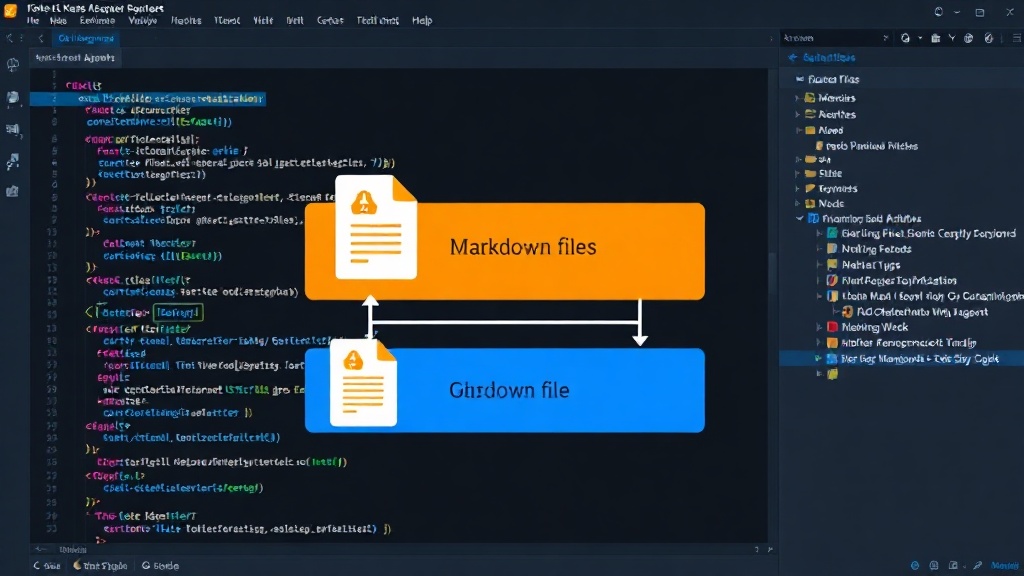
At the core of this system is a straightforward three-layer architecture. The first layer is the raw data: your notes, stored as plain Markdown files. This foundational layer ensures portability and avoids proprietary formats. The second layer is the version control system, Git, which provides a robust history of every change, allowing for rollbacks, branching, and collaboration if needed. It acts as the reliable memory for your knowledge base.
The third, and perhaps most innovative layer, is the AI agent. Running within VS Code, this agent is designed to read, search, and summarize the Markdown files. It leverages the structured nature of the notes and the version history provided by Git to offer contextual insights and rapid information retrieval. This agent doesn't just search text; it understands the relationships and evolution of ideas within the knowledge base.
Implementing the AI Agent in VS Code
The AI agent, running in VS Code, is the engine that makes the knowledge base truly dynamic. Dev highlights that this agent is configured to read and process the Markdown files. Its primary functions include intelligent search, summarization, and the ability to reconstruct context. Imagine asking your AI agent to "explain the rationale behind the Q3 product roadmap decision" and getting an accurate, context-aware answer derived directly from your notes.
This is achieved by configuring the AI agent to index the Markdown content. The agent can then perform semantic searches, understanding the meaning behind queries rather than just keyword matching. Furthermore, its ability to summarize allows for quick overviews of complex topics or long threads of thought. This transforms passive notes into an active, interactive knowledge repository. The agent is essentially a highly sophisticated research assistant, trained on your own intellectual output.
Leveraging Git for Version Control and History
Git serves as the immutable ledger for the knowledge base. Every edit, every addition, every deletion is tracked. This is crucial for understanding the evolution of ideas and decisions. If a later decision contradicts an earlier one, Git's history makes it easy to trace back and understand the shift. It prevents the loss of context that plagues ad-hoc note-taking systems.
Beyond simple version tracking, Git enables the AI agent to access historical context. The agent can be prompted to compare different versions of a note, identify when a specific piece of information was added or modified, or even reconstruct the state of the knowledge base at a particular point in time. This is akin to having a time machine for your thoughts, accessible via natural language queries through the AI agent.
The Power of Plain Markdown and Open Standards
The commitment to plain Markdown files and Git is a deliberate strategy to ensure longevity and avoid vendor lock-in. Unlike proprietary note-taking applications that store data in opaque formats, Markdown is universally readable and editable. This means the knowledge base remains accessible and usable regardless of future tool choices. If VS Code or the specific AI agent becomes obsolete, the core data remains intact and can be migrated to new tools.
This approach also simplifies integration. Because the data is in a standard format, it can be easily processed by any number of tools, not just the AI agent in VS Code. This creates a flexible ecosystem where different tools can interact with the knowledge base without complex APIs or custom connectors. It’s like having a universal adapter for all your intellectual property.
Practical Application and Reusability
Dev emphasizes that the pattern is genuinely useful and generic, applicable to anyone managing a significant body of knowledge. While specific business logic for NEXT4I is abstracted, the underlying architecture of using Markdown, Git, and an AI agent for knowledge management is universally transferable. This system offers a tangible path for developers, founders, and researchers to build their own AI-readable second brains.
The key takeaway is that building a powerful, AI-enhanced knowledge system doesn't require a massive budget or complex custom development. By combining established tools like Obsidian (for note organization, though the core data is plain Markdown), Git (for versioning), and a versatile AI agent within a familiar IDE like VS Code, individuals can create a personalized, intelligent knowledge repository that grows with them and remains under their complete control.