Introducing QORL: A New Paradigm in Query Optimization
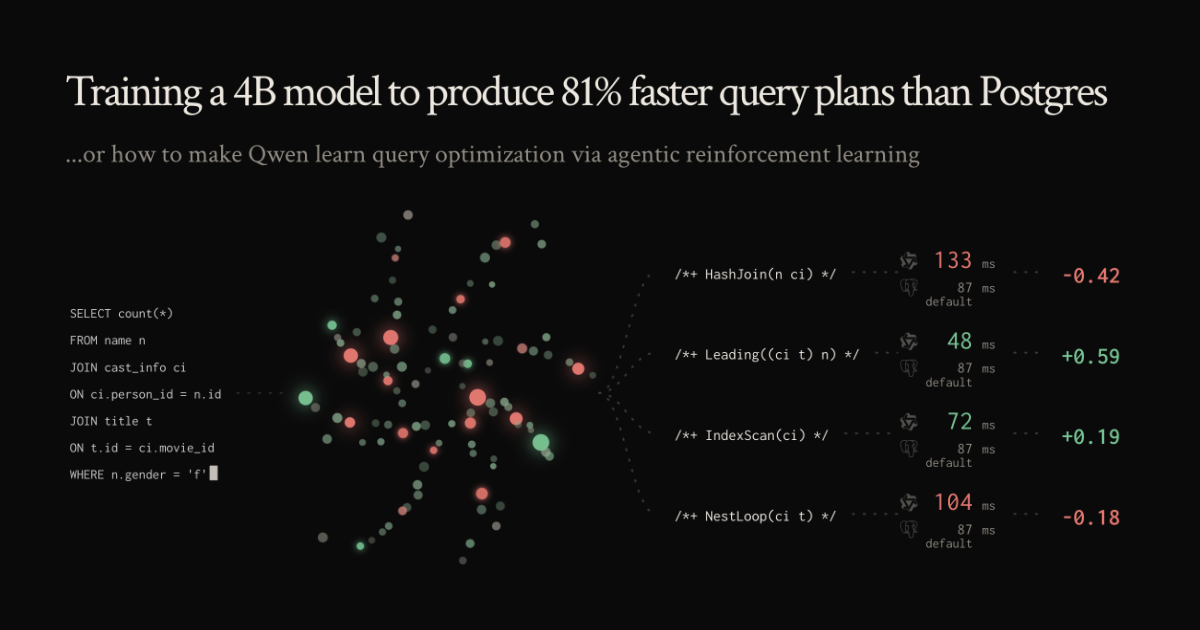
A research team has developed a novel approach to database query optimization, leveraging a large language model (LLM) to generate significantly faster query plans. The model, named QORL, trained on a dataset of 100 million SQL queries and their corresponding execution plans, has demonstrated an average of 81% faster query execution times compared to PostgreSQL's default query planner. This advancement marks a potential shift in how database performance is managed, moving beyond traditional heuristic-based optimizers towards learned models.
The core idea behind QORL is to treat query optimization as a sequence-to-sequence problem. Instead of relying on complex, hand-tuned algorithms that estimate costs and explore a vast search space, QORL learns to directly map an input SQL query to an optimal execution plan. This is analogous to how LLMs translate natural language sentences into coherent text; here, the "language" is SQL and the "translation" is an efficient query plan.
The researchers trained QORL on a massive corpus of query-plan pairs. This dataset was generated by running a diverse set of SQL queries against various database schemas and capturing the plans produced by PostgreSQL. The sheer scale of this dataset allows the model to learn intricate patterns and relationships between query structures, database statistics, and optimal execution strategies that might be difficult to explicitly codify in traditional optimizers.
The performance gains reported are substantial. Across a benchmark suite of queries, QORL-generated plans outperformed PostgreSQL's native optimizer by an average of 81%. In some specific cases, the speedup was even more dramatic, suggesting that QORL can identify optimizations that traditional methods miss. This is particularly noteworthy because PostgreSQL's optimizer is already highly sophisticated, incorporating decades of research and tuning.
The implications for database performance are far-reaching. For developers and database administrators, this could mean faster application response times, reduced infrastructure costs due to more efficient resource utilization, and simpler tuning processes. Instead of manually tweaking indexes or query structures, the database itself, powered by an AI like QORL, could potentially handle much of the optimization work automatically.
How QORL Works: Beyond Heuristics
Traditional database query optimizers operate on a set of heuristics and cost models. They break down a complex SQL query into a series of smaller operations (like scans, joins, sorts), estimate the cost (in terms of I/O, CPU, etc.) of executing these operations in different orders, and then choose the sequence with the lowest estimated cost. This process involves complex algorithms like dynamic programming or greedy approaches, and relies heavily on accurate database statistics (e.g., table sizes, data distribution) to make informed cost estimations.
QORL takes a fundamentally different approach. By framing query optimization as a learned task, it bypasses the need for explicit cost models and heuristic rules. The 4 billion parameter model learns a direct mapping from the query's abstract syntax tree (AST) or a linearized representation of the query to a sequence of physical operators that constitute an execution plan. This is akin to learning a complex function through extensive examples rather than by deriving its mathematical formula.
The training process involves feeding the model millions of SQL queries and their corresponding optimal execution plans. The model's parameters are adjusted to minimize the difference between the plan it predicts and the actual optimal plan observed in the training data. This supervised learning approach allows QORL to internalize complex optimization strategies that might be implicit in the vast dataset.
One of the surprising aspects of this research is the sheer scale of the model. A 4 billion parameter model is substantial, suggesting that capturing the nuances of query optimization requires a significant number of learned parameters. This contrasts with some other LLM applications where smaller, more specialized models can achieve remarkable results. The size of QORL indicates that the space of possible query plans and their associated performance characteristics is incredibly complex, necessitating a large model to navigate it effectively.
The researchers evaluated QORL against a suite of industry-standard benchmarks and real-world query workloads. The results consistently showed QORL's superiority over PostgreSQL's default planner, particularly for complex queries involving multiple joins and subqueries. The model's ability to generalize to unseen queries and database schemas is a testament to the robustness of its learned representations.
The Road Ahead: Integration and Future Potential
While the results are promising, integrating QORL into production database systems presents several challenges. Traditional query optimizers are deeply embedded within database engines, and their performance is critical for overall system responsiveness. Replacing or augmenting these components requires careful consideration of latency, memory usage, and the ability to adapt to changing data and schema conditions in real-time.
One of the key questions is how QORL would handle dynamic database environments. Traditional optimizers can re-evaluate plans based on current system load and data statistics. A learned model might require mechanisms for efficient retraining or online adaptation to maintain its effectiveness. Furthermore, the computational cost of running a 4B parameter model for every query needs to be balanced against the performance gains it provides.
However, the potential benefits are immense. Imagine a database system where the query optimizer is not a rigid set of rules but an intelligent agent that continuously learns and improves. This could lead to databases that are not only faster but also easier to manage and tune. It opens up possibilities for specialized optimizers tailored to specific workloads or hardware architectures.
The research also raises broader questions about the role of AI in database management. If AI can optimize query plans, what other aspects of database operations, such as indexing strategies, data partitioning, or even transaction management, could be learned and automated? QORL is a significant step towards a future where AI plays a central role in the performance and efficiency of data systems.
For developers, this means keeping an eye on how database vendors integrate such AI-driven optimization techniques. It could influence the queries they write and the assumptions they make about database performance. For founders building data-intensive applications, understanding these advancements could unlock new levels of efficiency and scalability.