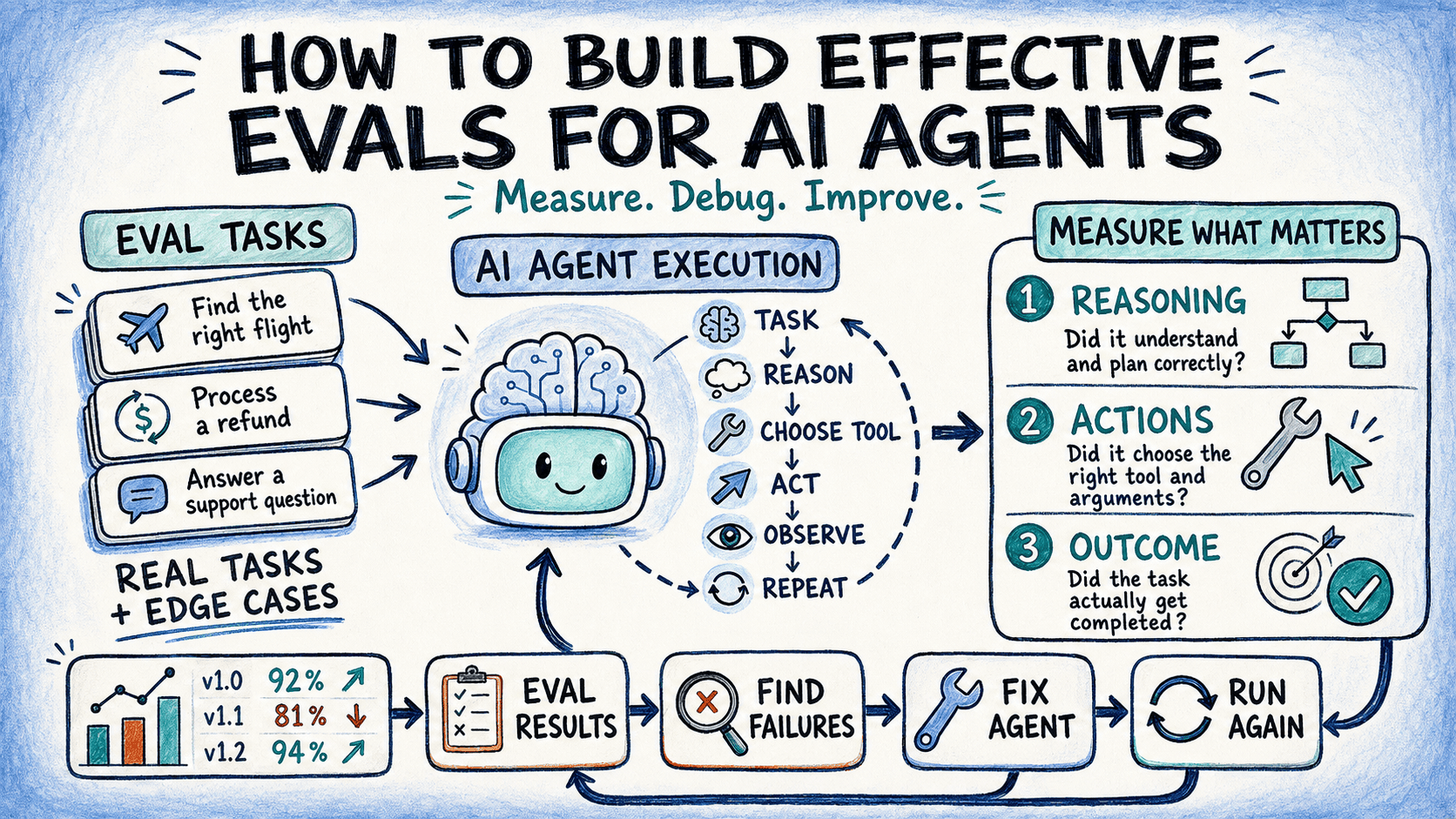
Defining the Core Challenge: Evaluating AI Agents
As AI agents become more sophisticated and autonomous, the need for rigorous evaluation methods intensifies. Unlike traditional software, where bugs are often deterministic and inputs/outputs clearly defined, AI agents operate in a more fluid and probabilistic landscape. Their performance can vary based on subtle prompt changes, environmental factors, or internal state. This inherent variability makes traditional testing insufficient. Effective evaluation is not just about checking if an agent *can* perform a task, but *how well* it performs it, under what conditions, and with what level of reliability. This means moving beyond simple pass/fail metrics to nuanced assessments of quality, safety, and efficiency.
The core challenge lies in creating evaluation frameworks that are both comprehensive and scalable. We need to ensure that an agent's performance on a limited set of test cases generalizes to its behavior in the real world. This requires careful design of tasks, thoughtful selection of evaluation criteria, and robust mechanisms for collecting and analyzing results. The goal is to build confidence in agent capabilities before deployment, identify areas for improvement, and track progress over time. This process is critical for any organization looking to leverage AI agents for complex, real-world applications.
Designing Effective Tasks for Agent Evaluation
The foundation of any effective AI agent evaluation is the task design. Tasks must be clearly defined, specific, and measurable. Ambiguity in task definition will inevitably lead to ambiguity in evaluation results. Think of it less like giving a vague instruction to a human assistant and more like writing a precise unit test for a piece of code. Each task should have a clear objective and a set of expected outcomes, even if those outcomes are qualitative rather than strictly quantitative.
When designing tasks, consider the following:
- Specificity: Avoid open-ended prompts. Instead of asking an agent to "research a topic," define the scope, the desired output format, and the key information points to be included. For example, "Research the market trends for sustainable packaging in the food industry for Q3 2023, summarizing key findings in a bulleted list of no more than 10 points."
- Complexity: Tasks should reflect the complexity of real-world scenarios the agent is intended to handle. This might involve multi-step processes, decision-making under uncertainty, or interaction with external tools and APIs. A single-turn question-answering task won't reveal an agent's ability to manage a long-term project.
- Variability: Include a diverse set of tasks that cover different aspects of the agent's intended functionality. This includes testing not only its primary capabilities but also its robustness, its ability to handle edge cases, and its safety protocols. For instance, if an agent is meant to book travel, test it with standard requests, requests with specific constraints (e.g., budget, specific airlines), and even nonsensical or impossible requests to gauge error handling.
- Measurability: Define clear criteria for success *before* you start evaluating. What does a good outcome look like? This might involve accuracy, completeness, adherence to constraints, efficiency (time taken, resources used), or even subjective qualities like helpfulness or politeness, depending on the agent's purpose.
Choosing the Right Graders for Evaluation
Once tasks are defined, the next crucial step is selecting how to grade the agent's performance. This is where the human element often becomes indispensable, especially for nuanced tasks where objective metrics fall short. The choice of grader depends heavily on the nature of the task and the desired evaluation depth.
Human Graders
Human graders offer the highest fidelity for subjective assessments. They can understand context, nuance, and intent in ways that automated systems currently struggle with. However, human grading is expensive, slow, and can suffer from inconsistency. To mitigate these issues:
- Develop Clear Rubrics: Provide graders with detailed guidelines and rubrics that outline specific criteria for scoring. This ensures that evaluations are as objective and consistent as possible across different graders.
- Train Graders: Invest time in training your human graders to ensure they understand the tasks, the scoring criteria, and the nuances of AI agent behavior.
- Use Multiple Graders: For critical evaluations, employ multiple human graders for the same task and average their scores or use a consensus mechanism to reduce individual bias.
Automated Graders
Automated grading is essential for scalability and speed, especially when dealing with large volumes of evaluations. This can involve:
- Rule-Based Checks: For tasks with clear, objective success criteria (e.g., did the agent extract a specific piece of information correctly? Did it adhere to a length constraint?), simple scripts can perform checks.
- Model-Based Evaluation: More advanced techniques involve using another AI model (often a large language model) to assess the output of the agent. This requires careful prompt engineering for the grading model and validation to ensure its assessments align with human judgment. For example, you could prompt an LLM to act as a "strict but fair reviewer" and score an agent's response based on a provided rubric.
The surprising detail here is not the complexity of automated grading, but the emergence of