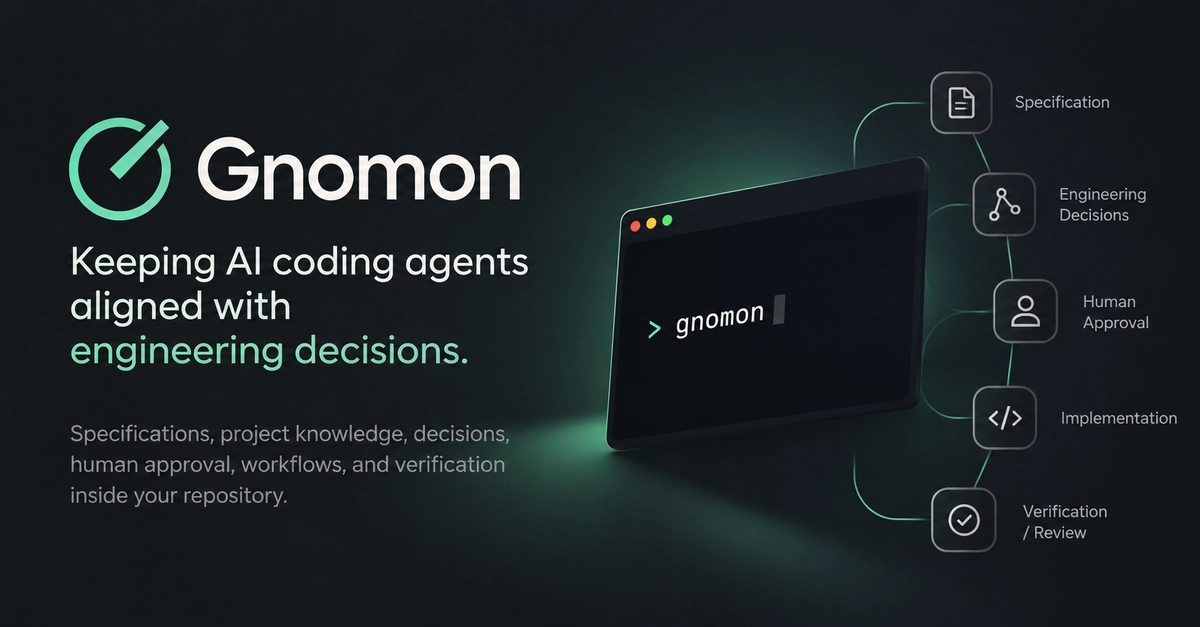
The Illusion of Understanding
AI coding agents have rapidly evolved, demonstrating an impressive ability to parse codebases and implement changes. Tools like GitHub Copilot and others can generate functional code snippets, refactor existing logic, and even suggest architectural modifications. This progress has led many to believe that the primary challenge in AI-assisted development lies in the agent's ability to generate correct and efficient code. However, as these agents are integrated into longer-lived, complex projects, a more profound limitation emerges: the inability to preserve the nuanced engineering context that underpins code decisions.
The code itself might persist across agent sessions, but the critical reasoning behind its creation often vanishes. An AI agent can identify a validation rule, for instance, but it struggles to discern whether that rule was born from a specific customer requirement, a deliberate architectural choice, a security mandate, or merely an assumption made by a previous agent during an earlier development phase. This distinction is not trivial; it is the bedrock of maintainable, scalable, and robust software engineering. Without it, AI-generated code risks becoming a black box, difficult to update, debug, or integrate with future development efforts.
Beyond Context Length: The Reasoning Gap
Initially, developers might attribute this gap to simple context limitations. The agent's window for processing information might be too small, leading it to forget crucial details between interactions. The intuitive solution appears to be providing more data: better prompts, larger project instruction files, or feeding the agent extensive documentation at the start of each session. While these tactics can offer marginal improvements, they fundamentally miss the core issue. The problem is not merely one of information recall or data volume; it is a deficit in understanding and retaining the *purpose* and *history* of engineering decisions.
Consider a scenario where an agent implements a performance optimization. A human engineer would understand if this optimization was a response to a recent spike in user traffic, a proactive measure based on predicted growth, or a trade-off to simplify a complex algorithm. An AI agent, however, might simply see the code change and replicate it, or even revert it if it conflicts with other, superficially more prominent, code patterns. It lacks the capacity to weigh the long-term strategic implications against immediate operational concerns, or to understand the organizational priorities that shaped those decisions.
This lack of retained context means that an AI agent operating in session N might undo or contradict decisions made in session N-1, not because the new code is technically incorrect, but because the agent has no memory of the *why* that guided the previous change. This leads to a frustrating cycle where developers spend more time correcting the AI's well-intentioned but contextually blind interventions than they save by its code generation capabilities.
The Unanswered Question: How Do We Build Persistent AI Memory?
The core challenge, therefore, shifts from teaching AI to write code to teaching it to understand and retain the principles of engineering judgment. How do we imbue AI coding agents with a persistent memory of architectural decisions, requirement justifications, and the trade-offs accepted by human teams? This is not a problem that can be solved by simply increasing token limits or refining prompt engineering. It requires a fundamental rethinking of how AI agents interact with and learn from the software development lifecycle.
One potential avenue is the development of explicit knowledge graphs or semantic layers that map code artifacts to their underlying design rationales, requirements, and team discussions. Imagine an agent that doesn't just see a function, but also sees metadata linking it to a Jira ticket, a Slack conversation about its implementation, and a decision log entry justifying its existence. This would allow the agent to access not just the code, but the context that makes the code meaningful. Such systems would need to be actively maintained, perhaps by humans flagging key decisions or by AI tools inferring them, creating a shared, persistent understanding.
Another approach could involve developing AI models that are specifically trained to reason about software evolution and decision-making. Instead of focusing solely on code generation, these models would need to prioritize understanding the *state* of an engineering project – its goals, constraints, and history – and use that understanding to guide their actions. This could involve multi-agent systems where one agent focuses on code generation and another on context management and validation, ensuring that new code aligns with established engineering principles.
The Cost of Lost Context
The implications of this context retention problem are significant for the future of AI in software development. If AI agents can only operate effectively in short, isolated sessions, their utility for complex, long-term projects diminishes. Developers will continue to be the primary guardians of engineering knowledge, using AI as a sophisticated autocomplete rather than a true development partner. This limits the potential for AI to accelerate large-scale refactoring, complex feature development, or the maintenance of legacy systems.
For founders, this means that the promised productivity gains from AI coding agents may not materialize as quickly or as broadly as anticipated for teams working on substantial codebases. The return on investment for these tools might be higher for small scripts or isolated tasks than for core product development. It also raises questions about the long-term maintainability of AI-assisted projects: if the engineering rationale is lost, who will be able to effectively manage and evolve the codebase in the future?
Ultimately, the true value of AI coding agents will be unlocked not when they can write code flawlessly, but when they can understand and respect the intricate web of decisions that define a software project. Until we solve the problem of preserving engineering context, AI will remain a powerful assistant, but not yet a fully integrated member of the engineering team.