AI Code Assistants Struggle with Project Context
AI coding assistants, trained on vast open-source datasets, often exhibit misplaced confidence. They might suggest a code change to the first file that appears to match a function name or directory structure, even when the critical logic resides elsewhere. This tendency stems from a fundamental lack of understanding about how different parts of an application connect. Researchers Sergeyuk, Golubev, Bryksin, and Ahmed identified this issue in 2024, noting that developers frequently complain about inaccurate suggestions and weak project comprehension from these tools. The core problem is that AI models, while adept at pattern matching, fail to grasp the intricate relationships and dependencies within a specific codebase. They see a file name and make an educated guess, presenting it with the same certainty as if they were working with a simple, isolated code snippet.
This limitation means that AI assistants are more commonly used for generating boilerplate code or summarizing existing functions, rather than for complex tasks like pinpointing the exact location for a modification that spans multiple files. The confidence with which these tools propose edits, often to the wrong files, can lead to wasted developer time and introduce subtle bugs. The AI treats each suggested edit as an independent event, unaware of the cascading effects or the specific user workflow it is meant to support.
Introducing the 'Code Tour' Concept
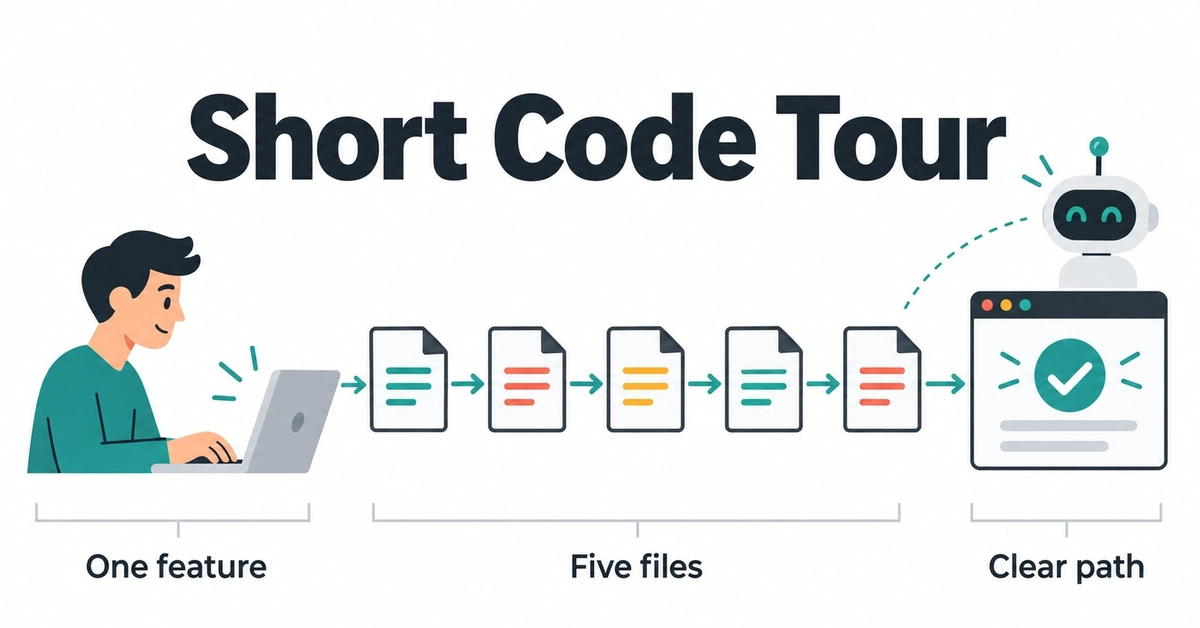
To address this gap in contextual understanding, researchers propose the concept of a 'code tour.' A code tour is essentially a guided walkthrough of a specific user action or feature from its initiation to its completion. By tracing a visible feature through the sequence of files and functions it interacts with, a code tour provides the AI assistant with the necessary project context. This context allows the AI to move beyond simple pattern matching and understand the flow of execution and data within the application.
Imagine a user wanting to change the color of a button on a website. Without a code tour, an AI might suggest changes to a generic CSS file or a component file that *looks* like it handles buttons. With a code tour, the AI would be shown the exact path: the user clicks the button (event handler), this triggers a state change (state management file), which then calls a rendering function (UI component file), and finally, the styling is applied (specific style file or component prop). This step-by-step traversal, even if short, imbues the AI with a critical understanding of the feature's architecture.
How Code Tours Enhance AI Assistance
The effectiveness of code tours lies in their ability to create a focused, linear narrative of code execution. Instead of the AI having to infer relationships from the entire codebase, it receives a curated path. This is analogous to giving a new employee a detailed onboarding manual for a single, critical task rather than just handing them the entire company directory. The manual guides them through the specific steps, stakeholders, and documentation relevant to that one job.
This approach directly tackles the common complaints about AI coding assistants: inaccurate suggestions, weak understanding of project structure, and overconfidence in incorrect guesses. By providing a clear, sequential trace of a feature's implementation, code tours equip AI models with the specific knowledge needed to navigate complex, interconnected codebases. This enables AI to offer more precise suggestions, understand the implications of changes, and avoid the pitfalls of superficial file matching.
The research suggests that even a 'short' code tour, focusing on a single, well-defined feature, can significantly improve an AI's ability to locate relevant code and suggest meaningful modifications. This is particularly valuable for large, legacy codebases where interdependencies can be obscure and difficult to map manually. For developers, this means less time spent correcting AI errors and more time leveraging AI for productive tasks like refactoring, debugging, and implementing new features with greater accuracy and speed.
Implications for Developers and AI Tooling
The concept of code tours has significant implications for the future of AI-assisted software development. It shifts the paradigm from AI as a code generator to AI as an intelligent collaborator that understands project-specific logic. This requires a new generation of AI tools and IDE integrations that can either automatically generate these tours or allow developers to easily define them.
For developers, the immediate benefit is more reliable AI assistance. When an AI can accurately pinpoint the correct files for a modification, it becomes a trusted partner rather than a source of frustration. This could democratize complex coding tasks, making them more accessible to junior developers or those working in unfamiliar codebases. Furthermore, by understanding code flow, AI could eventually assist in automated testing, refactoring complex modules, and even identifying potential performance bottlenecks based on execution paths.
The development of effective code tour mechanisms will likely involve sophisticated program analysis techniques, potentially combined with user-provided annotations or explicit feature definitions. The challenge lies in making this process seamless and non-intrusive for the developer. If defining a code tour becomes as complex as making the code change itself, the benefit is lost. The goal is to create tools that can either infer these tours from common usage patterns or offer simple, intuitive ways for developers to guide the AI's understanding of their project's critical workflows.