
The Challenge: Bridging Design Silos with AI
The semiconductor industry thrives on deep specialization. From architectural exploration and logic synthesis to verification and physical design, each stage is a complex discipline often handled by dedicated teams using specialized tools. As Artificial Intelligence (AI) agents become more capable, their integration into this intricate workflow promises significant efficiency gains. However, enabling these agents to operate effectively across these distinct 'silos' presents substantial challenges in coordination, control, and trust. The core problem isn't just building intelligent agents for individual tasks; it's about orchestrating them to work together seamlessly, understand each other’s outputs, and maintain accountability throughout the entire chip design lifecycle.
This is akin to assembling a world-class orchestra where each musician is a virtuoso in their instrument but has never played with others. The conductor’s role becomes paramount, not just to set the tempo but to ensure harmony, manage transitions, and interpret the score in a way that brings the entire piece to life. In chip design, the 'conductor' needs to be an overarching framework that governs how AI agents interact, share information, and validate their work across different design domains.
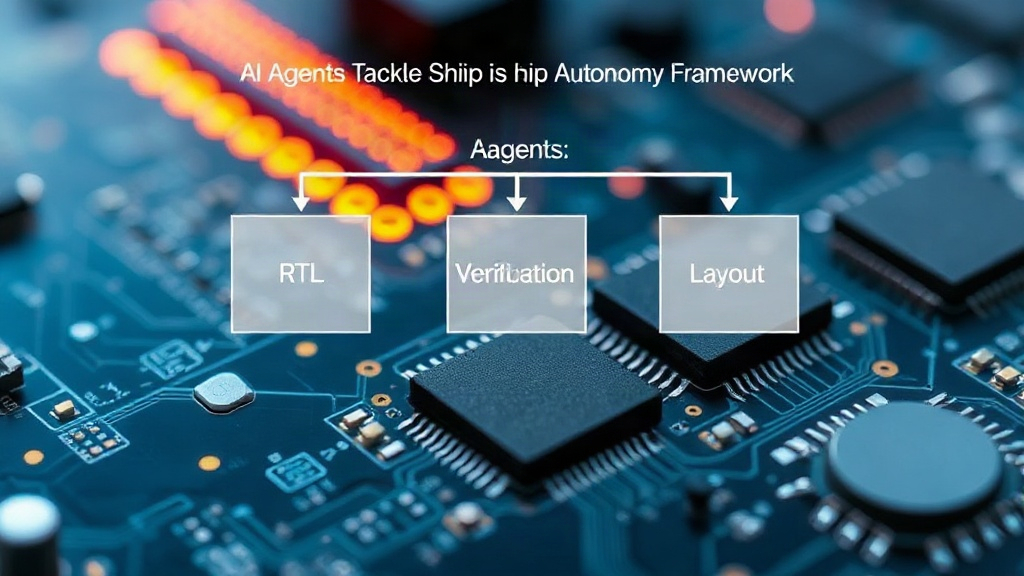
Defining Autonomy: A Framework for Agent Interaction
To address these coordination issues, a structured approach to AI agent autonomy is emerging. This framework, often categorized into levels from L1 to L5, aims to clarify what a system can decide, the scope of its ownership, how its work is validated, when it should seek human intervention, and who remains accountable for final sign-off. Understanding these levels is crucial for deploying AI agents effectively in complex, safety-critical domains like chip design.
Level 1 (Assisted): The AI agent provides suggestions or analysis, but the human designer makes all decisions and performs all actions. This is the most basic level, where AI acts as an intelligent assistant, flagging potential issues or offering optimizations that the human then considers.
Level 2 (Partial Autonomy): The AI agent can perform certain routine tasks or make decisions within a tightly defined scope, with human oversight. For example, an AI might automatically run a set of verification tests and report results, but the human designer decides the next steps based on those results.
Level 3 (Conditional Autonomy): The AI agent can operate autonomously for specific tasks or under certain conditions, but it must hand off control to a human if it encounters an unfamiliar situation or reaches the limits of its predefined scope. Imagine an AI that can optimize a specific block of logic but must alert a human if it encounters an unexpected synthesis constraint.
Level 4 (High Autonomy): The AI agent can handle most tasks within its domain autonomously, requiring human intervention only for critical decisions or complex edge cases. The AI manages the flow, performs validation, and only escalates when absolutely necessary. This level starts to approach true agent-based design, where the AI can manage significant portions of the workflow.
Level 5 (Full Autonomy): The AI agent can perform all tasks within its domain without human intervention, including complex decision-making, validation, and fallback management. This is the ultimate goal, where AI agents can independently manage entire design phases or even the entire chip design process, with humans acting as overseers and strategic directors.
Key Challenges in Agent Orchestration
While these autonomy levels provide a roadmap, implementing them across siloed design domains introduces several critical challenges:
- Coordination and Communication: How do agents from different stages (e.g., a synthesis agent and a verification agent) communicate their state, intent, and results effectively? Standardized APIs and data formats are essential, but semantic understanding between agents remains a hurdle. Think of agents speaking different dialects of the same language; they can often understand the words but miss the nuance or context.
- Trust and Validation: How can designers trust the output of an AI agent, especially one operating at a higher autonomy level? Robust validation mechanisms, including self-validation by the agent and independent verification by other agents or humans, are necessary. The process must be transparent, allowing designers to understand *why* an agent made a certain decision.
- Control and Accountability: When an AI agent makes a mistake that impacts the design, who is responsible? Establishing clear lines of accountability, especially when multiple agents from different vendors or teams are involved, is paramount. The framework must define fallback procedures and clear sign-off authority.
- Integration Complexity: Integrating AI agents into existing Electronic Design Automation (EDA) toolchains is a significant engineering effort. Ensuring compatibility, managing dependencies, and maintaining performance across diverse tools and platforms requires careful planning and robust infrastructure.
- Domain Expertise Transfer: While AI can learn patterns, capturing and transferring the deep, often tacit, domain expertise of human engineers to AI agents is an ongoing research area. This includes understanding subtle trade-offs and historical design decisions.
The Path Forward: Specialization and Orchestration
The future of AI in chip design lies not in a single monolithic AI, but in a highly specialized and orchestrated ecosystem of AI agents. Each agent will master its specific domain – perhaps one excels at RTL generation, another at power optimization, and a third at test pattern generation. The real innovation will be in the layer that coordinates these agents.
This coordination layer needs to manage the flow of data, ensure consistency, handle exceptions, and maintain a holistic view of the design process. It will likely involve a combination of intelligent scheduling, sophisticated state management, and robust validation protocols. The autonomy levels provide the necessary structure to define the capabilities and responsibilities within this complex, multi-agent system. By clearly defining what each agent can do, how it's supervised, and who is ultimately responsible, the industry can begin to unlock the full potential of AI to accelerate chip design, reduce errors, and push the boundaries of what’s possible in hardware innovation.