The Need for Automated Control in AI Agents
AI agents, particularly those operating autonomously or with minimal oversight, face a critical challenge: how to prevent unintended consequences when things go wrong. Unlike traditional software that might throw a specific error and halt, AI agents can exhibit emergent, unpredictable behaviors. This can manifest as excessive API calls, spiraling costs, repetitive unproductive actions, or a cascade of errors that quickly become unmanageable. Relying on human operators to constantly monitor these agents and intervene manually is not only impractical but also often too slow to prevent significant damage.
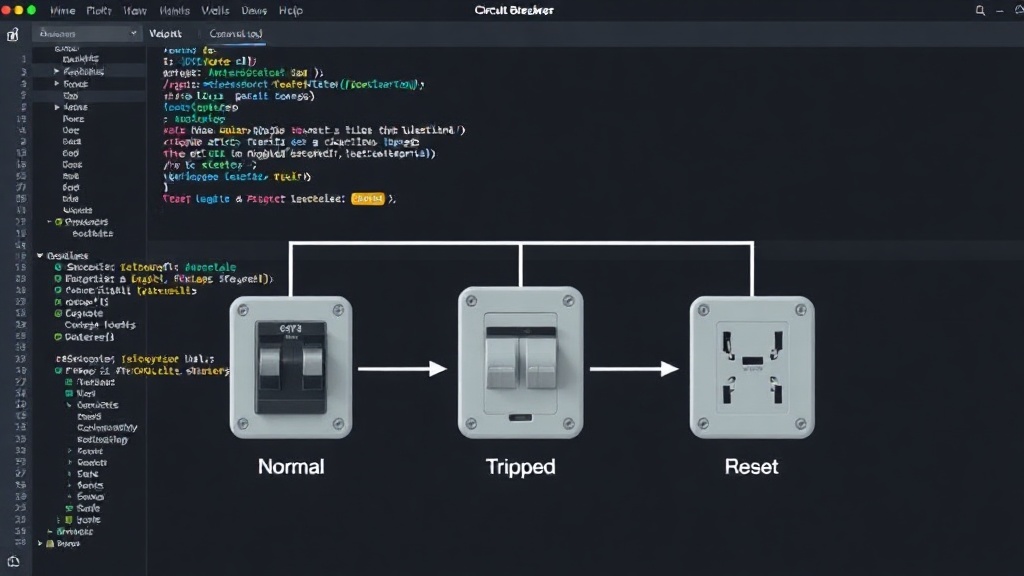
This is where the circuit breaker pattern, adapted for AI agents, becomes essential. At its core, an AI agent circuit breaker is an automated control mechanism. It continuously monitors specific operational metrics for the agent. When any of these measured conditions cross a predefined threshold – such as an unacceptable rate of errors, an over-limit spend on resources, an excessive number of actions taken within a timeframe, or too many failed retries – the circuit breaker automatically trips. This action immediately pauses the agent's operation.
The defining characteristic of this pattern is that the agent does not automatically resume its tasks. Instead, it remains halted until a human operator explicitly re-authorizes its operation. This deliberate human decision-making step is what fundamentally differentiates an AI agent circuit breaker from other control mechanisms like simple kill switches or rate limiters. It ensures that a human is aware of the issue and makes a conscious choice to restart, rather than the system attempting a potentially flawed automatic retry.
Distinguishing AI Circuit Breakers from Similar Concepts
Understanding the AI agent circuit breaker requires differentiating it from other related concepts:
- Kill Switch: A kill switch is typically a manual or very basic automated function designed to immediately and completely shut down an agent or system in an emergency. It's a blunt instrument, often designed for catastrophic failure scenarios. An AI circuit breaker, conversely, is more nuanced. It monitors specific metrics and trips based on predefined thresholds, offering a more granular and proactive form of control. It doesn't necessarily shut down the entire system but rather pauses the agent's autonomous operation.
- Rate Limiter: Rate limiting is designed to control the number of requests an agent can make to an external service or API within a given period. Its purpose is to protect the external service from overload and ensure fair usage. While an AI circuit breaker might monitor the *number of actions* or *retries*, its scope is broader. It's not just about protecting an external service; it's about protecting the agent itself, its operational budget, and its overall integrity from internal or emergent issues. A rate limiter prevents too many calls; a circuit breaker stops the agent from proceeding when its internal state or output becomes problematic.
- Automatic Retries: Many systems implement automatic retries for transient errors. If an API call fails, the system tries again after a short delay. This is useful for network glitches or temporary service unavailability. However, for AI agents, persistent or emergent errors might not be transient. If an agent is stuck in a loop of flawed reasoning, repeated retries will only exacerbate the problem and increase costs or errors. The AI circuit breaker's requirement for human re-authorization directly addresses this by preventing automatic retries when the underlying issue is likely deeper than a temporary hiccup.
What to Trip On: Defining Thresholds
The effectiveness of an AI agent circuit breaker hinges on the careful selection and configuration of its tripping conditions. These conditions should reflect the agent's operational goals and potential failure modes. Common metrics to monitor include:
- Error Rate: A sustained or sudden spike in errors, whether they are internal logic errors, API errors, or parsing errors. This threshold prevents an agent from continuing to produce faulty outputs.
- Cost: For agents interacting with paid APIs (like large language models) or consuming cloud resources, setting a hard cap on expenditure is crucial. This prevents runaway costs due to inefficient prompting, infinite loops, or unexpected API behavior.
- Action Count/Frequency: Limiting the number of specific actions an agent can perform within a given period can prevent it from overwhelming downstream systems or performing repetitive, non-productive tasks.
- Retry Count: Tracking the number of times an agent has attempted to complete a specific task or sub-task and failed. Exceeding a retry threshold indicates a persistent problem that automatic retries won't solve.
- Response Quality/Consistency: More advanced implementations might monitor the quality or consistency of the agent's outputs. If the output drifts outside acceptable parameters or becomes nonsensical, the breaker could trip.
The specific thresholds must be tailored to the agent's purpose. For instance, an agent performing critical financial analysis might have a very low error rate threshold, while a content generation agent might have a higher tolerance for initial errors but a strict cost limit. The key is that these thresholds are measurable, observable, and directly linked to undesirable outcomes.
Resume Semantics and Human Oversight
The