Understanding ACME Challenge Mechanisms
Automated TLS certificate issuance, powered by protocols like ACME (Automated Certificate Management Environment), simplifies certificate renewal. From an external perspective, it appears straightforward: an ACME client requests a certificate, a Certificate Authority (CA) issues a challenge, the client proves domain control, and the CA issues the certificate. This automation eliminates the need for manual CSR generation, file uploads, and certificate downloads.
The core engineering challenge lies in the verification process. A CA cannot simply trust a client's assertion of domain ownership. It requires independently verifiable proof that the requester controls the specific domain (or identifier) for which the certificate is sought. ACME provides several challenge mechanisms to establish this control, with the HTTP-01 and DNS-01 challenges being the most prevalent.
The HTTP-01 Challenge Explained
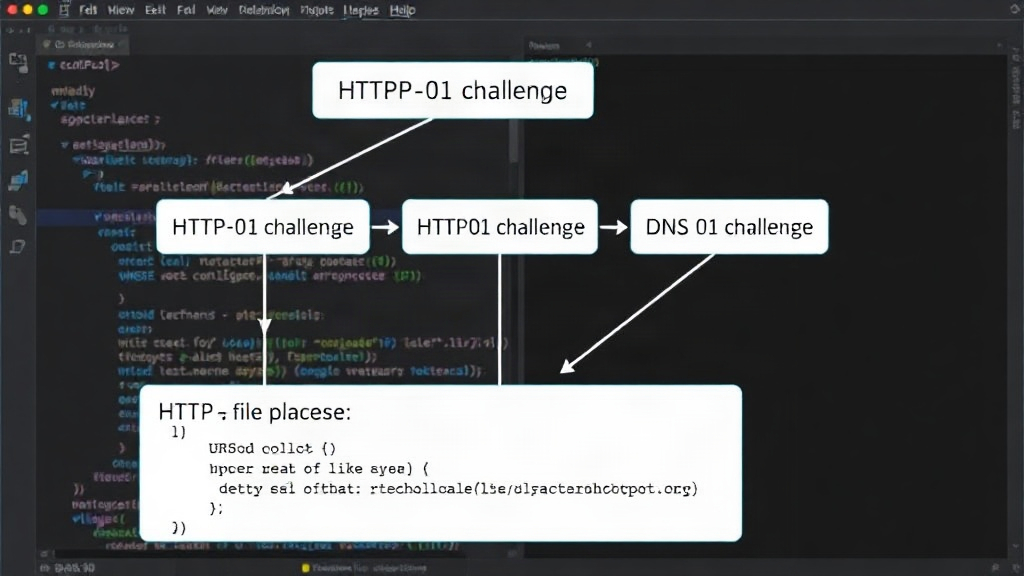
The HTTP-01 challenge is designed to verify domain control by requiring the ACME client to place a specific file on a web server accessible at the domain in question. This file contains a unique token generated by the CA and a corresponding key authorization. The CA then attempts to retrieve this file by making an HTTP request to a predictable URL on the domain's web server. If the CA can successfully retrieve the file and verify its contents, it confirms that the client has control over the web server hosting the domain.
The process typically unfolds as follows:
- The ACME client requests a certificate for a specific domain (e.g.,
www.example.com). - The CA generates a unique token and a key authorization for this request.
- The CA constructs a URL:
http://www.example.com/.well-known/acme-challenge/TOKEN, whereTOKENis the unique identifier. - The ACME client, running on a server that controls
www.example.com, must place a file at this exact location. The file's content must beTOKEN.KEY_AUTHORIZATION. - The CA then makes an HTTP GET request to this URL.
- If the CA receives the correct content (
TOKEN.KEY_AUTHORIZATION) from the server, the challenge is satisfied.
This mechanism is conceptually simple and relies on the standard HTTP protocol. However, it requires the ACME client to have write access to the web server's document root for the domain. This can be a hurdle for users who do not manage their own web servers or who use services that abstract away direct file system access. Furthermore, the challenge is only valid for a short period, typically 24 hours, and must be completed within that window.
The DNS-01 Challenge Explained
The DNS-01 challenge offers an alternative verification method that bypasses the need for direct web server access. Instead, it leverages control over the domain's DNS records. The ACME client must create a specific TXT record in the domain's DNS zone. This TXT record contains a unique token and key authorization, similar to the HTTP-01 challenge, but formatted for DNS.
The steps for a DNS-01 challenge are:
- The ACME client requests a certificate for a domain (e.g.,
example.com). - The CA generates a token and key authorization.
- The CA constructs a DNS TXT record name:
_acme-challenge.example.com. - The ACME client must create a TXT record with the hostname
_acme-challenge.example.comand the valueTOKEN.KEY_AUTHORIZATION. - The CA then queries DNS for this specific TXT record.
- If the CA successfully resolves the TXT record and verifies its content, the challenge is satisfied.
The primary advantage of the DNS-01 challenge is its flexibility. It does not require direct access to a web server. Any entity that can manage the domain's DNS records can satisfy this challenge. This is particularly useful for wildcard certificates (e.g., *.example.com), as a single TXT record can validate all subdomains. It's also beneficial for users whose domains are hosted on platforms where direct file uploads are not feasible or allowed. The main drawback is that DNS propagation can take time, and the challenge must be resolved within the CA's validation window, which can sometimes be tight depending on DNS TTLs.
Comparing HTTP-01 and DNS-01
Both HTTP-01 and DNS-01 challenges serve the same fundamental purpose: to prove control over a domain. However, they differ significantly in their implementation and requirements. The HTTP-01 challenge is generally simpler to implement for clients that have direct control over their web servers. It relies on universally accessible HTTP and does not require special DNS configurations. The main constraint is the need for web server write access and the ability to serve content over HTTP.
The DNS-01 challenge offers a broader reach, especially for complex hosting environments or when wildcard certificates are needed. It delegates the proof of control to the DNS infrastructure, which is often managed separately from the web hosting. This separation can be an advantage in distributed or managed hosting scenarios. However, it introduces a dependency on DNS propagation times and the client's ability to automate DNS record creation, which can sometimes be more complex than configuring a web server.
The choice between these two mechanisms often depends on the specific infrastructure and operational capabilities of the ACME client and the domain owner. Many ACME clients support both methods, allowing users to select the most appropriate option for their environment. The underlying principle remains consistent: verifiable proof of control is paramount for automated TLS certificate issuance.
The Broader ACME Ecosystem
These challenges are just one part of the ACME protocol. Beyond validation, ACME defines mechanisms for certificate ordering, renewal, and revocation. The protocol aims to make TLS certificate management as seamless as possible, enabling widespread adoption of HTTPS and enhanced web security. The success of ACME, particularly with Let's Encrypt, has demonstrated the viability of automated certificate management at scale. The internal workings of these challenges, though technical, are critical to the trust and security that the system provides.
What remains an open question is how ACME implementations will adapt to emerging domain control verification methods or evolving DNS technologies, such as DNSSEC validation, to further bolster the security and resilience of the certificate issuance process. As the digital landscape shifts, so too must the foundational mechanisms that secure it.