
AI Models•Jul 13, 02:55 AM
VoltMem: LLM Agent Memory Layer Tackles Stale Data Problem
Developer creates VoltMem, a memory layer for LLM agents that distinguishes volatile facts from stable beliefs to improve agent reliability.
Share:

Five shifts. Five minutes. No noise.
No spam. Unsubscribe anytime. Powered by Beehiiv.
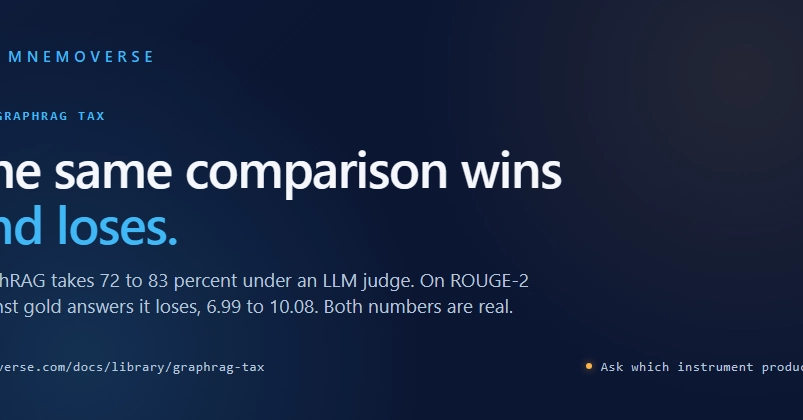
New research reveals GraphRAG's effectiveness depends entirely on whether it's judged by an LLM or against ground truth.
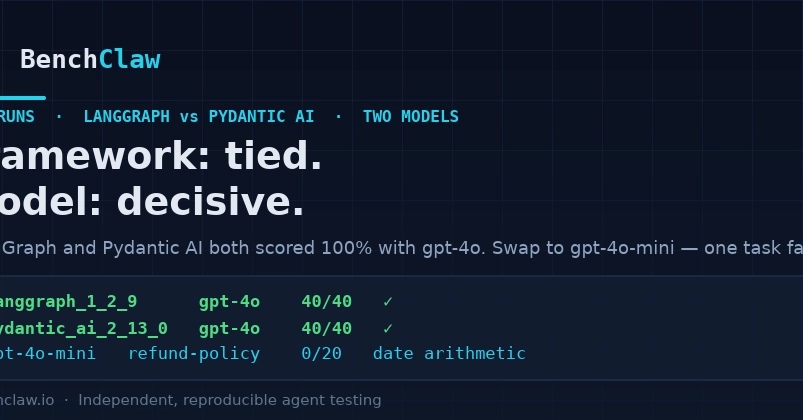
A controlled benchmark reveals LangGraph and Pydantic AI perform identically, but changing the underlying LLM exposes critical task failures.

The influential Linux distribution has formally adopted a policy allowing the responsible integration of generative AI tools.
Developer creates VoltMem, a memory layer for LLM agents that distinguishes volatile facts from stable beliefs to improve agent reliability.

A production AI agent saw dramatic performance and cost improvements after a strategic migration to OpenAI's latest model.

Beyond basic vector similarity, metadata filtering and reranking significantly speed up and refine Retrieval Augmented Generation responses.

A developer built an AI agent that leverages Claude's tool-use capabilities in a simple loop to perform complex tasks.

SaaStr's Jason Lemkin dissects OpenAI's government stake idea, the end of 'block risk,' and why frontier AI models are surprisingly affordable.

AI fluency means understanding agent evals. Here's how to choose and implement them for dependable AI.

Researchers propose a novel framework to decode the complex reasoning processes within large language models, moving beyond black-box analysis.

A subtle research bias is leading AI models to achieve superficial wins while ignoring deeper, more complex problems.

Achieving 60 FPS video segmentation on Android demands ruthless optimization within a 16.67ms window.

Developer creates 'FanForge' to score live event excitement and reward superfans, proving passion is a universal metric.