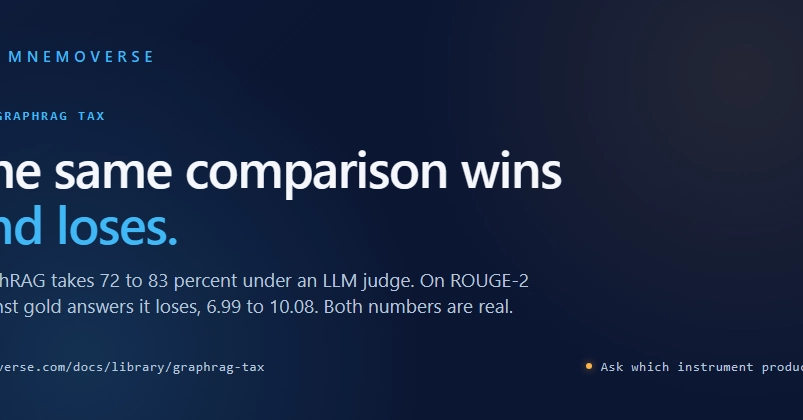
The Ambiguity of GraphRAG Benchmarks
The rapid advancement of retrieval-augmented generation (RAG) techniques, particularly GraphRAG, has spurred a race to quantify their performance. However, a critical examination of recent findings reveals a significant dependency: the reported success of GraphRAG hinges entirely on the evaluation instrument used. This isn't a subtle nuance; it's a fundamental challenge that could be misdirecting development and adoption efforts.
The core of the issue lies in how comparisons are made. When GraphRAG is evaluated using community-generated summaries and an LLM judge—a common practice in some benchmarks—it appears to excel. These evaluations, as cited from arXiv:2404.16130, show GraphRAG achieving impressive comprehensiveness (72-83%) and diversity (62-82%) win rates for breadth-oriented sensemaking questions. Furthermore, the technique demonstrates a remarkable ability to reduce answer token count by approximately 97% when employing root-level summaries. These figures paint a picture of a highly efficient and effective system, numbers that are frequently quoted in discussions about the technology's capabilities.
The scenario changes dramatically when GraphRAG is measured against a more rigorous standard: ground truth data. When subjected to ROUGE-2 evaluation against established gold answers, the narrative shifts. The same research indicates that GraphRAG actually underperforms standard RAG. On the SQuALITY benchmark, GraphRAG scores 6.99, significantly lower than RAG's 10.08. Similarly, on the QMSum dataset, GraphRAG achieves a score of 3.23, trailing RAG's 6.32. This stark contrast suggests that the perceived superiority of GraphRAG in the initial evaluations might be an artifact of the judging methodology rather than an inherent advantage in information recall or synthesis accuracy when compared to a definitive correct answer.

The Influence of LLM Judges and Summary Ordering
The discrepancy is further illuminated by research into the biases inherent in LLM judges themselves. Another paper (arXiv:2502.11371) points out that the simple ordering of summaries presented to an LLM judge can significantly influence its preference. This positional bias means that an LLM might favor a summary not because it is objectively better, but because it appeared earlier or later in a sequence, or due to subtle phrasing that aligns with its training data's implicit biases. When GraphRAG's performance is measured by such a judge, it's not just assessing the quality of the retrieved and synthesized information, but also how well that information is presented to a potentially biased arbiter.
This finding raises a critical question for the field: are we accurately measuring the capabilities of GraphRAG, or are we measuring how well GraphRAG plays to the strengths and weaknesses of LLM evaluators? The implications are profound. If the widely cited metrics are derived from LLM judges without ground truth, they may be overstating GraphRAG's real-world efficacy. Developers and researchers relying on these numbers to guide their work could be optimizing for a benchmark that doesn't reflect true performance against factual accuracy.
Re-evaluating RAG Performance Metrics
The practical consequence for developers is clear: simply quoting the impressive LLM-judged scores for GraphRAG is insufficient. A deeper dive into the evaluation methodology is required. When considering GraphRAG for applications, particularly those where factual accuracy is paramount, it's crucial to understand its performance against gold standards, not just against other LLM-generated outputs. This means that developers looking to implement GraphRAG need to be discerning about the benchmarks they trust.
For the broader RAG community, this highlights a persistent challenge in evaluating complex generative systems. The move towards more sophisticated RAG architectures like GraphRAG necessitates equally sophisticated and reliable evaluation frameworks. Relying on simplified or biased metrics can lead to a misleading understanding of progress. The field needs to prioritize evaluations that incorporate ground truth comparison and actively mitigate known biases in automated judging systems. This will ensure that the reported wins and losses for GraphRAG, and indeed for all advanced RAG techniques, reflect genuine advancements in system capabilities rather than clever manipulations of evaluation instruments.
The research underscores that while GraphRAG may offer benefits in areas like breadth and diversity when judged by LLMs, its performance against factual accuracy metrics like ROUGE-2 against gold answers reveals a more complex picture. The community must move towards standardized, ground-truth-based evaluations to foster genuine progress and avoid the pitfalls of self-referential benchmarks.