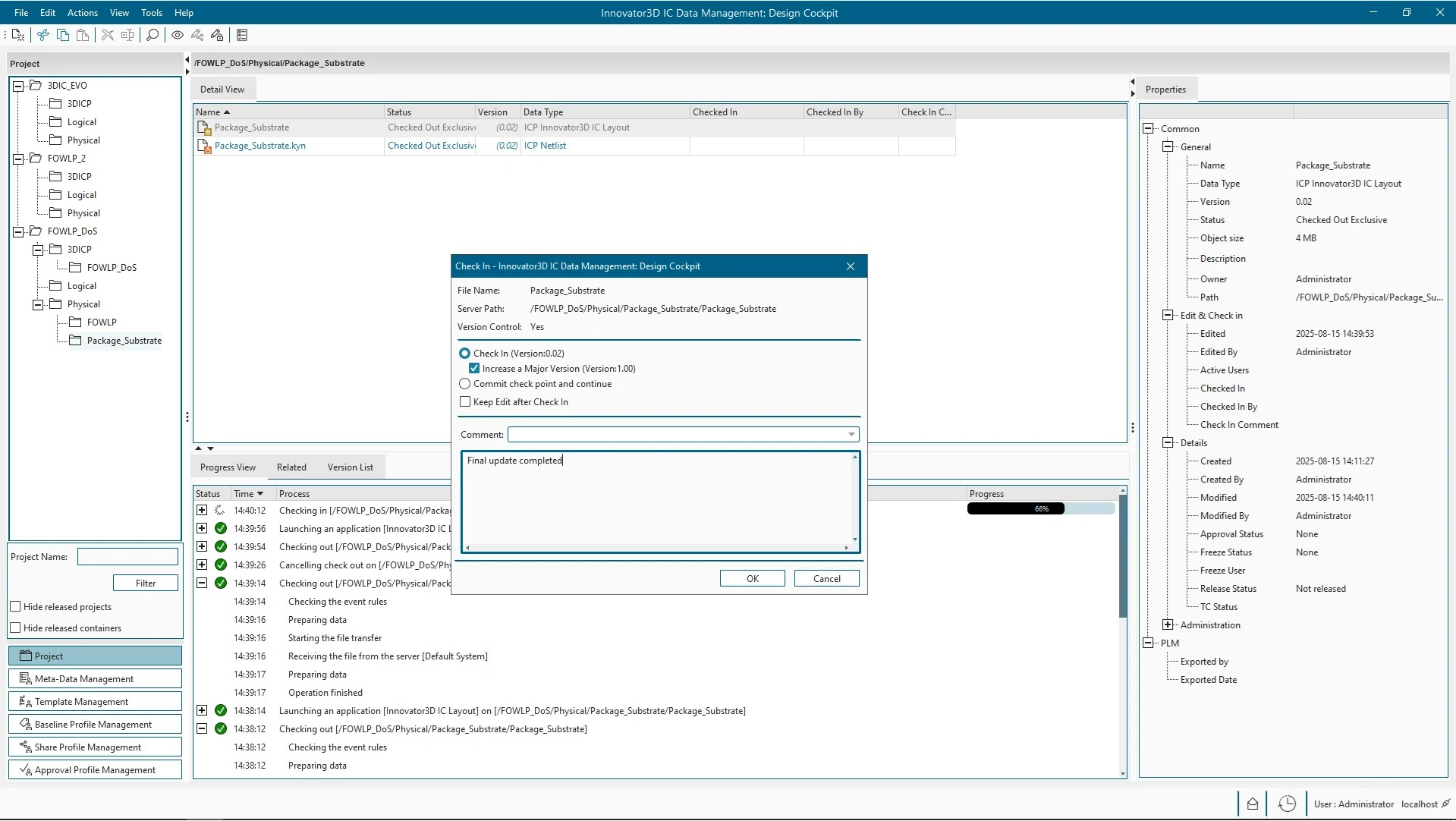
The Challenge of 3D-IC Design Data Management
The burgeoning field of 3D-Integrated Circuits (3D-IC) and heterogeneous integration presents a fundamental challenge: how do we effectively manage the design data, ensure traceability, and maintain robust revision control across multiple, disparate chiplets that form a single, complex system? Unlike traditional monolithic designs where all components reside on a single die, 3D-ICs stack or place multiple chiplets in close proximity, often manufactured by different foundries using various process nodes. This complexity multiplies the demands on design data management (DDM) systems.
The core issue is that a 3D-IC is not just a collection of independent components; it is a single, integrated system where the interdependencies between chiplets are critical. A change in one chiplet's design, its physical layout, or its manufacturing process can have cascading effects on others. Without sophisticated DDM, ensuring that all elements are compatible, that interfaces are correctly implemented, and that the final integrated system functions as intended becomes an almost insurmountable task. This is particularly true as the industry moves towards multi-chiplet designs, where each chiplet might be an independently developed product or sourced from a third-party IP vendor. The traditional DDM tools, often built for single-die designs, struggle to cope with the distributed nature and the sheer volume of data involved.
Ensuring Traceability and Revision Control
Traceability in 3D-IC design is paramount. It means being able to track every piece of IP, every design decision, and every modification back to its origin. For a multi-chiplet design, this involves understanding not only the lineage of each individual chiplet but also how they are interconnected. For instance, if a performance issue arises in the final 3D-IC, engineers need to quickly identify which specific chiplet, which version of its IP, and which design parameter might be the root cause. This requires a DDM system that can link design elements across chiplets, map physical connections to logical ones, and record all changes with precise timestamps and justifications.
Revision control takes on a new dimension. In a monolithic design, a single revision history suffices. In a 3D-IC, multiple chiplets might have their own independent revision histories. The DDM system must then manage the 'system revision' – a snapshot of the entire 3D-IC at a specific point in time, ensuring that all constituent chiplets are compatible and verified together. This prevents the integration of incompatible revisions, a common pitfall in complex, multi-vendor projects. Think of it like managing a complex software project with multiple microservices: you need to know not just the version of each service, but the specific combination of versions that are known to work together. For hardware, the stakes are higher, and the lead times for correction are significantly longer.
Key Components of Effective 3D-IC DDM
Several key aspects define effective DDM for 3D-ICs:
- Unified Data Repository: A central repository that can store and manage design data from all chiplets, regardless of their origin or format. This repository must be capable of handling various file types, including schematics, layout files, netlists, simulation results, and manufacturing data.
- Hierarchical Design Representation: The system needs to represent the 3D-IC design hierarchically, showing how individual chiplets are assembled and interconnected. This allows designers to navigate the complexity and understand the relationships between different parts of the system.
- Version Management for Interdependencies: Beyond simple versioning, the system must understand and manage the interdependencies between chiplet versions. It should enforce rules that prevent the integration of chiplets that are not mutually compatible based on their revision history and interface specifications.
- Automated Traceability Linking: Mechanisms to automatically link design elements, requirements, test cases, and bug reports across chiplets. This automates much of the manual effort currently required to maintain traceability, reducing errors and saving time.
- Collaboration and Access Control: With multiple teams and potentially external vendors involved, robust access control and collaboration features are essential. The DDM system must ensure that only authorized personnel can access or modify specific design data, while facilitating seamless collaboration among authorized users.
The Role of IP Management
Intellectual Property (IP) management is intrinsically linked to DDM in 3D-ICs. Chiplets are often built using pre-designed IP blocks, either developed in-house or licensed from third-party IP providers. When integrating these IP blocks into chiplets, and then integrating those chiplets into a 3D-IC, the management of IP becomes critical. Each IP block has its own set of specifications, design files, and revision history. The DDM system must be able to track which IP versions are used in which chiplets, and how these IP versions interact within the broader 3D-IC context. This is vital for ensuring functional correctness, performance, and for managing licensing agreements.
Furthermore, the interfaces between IP blocks, and between chiplets, are crucial. These interfaces must be standardized and rigorously managed. Any ambiguity or change in an interface specification can lead to integration failures. Therefore, the DDM system should include capabilities to define, verify, and track interface specifications, ensuring that all IP blocks and chiplets adhere to these standards throughout the design cycle. This is akin to defining strict API contracts in software; for hardware, these contracts are physical and electrical, making their management even more stringent.
Future Directions and Tools
The industry is actively developing solutions to address these DDM and IP management challenges. EDA vendors are enhancing their platforms to support heterogeneous integration flows. This includes better support for multi-die packaging, inter-chiplet communication protocols, and advanced DDM capabilities that can handle the complexity of distributed designs. The trend is towards more integrated DDM solutions that are not separate add-ons but are fundamental to the entire electronic design automation (EDA) toolchain. This aims to provide a seamless experience from early-stage design exploration to final manufacturing, ensuring that data integrity and traceability are maintained at every step.
As 3D-IC architectures become more prevalent, the sophistication of DDM and IP management tools will be a key differentiator for semiconductor companies. The ability to efficiently manage the complexity of multi-chiplet designs will directly impact time-to-market, development costs, and the ultimate performance and reliability of the final products. Companies that invest in robust DDM strategies and tools will be better positioned to harness the full potential of heterogeneous integration.