Shrinking Large Multimodal Models for Edge Deployment
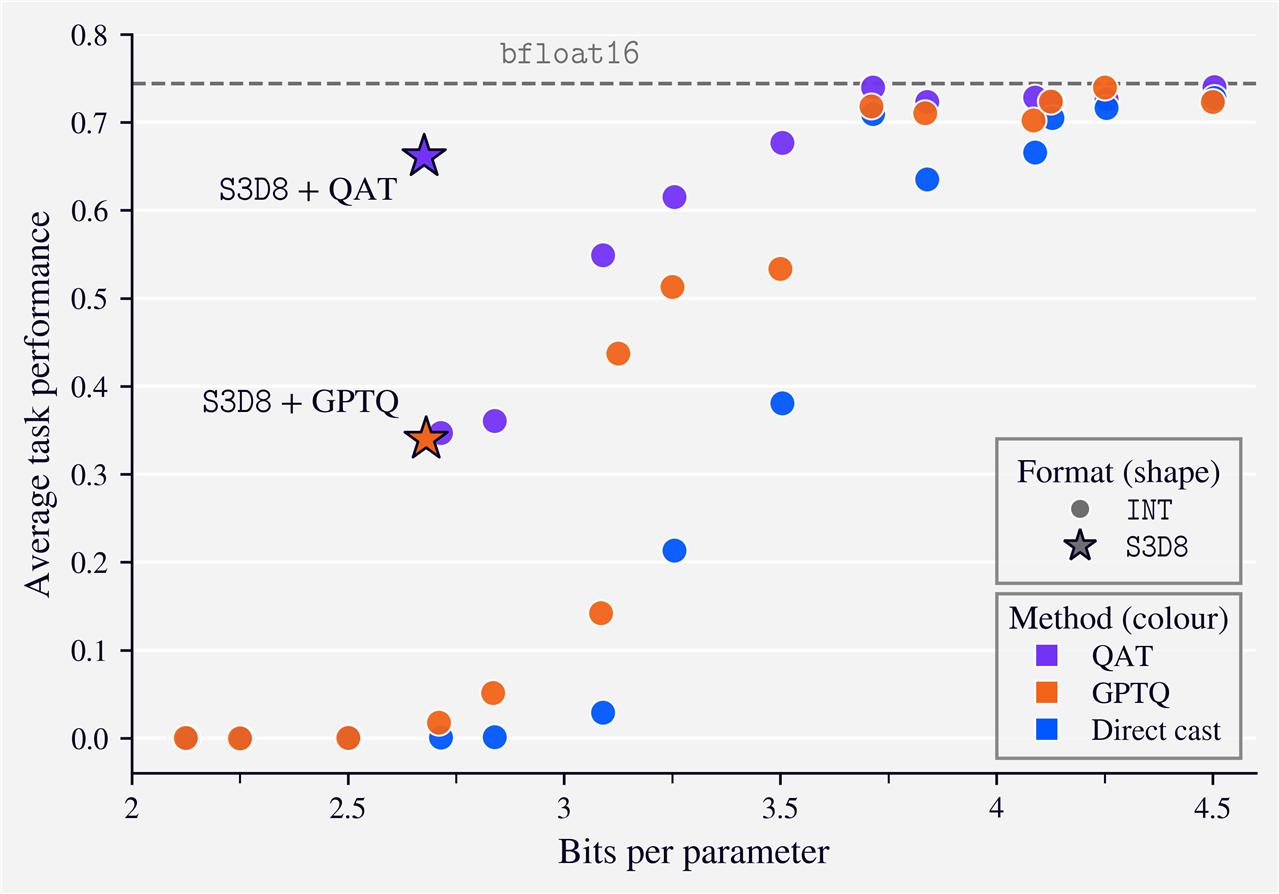
Deploying large multimodal models (VLMs) on resource-constrained edge devices, particularly mobile CPUs, presents a significant challenge. These models, often boasting billions of parameters, require substantial memory and computational power, making them impractical for on-device inference. A recent advancement tackles this head-on by compressing an 11-billion parameter VLM to an astonishing 2.7-bit weight representation, enabling efficient execution on mobile processors without a drastic loss in accuracy.
The core innovation lies in a two-pronged approach. First, a novel weight format is introduced specifically designed for efficient decoding. This format rethinks how model weights are stored and accessed, moving away from standard representations that are not optimized for the low-bit precision targeted. The goal is to reduce the memory footprint and the bandwidth required to load model parameters during inference. This is crucial for mobile environments where memory is scarce and I/O operations can be a bottleneck.
Second, the compression process leverages quantization-aware training (QAT). Unlike post-training quantization (PTQ), which applies quantization after a model has been fully trained, QAT integrates the quantization process into the training loop itself. This allows the model to learn to adapt to the reduced precision, minimizing the accuracy degradation that typically accompanies aggressive quantization. By simulating the effects of low-bit weights during training, the model becomes more robust to the compression, preserving its performance on multimodal tasks.
The result is an 11B parameter VLM that, after compression to 2.7-bit weights, becomes significantly more amenable to deployment on mobile CPUs. This breakthrough has profound implications for bringing advanced AI capabilities directly to user devices, enabling richer on-device experiences without constant reliance on cloud connectivity. Such capabilities could include real-time image and video analysis, sophisticated natural language understanding for local assistants, and personalized AI features that respect user privacy by keeping data on the device.
The Technical Underpinnings of 2.7-bit Compression
Achieving such a low bit-weight representation, particularly 2.7 bits, requires meticulous engineering. Standard integer or floating-point formats are far too coarse. This novel approach likely involves a hybrid scheme, where most weights are quantized to a very low number of bits (e.g., 2 or 3 bits), while a small subset of critical weights might retain slightly higher precision or be represented differently to compensate for potential accuracy loss. The "novel weight format" mentioned in the research is key here. It's not just about reducing the bit count per weight, but also about how these low-bit values are structured and processed efficiently by the CPU's arithmetic logic units.
Consider the challenge of representing information with just 2.7 bits. A standard 2-bit system allows for 4 distinct values (00, 01, 10, 11). A 3-bit system allows for 8 distinct values. 2.7 bits implies an average, suggesting a non-uniform distribution of bit usage across weights, or a clever encoding that packs information more densely. This could involve techniques like using variable-length codes for different weight groups, or exploiting redundancies in the weight distribution. The decoding efficiency is paramount; if unpacking these compressed weights takes more computational effort than processing them in a higher precision format, the benefit is lost. The research likely details custom decoding kernels optimized for mobile architectures.
Quantization-aware training is the critical partner to this novel format. Training a model from scratch or fine-tuning it with the knowledge that its weights will be quantized to 2.7 bits forces the optimization process to find weight configurations that are resilient to this extreme precision reduction. This is analogous to designing a bridge with specific load-bearing constraints in mind from the blueprint stage, rather than trying to reinforce an existing bridge after it's built. The QAT process would typically involve simulating the quantization and de-quantization steps during backpropagation, allowing gradients to flow through the quantized layers and guide the learning of more robust weights.
The specific multimodal tasks the VLM is trained for also play a role. VLMs typically handle tasks involving both vision and language, such as image captioning, visual question answering, and text-to-image generation. The success of this compression technique hinges on whether the core features required for these tasks can be adequately represented and learned within the 2.7-bit constraint. For instance, critical edge detection features in images or nuanced semantic understanding in text might be particularly sensitive to low-bit quantization.
Referenced Sources
- verified