The Need for Compression
In today's data-driven world, files are getting larger. Whether it's massive software packages, extensive backups, or vast server logs, the sheer volume of data presents challenges. Storing more data requires more disk space, and transferring larger files consumes more bandwidth and takes longer. Compression addresses this by representing the same information using fewer bits. The key principle is that when the compressed file is decompressed, it must yield an exact, bit-for-bit identical copy of the original file. No information is lost; it's merely encoded more efficiently.
Identifying and Exploiting Repetitions
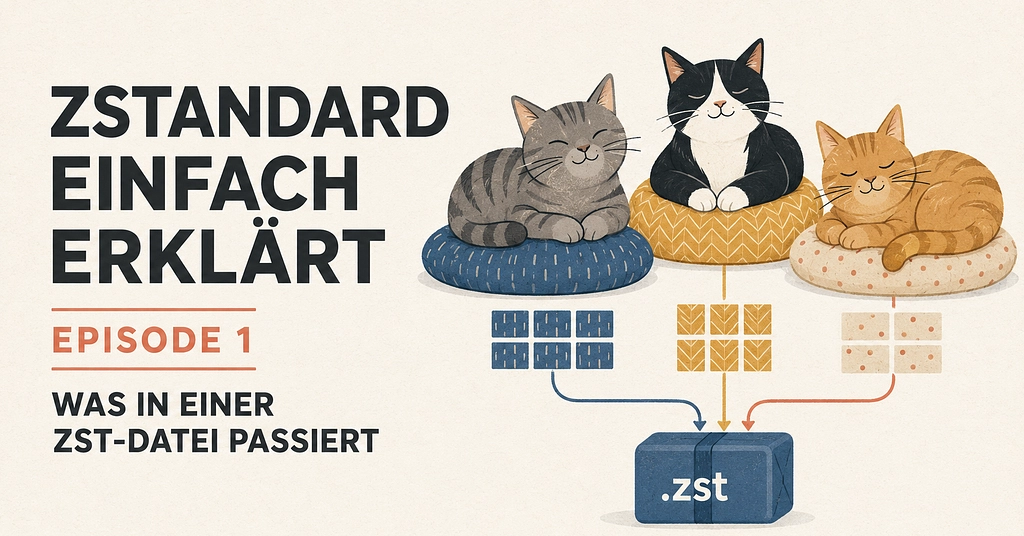
At its core, compression works by finding and eliminating redundancy. Most data contains repeated patterns. Consider the sentence: "Kleine Katzen kuscheln auf kleinen Kissen." A naive compression algorithm might see the repetition of "kleinen" and "Katzen" and find a way to represent these repetitions more compactly. Zstandard (often abbreviated as ZST) is a modern, high-performance compression algorithm developed by Facebook. It excels at identifying these patterns, even across large datasets, and replacing them with shorter references. This process is what allows ZST files to be significantly smaller than their original counterparts.
How Zstandard Achieves Speed and Efficiency
Zstandard's design prioritizes both high compression ratios and high compression/decompression speeds. It achieves this through a multi-stage approach. First, it employs a dictionary-based compression technique, similar to older algorithms like LZ77. This involves building a dictionary of frequently occurring sequences of bytes within the data. When a sequence is encountered again, instead of writing the entire sequence, the algorithm writes a short reference to its position in the dictionary. This is highly effective for text and structured data.
Beyond simple dictionary matching, Zstandard incorporates advanced techniques. It uses a context-mixing entropy coder, which adapts its statistical models based on the local data context. This allows it to more accurately predict the probability of the next byte, leading to better compression. Unlike some older algorithms that trade speed for compression ratio or vice-versa, Zstandard offers a tunable trade-off. Users can select a compression level from 1 (fastest, lowest compression) to 22 (slowest, highest compression), allowing them to optimize for their specific use case. This flexibility makes it suitable for a wide range of applications, from real-time streaming where speed is paramount, to archival storage where maximum space savings are desired.
The Decompression Process
Decompression in Zstandard is designed to be exceptionally fast. While compression involves analyzing data, building dictionaries, and making complex decisions, decompression primarily involves reading the compressed data and substituting the references with the actual data sequences they represent. Because the dictionary and the logic for referencing are pre-defined or included within the compressed stream, the decompressor can often operate with minimal computational overhead. This rapid decompression is a critical factor in Zstandard's popularity for software distribution and large file downloads, as it minimizes the user's waiting time.
The algorithm's architecture is also optimized for modern multi-core processors. It can leverage multiple threads for both compression and decompression, significantly speeding up the process on systems with more than one CPU core. This parallel processing capability is another reason why Zstandard often outperforms older compression algorithms in benchmarks, especially when dealing with very large files.
Use Cases for Zstandard
Zstandard's combination of speed and compression ratio makes it a versatile tool. It's commonly found in:
- Software Distribution: Many Linux distributions and package managers use ZST for distributing software packages, reducing download sizes and installation times.
- Databases and Filesystems: Zstandard is used to compress data stored in databases and certain filesystems to save space without significantly impacting read/write performance.
- Web Content: Web servers can use Zstandard to compress HTTP responses, speeding up page load times for users whose browsers support it.
- Backups and Archiving: For large data archives and backups, Zstandard offers a good balance between reducing storage requirements and enabling quick restores.
- Log Files: Compressing large volumes of log data can save significant storage space.
The surprising detail here is not just the efficiency Zstandard offers, but its ability to achieve this across such a broad spectrum of use cases without requiring extensive tuning for each one. While levels can be adjusted, the default settings often provide an excellent starting point.
Looking Ahead: Episode 2
This first episode focused on the fundamental principles of compression and how Zstandard applies them to create smaller files. Episode 2 will dive deeper into the practical implementation, exploring how developers can integrate Zstandard into their applications and workflows, and comparing its performance against other popular compression tools. If you're a developer dealing with large datasets, understanding Zstandard's capabilities can significantly impact your application's performance and storage costs.