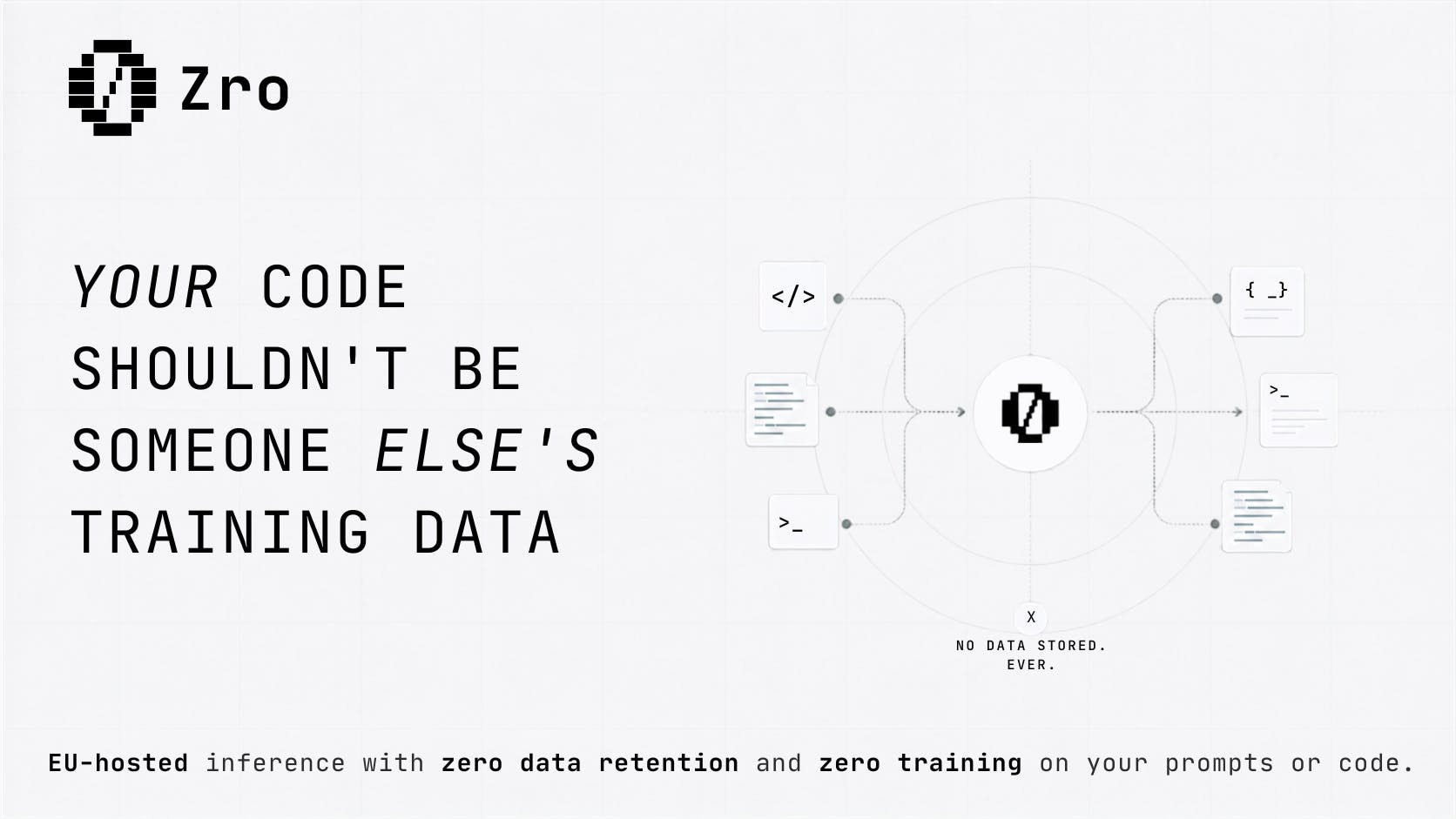
The Challenge of Private AI Code Generation
The rapid integration of AI into software development workflows presents a significant paradox: developers want the productivity gains from AI coding assistants, but they are understandably hesitant to send proprietary or sensitive code to third-party cloud services. This concern is amplified when dealing with internal codebases, intellectual property, or algorithms that could be exploited if exposed. Existing solutions often require users to trust that their data is handled securely and anonymously by the AI provider, a trust that is difficult to verify and can be a non-starter for many organizations.
Zro emerges as a contender in this space, aiming to address this critical privacy gap. The product is designed to enable private inference for coding agents, meaning developers can leverage AI-powered code generation, completion, and analysis without their code ever leaving their local environment or a trusted, on-premise setup. This approach fundamentally shifts the trust model from relying on a third-party vendor to maintaining control over sensitive data.
How Zro Aims to Ensure Privacy
At its core, Zro focuses on enabling AI models to perform inference—the process of using a trained model to make predictions or generate outputs—on sensitive data while maintaining that data's confidentiality. While the specifics of Zro's underlying technology are not detailed in the provided source, the promise is clear: developers can interact with AI agents for coding tasks, and the code itself remains private. This likely involves a combination of techniques such as:
- Local Execution: Running AI models directly on the developer's machine or within their secure network infrastructure.
- Confidential Computing: Potentially leveraging hardware-based Trusted Execution Environments (TEEs) to process data in an encrypted state, even while in use.
- Differential Privacy: Although less common for direct code inference, it's a technique that could be used to anonymize inputs or outputs if any data were to be aggregated for model improvement.
The implication for developers is the ability to use AI assistants for tasks like debugging, code completion, test generation, or even drafting entire functions, all without the anxiety of exposing valuable intellectual property. This could democratize access to advanced AI coding tools for a wider range of companies, including those with stringent compliance or security requirements.
The Landscape of AI Coding Assistants
The market for AI-powered coding tools has exploded in recent years. Tools like GitHub Copilot, Amazon CodeWhisperer, and various open-source models have demonstrated the power of AI to boost developer productivity. However, many of these solutions operate primarily in the cloud, raising privacy concerns that Zro seeks to mitigate. The success of Zro will likely depend on its ability to offer comparable performance and usability to these cloud-based alternatives while delivering a robust privacy guarantee.
The technical challenge lies in balancing performance with privacy. Running complex AI models locally can be resource-intensive, requiring significant computational power and memory. Furthermore, ensuring true privacy, especially against sophisticated adversaries, is a complex undertaking. Zro's approach will need to be transparent and verifiable to gain widespread adoption among security-conscious developers and organizations.
What's Next for Private AI Development?
Zro's entry into the market highlights a growing trend: the demand for privacy-preserving AI solutions across various domains, not just coding. As AI becomes more embedded in critical business processes, the need for tools that can operate without compromising data confidentiality will only increase. If Zro can successfully deliver on its promise, it could set a new standard for how AI agents interact with sensitive code, potentially paving the way for similar private inference solutions in areas like legal document analysis, financial modeling, and healthcare data processing.
The question remains whether Zro can offer a seamless integration into existing developer workflows and provide AI capabilities that are competitive with established cloud-based services. Developers are often pragmatic; the most private solution is only valuable if it is also practical and effective.