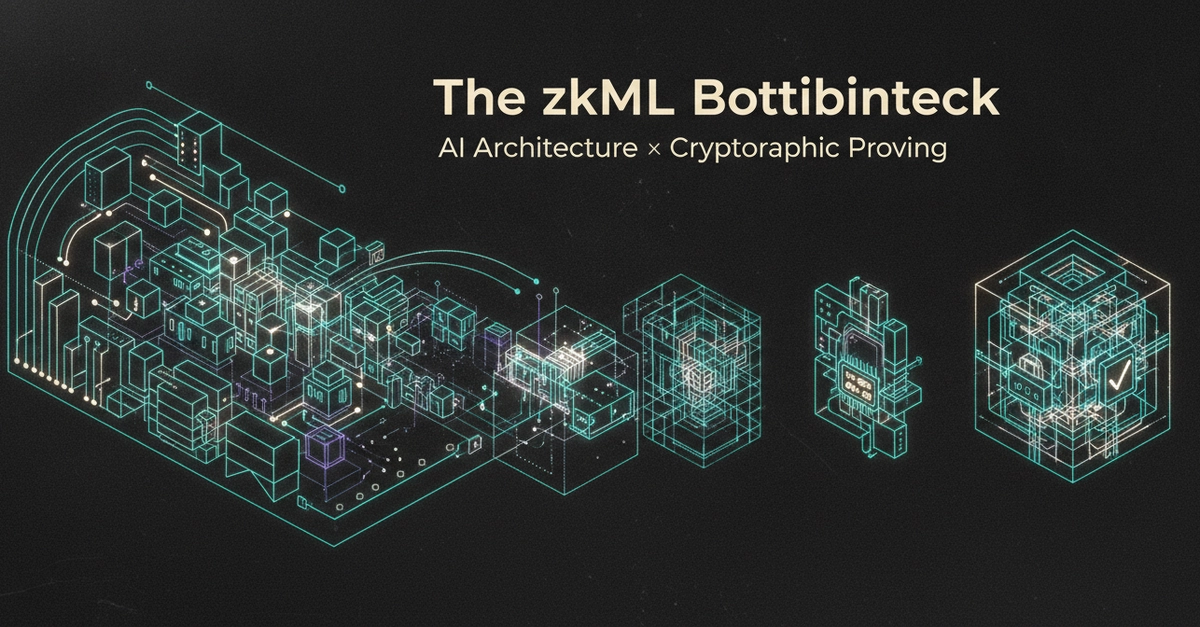
The Verifiability Challenge in AI
Deep learning curricula often present a linear progression of model architectures—from perceptrons and MLPs to CNNs, RNNs, and finally attention-based models like Transformers and Vision Transformers (ViTs). This narrative typically focuses on increasing model capability: how each generation better represents information, captures dependencies, or bridges modalities. However, a parallel, often understated, story unfolds within this progression: verifiability. As models grow more powerful and complex, their computational requirements escalate dramatically. This complexity becomes critical not when a human simply reads a model's output, but when that output triggers an automated action—like an AI agent trading assets, authorizing payments, or executing a robotic command.
When AI systems operate autonomously, the question shifts from "Did the model produce an answer?" to "Can we cryptographically verify that the model's computation was performed correctly and that its inputs were valid?" This is the core of the zero-knowledge machine learning (zkML) challenge. The bottleneck is not an inherent limitation in proving the mathematical operations of modern AI architectures, such as Transformers. Instead, it lies in the sheer scale and complexity of these computations, and in developing cryptographic systems that can efficiently and scalably attest to their correctness.
Architecture-Aware Cryptography for AI
Early approaches to verifiable computation, like general-purpose zero-knowledge proof systems, treated computations as opaque black boxes. They could prove that a computation was executed correctly, but they lacked any understanding of the underlying computational structure. This is akin to verifying a complex software program by simply checking its final output without understanding its algorithms or data structures. For simple computations, this works. But for the massive, multi-layered operations of modern neural networks, this approach is prohibitively inefficient. The resulting proof sizes and verification times become astronomical, rendering them impractical for on-chain applications or real-time verification.
The real innovation in zkML is the development of what can be called "architecture-aware" cryptography. Instead of treating a Transformer model as an undifferentiated block of computation, these new systems understand its constituent parts: the attention mechanisms, feed-forward networks, layer normalization, and positional encodings. By building cryptographic primitives that are specifically tailored to these architectural components, it becomes possible to generate proofs much more efficiently. This is analogous to how specialized hardware, like GPUs, accelerates matrix multiplications in AI training; architecture-aware zkML techniques create specialized cryptographic "circuits" that mirror the AI model's structure, drastically reducing the proof overhead.

Consider the attention mechanism, a cornerstone of modern NLP and computer vision models. It involves complex matrix multiplications, softmax operations, and weighted sums. Designing zero-knowledge circuits that can efficiently prove these specific operations, rather than a generic computation, is where the efficiency gains are realized. This shift from general-purpose verifiable computation to specialized, architecture-aware proofs is what makes zkML viable for complex models.
Beyond Code: The MVP of Verifiable AI
The challenge of building verifiable AI systems echoes a broader principle in product development: the most expensive part of building a Minimum Viable Product (MVP) is often not the code itself, but deciding what *not* to build. Teams often fall into the trap of over-engineering, anticipating future needs and building a comprehensive feature set before validating core assumptions. This leads to bloated "MVPs" that are costly to develop and difficult to iterate on.
In the context of zkML, this translates to a crucial strategic question: what is the core problem we are trying to solve with verifiable AI? Is it the ability to prove *any* AI computation, or is it the ability to prove specific, high-value AI outputs that require on-chain trust? The latter is a much more tractable problem. An MVP in zkML should aim to answer a single, critical question: "Can we cryptographically guarantee the integrity of this specific AI-driven decision or action?"
This focus reframes the development effort. Instead of attempting to build a universal zkML prover for every conceivable AI model, teams should concentrate on optimizing cryptographic circuits for the specific architectures and operations most relevant to their use case. For instance, if the goal is to build an AI agent that executes trades on a decentralized exchange, the focus would be on efficiently proving the computations of a model that predicts market movements and determines optimal trade execution. This means developing and optimizing circuits for the specific layers and operations within that predictive model, rather than trying to create a one-size-fits-all solution.
The implication for anyone building AI agents on platforms like Ethereum is clear: prioritize architectural understanding in your cryptographic proof systems. The bottleneck is not the theoretical possibility of proving Transformers, but the practical engineering challenge of building scalable, efficient, and architecture-aware zero-knowledge circuits. Success will come from identifying the core AI computations that need verification and developing specialized cryptographic tools for them, rather than seeking a universal proof solution.
The Future of Trust in AI
As AI systems become increasingly integrated into critical decision-making processes, the demand for verifiable computation will only grow. The ability to provide cryptographic assurances about AI outputs is essential for building trust, enabling autonomous systems, and ensuring accountability. The progress in zkML, particularly the move towards architecture-aware cryptographic primitives, is a significant step in this direction. It transforms the problem from an insurmountable computational hurdle into an engineering challenge—one that can be tackled by focusing on specific use cases and optimizing for the unique structures of modern AI models.
The convergence of AI and cryptography, driven by the need for verifiability, is paving the way for a new era of trustworthy AI agents and decentralized applications. The key takeaway is that the future of zkML hinges not on whether complex AI models can be mathematically represented for proof, but on our ability to efficiently and scalably prove their execution in a way that is both cryptographically sound and practically implementable.