The Cognitive Load of Code Navigation
Developers routinely spend more time reading and understanding existing code than writing new code. This reality creates a significant challenge when encountering large repositories, whether they are legacy systems or new open-source projects. The sheer volume of files and the intricate relationships between components can lead to a feeling of being lost, akin to needing a map to navigate a city. This information overload taxes cognitive resources, slowing down development cycles and increasing the likelihood of errors.
The core problem lies in the constant context switching required. Developers must continuously ask themselves:
- What is the primary function of this particular module?
- How do different components or services interact with each other?
- Where is the core business logic embedded within the codebase?
Answering these questions efficiently is crucial for productive development. Without clear insights into the codebase's structure and logic, developers struggle to contribute effectively, onboard new team members, or even debug issues. The time spent deciphering these complexities detracts from the actual task of building and innovating.
Introducing Zbloue: An AI-Powered Solution
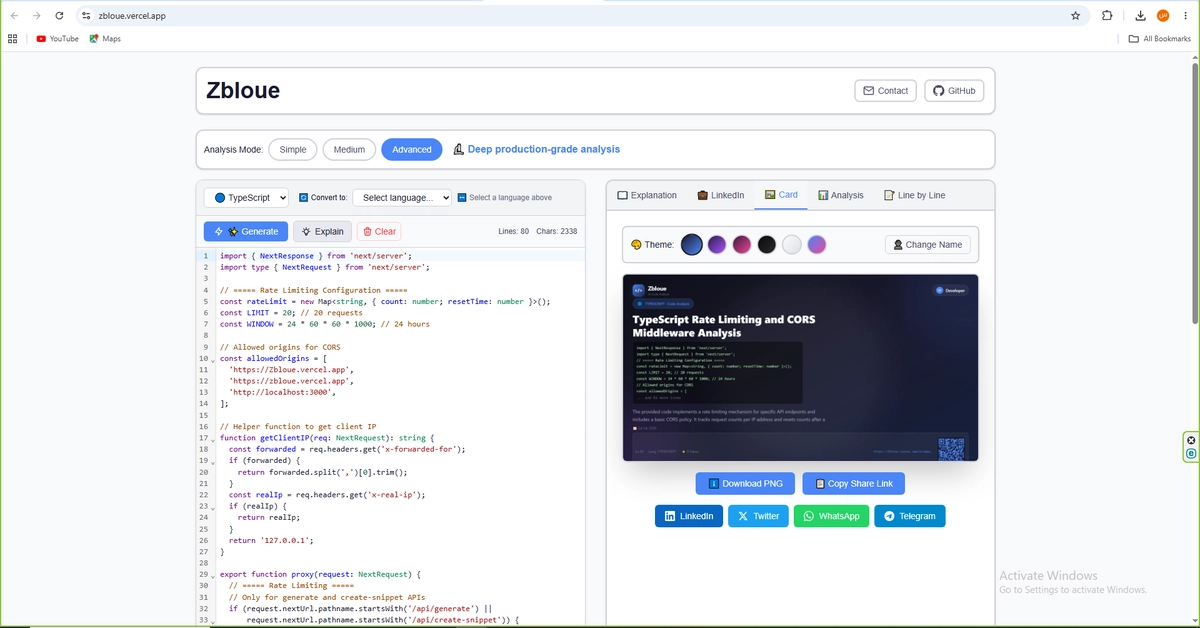
To address this pervasive issue, Seyed Jafar is building Zbloue. The project is designed to act as a bridge, connecting the complexity of code with the actionable insights developers need. Zbloue is conceptualized as an AI-powered code analysis tool. Its primary objective is to enable developers to grasp the essence of a codebase rapidly.
The tool aims to provide a higher-level understanding of code structures and dependencies. Instead of manually tracing function calls or sifting through directory trees, developers can leverage Zbloue to gain immediate clarity. This approach directly combats the cognitive load associated with code navigation, freeing up mental bandwidth for more critical tasks.
The vision for Zbloue is to transform the developer experience when entering unfamiliar code territory. By offering intelligent analysis and visualization, it promises to reduce the onboarding time for new developers and accelerate the debugging process for experienced ones. The goal is not just to present information, but to make that information immediately useful and actionable, streamlining the entire development workflow.
The Importance of Building in Public
While Zbloue focuses on code comprehension, the broader context of software development highlights the value of transparency and community engagement. The journey of building any software project, including Zbloue itself, often involves iterating based on user feedback and addressing unforeseen challenges. Projects like BOINKO, which are built in public, demonstrate the benefits of documenting the development process, including both successes and failures.
Building in public allows for early validation of ideas and features. It fosters a community around the project, providing a feedback loop that is invaluable for shaping the product. Documenting the journey helps others learn from the experience, whether it’s about specific technologies, architectural decisions, or the challenges of product-market fit. This transparency can be as critical to a project's success as the code itself, ensuring that the final product resonates with its intended users.
For Zbloue, this philosophy implies that the development process itself will likely be transparent, allowing potential users to follow its progress and contribute to its evolution. This approach ensures that Zbloue is not developed in a vacuum but is shaped by the real-world needs and feedback of the developer community it aims to serve. The ultimate success of Zbloue will hinge not just on its technical capabilities but on its ability to solve a problem that resonates deeply with developers and to be developed in a way that builds trust and community.
The Future of Code Comprehension Tools
The demand for tools that simplify code comprehension is growing. As software systems become larger and more distributed, the ability to quickly understand complex codebases becomes a competitive advantage for development teams. AI-driven analysis offers a promising path forward, moving beyond static analysis or simple documentation generators.
Tools like Zbloue could potentially integrate with existing development environments, providing real-time insights as developers write or review code. Imagine an IDE plugin that, upon opening a new file, provides a concise summary of its purpose, its key dependencies, and its relationship to the broader application architecture. Such capabilities would drastically reduce the time spent on initial code exploration.
The success of Zbloue will depend on its ability to accurately interpret complex code, identify critical relationships, and present this information in an intuitive and accessible manner. If successful, Zbloue could redefine how developers approach new code, making the often-daunting task of code navigation a more manageable and productive experience.