
Introducing YouTrackDB: A New Approach to Graph Databases
JetBrains, the company behind popular developer tools like IntelliJ IDEA and YouTrack, has introduced YouTrackDB, a novel general-use object-oriented graph database. Unlike traditional relational databases that store data in tables, or even many existing graph databases that focus on specific use cases, YouTrackDB aims to provide a flexible and powerful foundation for managing highly interconnected data.
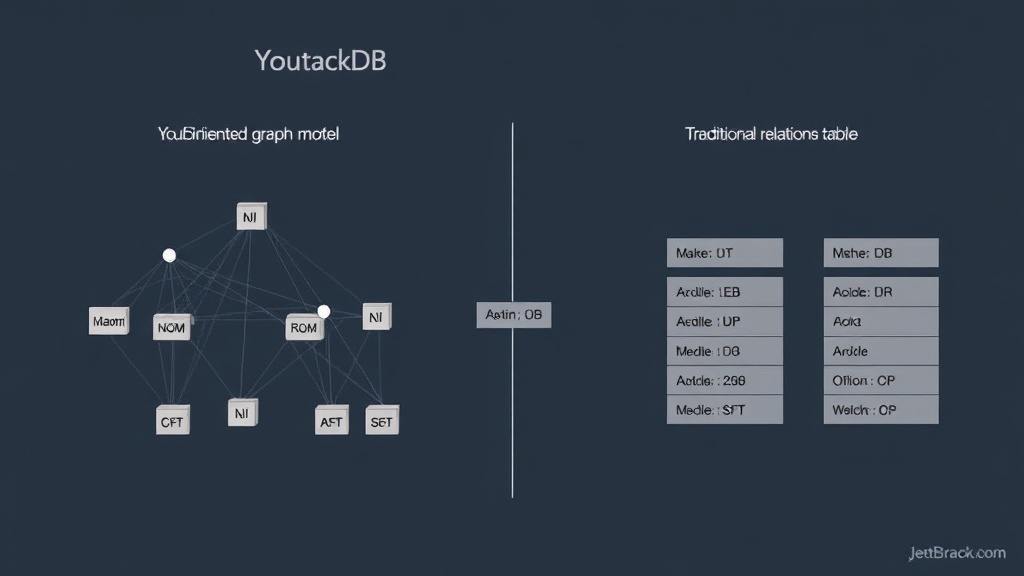
The core innovation lies in its object-oriented nature combined with a graph-based storage model. This means developers can model their data using familiar object-oriented concepts like classes, objects, inheritance, and encapsulation, while benefiting from the inherent strengths of graph databases for representing and querying complex relationships. This dual approach could simplify development for applications that struggle with the impedance mismatch between object-oriented programming languages and relational database schemas.
Graph databases excel at navigating and querying connections between data points. Think of a social network: finding friends of friends, or recommending connections based on shared interests. While many graph databases are optimized for specific network analysis tasks, YouTrackDB positions itself as a more general-purpose solution. Its object-oriented paradigm is designed to make it more approachable and easier to integrate into existing object-oriented codebases.
Key Features and Design Principles
While specific technical details are still emerging, the announcement highlights several key aspects of YouTrackDB's design:
- Object-Oriented Model: Data is represented as objects with properties and relationships. This aligns naturally with modern programming languages, reducing the need for complex Object-Relational Mappers (ORMs) or Object-Graph Mappers (OGMs).
- Graph-Native Storage: Underlying the object model is a graph structure. This allows for efficient traversal of relationships, making queries that involve multiple hops between entities significantly faster than in relational systems.
- General-Purpose Use: YouTrackDB is not narrowly focused on a single domain like social networks or fraud detection. It's intended for a broad range of applications requiring sophisticated data relationship management.
- Developer Experience: Coming from JetBrains, a company deeply invested in developer productivity, YouTrackDB is expected to prioritize ease of use, robust tooling, and a smooth integration into developers' existing workflows.
The implications of an object-oriented graph database are significant. For developers accustomed to languages like Java, C#, Python, or Kotlin, defining data structures and relationships within the database could feel like an extension of their programming language. This contrasts with traditional graph databases that often use proprietary query languages (like Cypher for Neo4j) or require developers to map object structures to graph nodes and edges manually.
Potential Use Cases and Market Position
The general-purpose nature of YouTrackDB opens up a wide array of potential applications:
- Knowledge Graphs: Building complex interconnected knowledge bases where entities and their relationships are central.
- Content Management Systems: Managing intricate relationships between articles, authors, tags, categories, and user interactions.
- Product Catalogs: Representing products with complex attribute hierarchies, dependencies, and cross-sell/upsell relationships.
- Identity and Access Management: Modeling users, roles, permissions, and resources with fine-grained control.
- Project Management and Issue Tracking: Naturally extending from YouTrack's own domain, managing dependencies between tasks, epics, bugs, and team members.
In the current database landscape, YouTrackDB enters a market with established players in both the relational and graph database spaces. Relational databases like PostgreSQL and MySQL remain dominant for structured, tabular data. In the graph database world, Neo4j has been a long-standing leader, alongside other specialized solutions. YouTrackDB's unique selling proposition is its fusion of object-orientation with graph capabilities, aiming to bridge the gap for developers who find traditional graph models too abstract or relational models too cumbersome for complex, interconnected data.
The surprising detail here is not the existence of another graph database, but the specific approach taken by JetBrains. By leaning into an object-oriented paradigm, they are directly addressing a common pain point for developers: the difficulty of mapping complex application objects to a graph structure. This suggests a database designed with the developer's mental model at its forefront, potentially lowering the barrier to entry for graph database adoption.
The Road Ahead
As YouTrackDB matures, several questions will arise. How will its performance compare to specialized graph databases for highly specific tasks? What will its query language look like, and how deeply will it integrate with JetBrains' existing IDEs? And crucially, what will be the migration path for existing YouTrack users who might want to leverage this new database technology?
What nobody has addressed yet is the long-term impact on the broader object-oriented programming ecosystem. If YouTrackDB proves successful, could it inspire other database vendors to adopt more object-oriented principles? Or will it remain a niche solution tightly integrated with JetBrains' development environment? The answers will shape how developers think about and interact with their data for years to come.
For now, YouTrackDB represents an intriguing development in the database world. Its object-oriented approach to graph data management promises to simplify development for complex applications and offers a compelling alternative for teams seeking a more intuitive way to handle interconnected information.