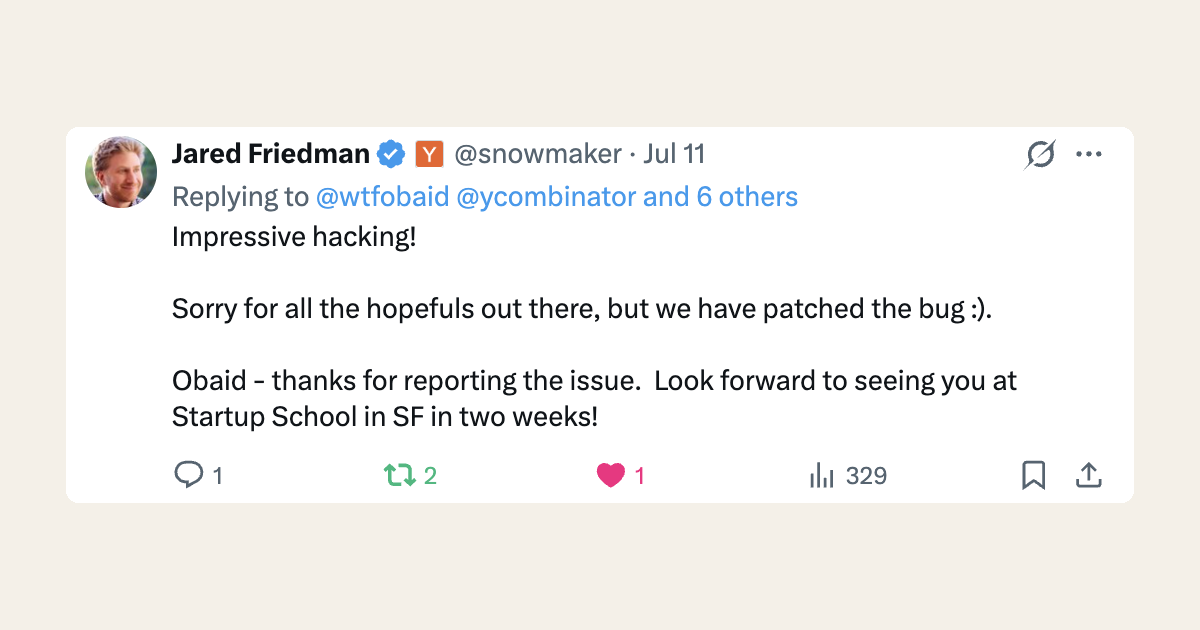
The Application Loophole
When Y Combinator announced its Startup School, the promise was accessible education for founders. What wasn't immediately apparent was the application process itself, and for one developer, a deep dive into its mechanics revealed an unexpected pathway to acceptance. Instead of focusing on the typical metrics like team size, product-market fit, or even a polished pitch deck, this founder identified a specific technicality within the application submission system that, when exploited, bypassed the usual screening stages.
The core of the "hack" wasn't about deception in the traditional sense, but rather a precise understanding of how the application platform processed submissions. The system, designed to handle a high volume of applicants, likely had automated checks or a specific flow for certain submission types. By carefully crafting his application, not for its content's inherent strength according to typical startup metrics, but for how it would be parsed and categorized by the backend, he was able to trigger a specific outcome: direct admission into the Startup School program without the standard review process.
This approach is less about gaming a system with false information and more about understanding the system's design – a classic hacker mindset applied to an educational application. It highlights a crucial difference between building a product and understanding the infrastructure it runs on. For developers, this story serves as a reminder that the tools and platforms we interact with daily, even those seemingly benign like an application portal, have underlying logic that can be understood and, in some cases, leveraged. The surprising detail here is not the admission itself, but the method: a technical understanding of the application pipeline, not a compelling business idea, was the key.
This strategy, while effective for this individual, raises questions about the scalability and fairness of such application systems. If a system can be "hacked" by understanding its technical implementation rather than its intended qualitative assessment, it suggests a potential vulnerability in how promising founders are identified. It’s akin to finding a secret back door into a building that was designed to be secured by a complex lock on the front door. The door is technically functional, but it bypasses the intended security measures.
Implications for Future Applications
The implications for future applicants and for YC itself are significant. For applicants, it suggests that a thorough understanding of the application platform's logic, if discoverable, could be more valuable than a perfect pitch. This shifts the focus from business acumen to technical investigation. For YC and similar organizations, it necessitates a review of their application processes. Are there unintended pathways that bypass the qualitative review designed to identify strong founders? The goal of Startup School is to nurture promising entrepreneurs, and if the entry point can be circumvented by a technicality, the cohort might not truly represent the founders who would benefit most from the program's mentorship and resources.
The developer in question didn't present a fully formed company or a revolutionary idea at the outset. Instead, he leveraged his technical skills to gain access to an opportunity. This is a testament to the power of understanding systems, a skill highly valued in the tech industry. It’s a stark contrast to the usual narrative of startup success, which often emphasizes market disruption and innovative business models. Here, the innovation was in the process of application itself.
What nobody has addressed yet is the long-term impact on the individual's journey within Startup School. Did this 'hack' set a precedent for how they approached the program? Did the skills used to gain entry translate into success during the program, or was it a one-off technical exploit with no bearing on their entrepreneurial development? The answer to this could inform whether such 'hacks' are merely clever shortcuts or genuinely indicative of a founder's problem-solving capabilities.
This incident also brings to the forefront the perennial tension between automation and human oversight in large-scale application processes. While automation is necessary for efficiency, it can create blind spots. The developer's success indicates that the automated or semi-automated parts of the process were susceptible to a specific, technically-minded input that bypassed the human element intended for evaluation. It suggests that the system was designed to check boxes, and he found a way to tick them with unintended inputs.