The Sentence Boundary Detection Challenge
Sentence boundary detection sounds deceptively simple. A quick scan of punctuation marks like periods, question marks, and exclamation points might suggest a straightforward task: split text wherever these appear. However, anyone who has attempted this knows the reality is far more complex. The presence of abbreviations (like "Dr.", "St.", "etc."), decimal numbers, URLs, nested quotation marks, ellipses, legal citations, and specialized jargon from fields like biomedicine transforms the task from a simple text split into a nuanced, language-specific puzzle. These elements can mimic sentence-ending punctuation, leading to incorrect segmentation.
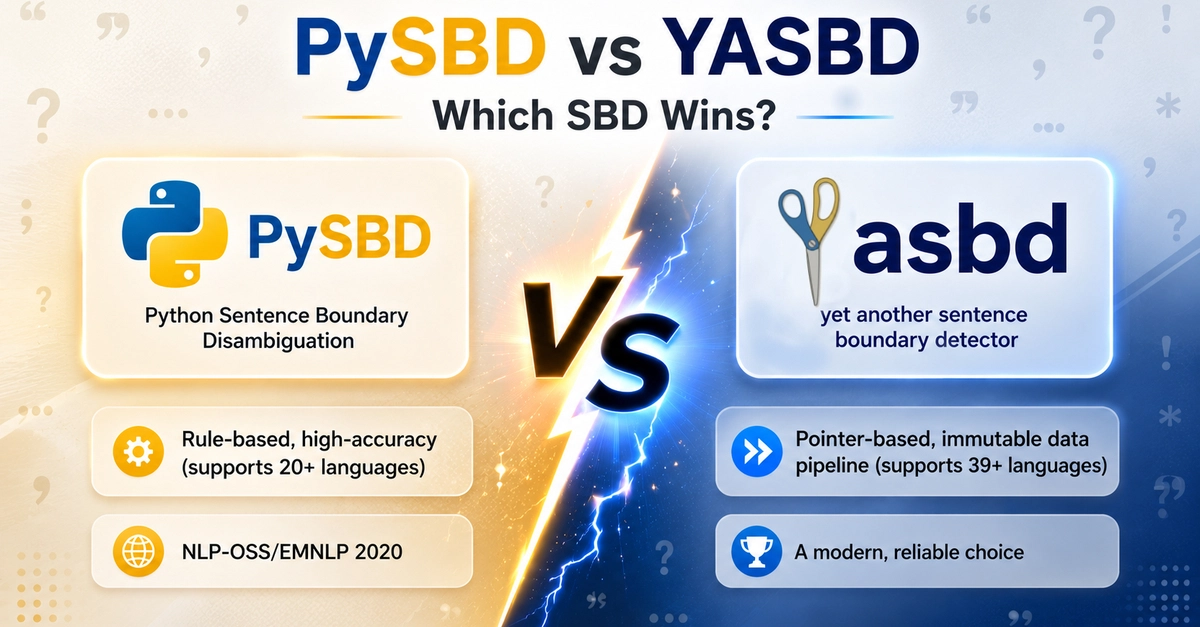
Two prominent Python libraries, pysbd and yasbd-lib, approach this challenge with fundamentally different philosophies, impacting their architecture, performance, and language coverage. Understanding these differences is crucial for developers and data scientists dealing with large volumes of unstructured text.
Architecture: Mutation vs. Pointers
The core divergence between pysbd and yasbd-lib lies in their architectural design and how they process input strings. This distinction affects how efficiently they handle large datasets and their internal memory management.
pysbd: The Pragmatic Segmenter Port
pysbd, released in 2020, is a port of the Ruby Pragmatic Segmenter library. Its approach can be broadly characterized as mutation. When pysbd processes text, it often modifies the input string in place or works with internal representations that are akin to modifying the original data structure. This method involves iterating through the text and applying rules to identify sentence boundaries. While effective, this can lead to higher memory usage, especially with very large strings, as intermediate states or modified copies of the string might be maintained.
The library boasts support for 22 languages, leveraging the extensive rule sets developed for its Ruby predecessor. Its strength lies in its maturity and the breadth of linguistic edge cases it attempts to cover through a comprehensive, albeit sometimes complex, set of regular expressions and heuristics. The porting process means it inherits a robust, well-tested set of rules, making it a reliable choice for many common use cases.
yasbd-lib: The Pointer-Based Approach
yasbd-lib, a newer entrant, takes a different architectural stance, which can be described as using pointers or indices. Instead of modifying the input string or creating extensive intermediate copies, yasbd-lib focuses on identifying the start and end indices of sentences within the original string. This approach is generally more memory-efficient. It treats the input string as immutable and merely records the locations of sentence boundaries. This is akin to highlighting specific sections of a document without rewriting the document itself.
This pointer-based architecture is particularly advantageous when processing massive text corpora where memory footprint is a critical concern. By minimizing data duplication and in-place modification, yasbd-lib can achieve faster processing speeds on large files, as it avoids the overhead associated with string manipulation and memory allocation/deallocation.
Language Coverage and Performance Trade-offs
The differing philosophies also extend to their language support and performance characteristics. yasbd-lib currently supports 39 languages, significantly more than pysbd's 22. This expanded coverage is a direct result of its newer development cycle and potentially a more modular design that facilitates the addition of language-specific rules. The library claims to offer a more performant solution, especially for large-scale processing, due to its memory-efficient pointer-based architecture.
However, the performance of any sentence boundary detection library is highly dependent on the specific dataset and the complexity of the text. While yasbd-lib's architecture suggests a theoretical advantage in speed and memory usage, real-world performance can vary. Factors such as the density of abbreviations, the prevalence of complex sentence structures, and the specific language rules implemented can all influence the outcome. For instance, a dataset with a high concentration of complex legal or scientific text might stress the rule sets of either library differently.
pysbd, with its longer lineage and porting from a mature Ruby library, benefits from extensive community testing and refinement of its rules. This might make it more robust for certain edge cases within its supported languages, even if its raw speed is not as high as theoretically possible for yasbd-lib.
Choosing the Right Tool
The choice between yasbd-lib and pysbd hinges on specific project requirements. For developers working with massive datasets where memory efficiency and processing speed are paramount, yasbd-lib's pointer-based architecture and broader language support make it a compelling option. Its approach is akin to a highly organized librarian who meticulously notes the location of every book section without rearranging the entire library.
Conversely, if the project involves a smaller dataset, or if maximum compatibility with established rule sets and a wider range of thoroughly tested edge cases within a specific set of languages are prioritized, pysbd remains a strong contender. Its maturity and the extensive work put into its rule engine provide a reliable and predictable segmentation experience for its 22 supported languages. The decision is not simply about which library is 'better,' but which aligns more closely with the operational constraints and linguistic demands of the task at hand.
Ultimately, both libraries aim to solve the same complex problem: accurately segmenting text into meaningful sentences. They achieve this through distinct architectural lenses, offering developers a choice that reflects different priorities in performance, memory usage, and language coverage.