The Problem With Cloud-Based File Tools
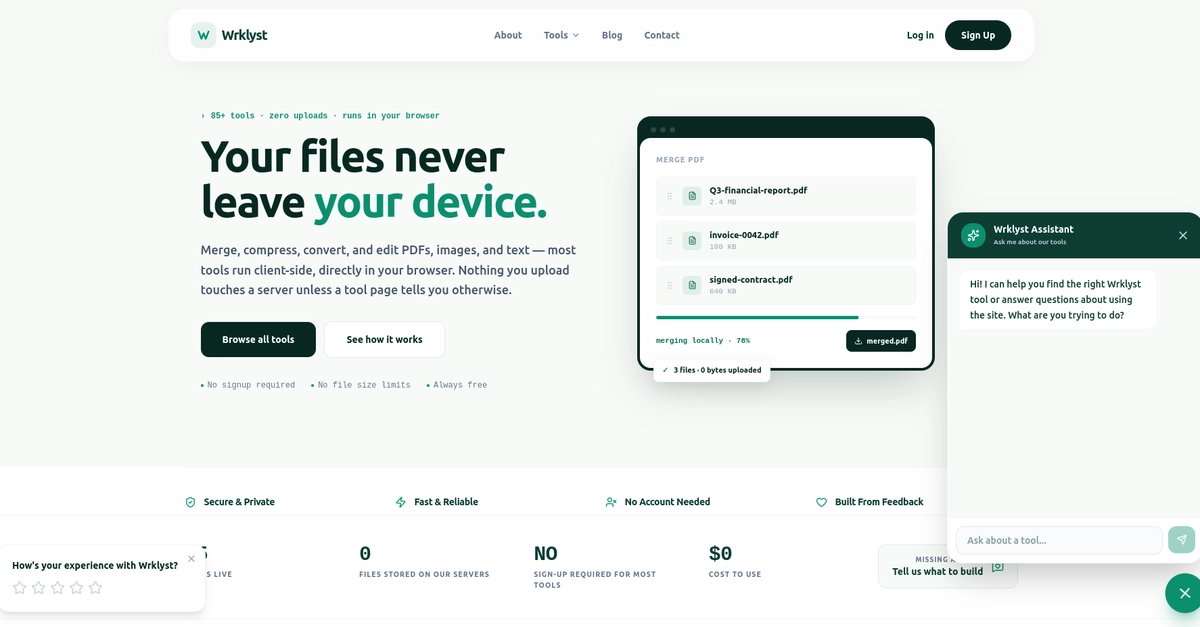
Many popular online tools for manipulating files, such as PDF editors or image converters, require users to upload their documents to remote servers. This practice presents a significant privacy and security risk, especially for users dealing with sensitive or confidential information. Gaurav Sheoran, a developer, experienced this frustration firsthand and decided to build an alternative. His solution, Wrklyst, aims to provide a suite of free utility tools that operate exclusively within the user's web browser, meaning files are processed locally and never transmitted over the internet.
Sheoran's motivation stems from a desire for greater control and privacy. By keeping file operations client-side, Wrklyst bypasses the need for server-side processing, thereby eliminating the potential for data breaches or unauthorized access that can occur with cloud-based services. This approach is particularly valuable for professionals in legal, finance, healthcare, and other sectors where data sensitivity is paramount.
The core technology enabling this local processing is WebAssembly (Wasm). Wasm allows code written in languages like C++, Rust, or Go to be compiled into a binary instruction format that can be executed by web browsers at near-native speeds. This enables computationally intensive tasks, such as PDF merging, image compression, or even complex regex operations, to be performed directly on the user's machine without relying on server resources.
What Wrklyst Offers Users
Wrklyst is designed as a growing collection of versatile tools, categorized to serve a wide range of users, from general consumers to developers. The current offering includes:
PDF Tools
- Merge PDFs: Combine multiple PDF documents into a single file.
- Compress PDFs: Reduce the file size of PDFs, making them easier to share and store.
- Convert PDFs: Transform PDFs into other common formats, and vice versa.
- Sign PDFs: Add digital signatures to PDF documents securely.
Image Tools
- Convert Images: Change image formats (e.g., JPG to PNG, WEBP to JPG).
- Compress Images: Optimize image files for web or storage without significant quality loss.
- Resize Images: Adjust the dimensions of images.
Writing Tools
- Word Counter: Quickly count words, characters, and sentences in a block of text.
- Grammar Checker: Identify and suggest corrections for grammatical errors and stylistic issues.
Developer Tools
- JSON Formatter/Validator: Beautify and validate JSON data for easier reading and debugging.
- Regex Tester: Test and refine regular expressions against sample text.
- Base64 Encoder/Decoder: Encode and decode strings using Base64.
Security Tools
- Password Generator: Create strong, random passwords.
- Hashing Tool: Generate various types of cryptographic hashes (e.g., MD5, SHA-256) for data integrity checks.
Sheoran plans to add more tools weekly, indicating a commitment to expanding the platform's utility. The emphasis remains on functionality that benefits from local processing and user privacy.
The Technology Behind Local Processing
The choice of Next.js with the App Router provides a modern framework for building the user interface and managing application logic. Next.js is known for its performance optimizations, server-side rendering capabilities, and developer experience, making it suitable for creating a fast and responsive web application. However, for Wrklyst, the critical component is its ability to leverage WebAssembly for all file processing tasks. This allows computationally intensive operations to run efficiently within the browser environment, mimicking the performance of native desktop applications.
WebAssembly acts as a compilation target for various programming languages. Developers can write their tool logic in languages like Rust or C++, compile it to Wasm, and then integrate it into the JavaScript frontend. This approach offers several advantages:
- Performance: Wasm executes at near-native speeds, significantly faster than JavaScript for CPU-bound tasks.
- Portability: Wasm modules can run in any modern web browser, regardless of the underlying operating system.
- Security: Wasm runs in a sandboxed environment, preventing it from accessing arbitrary system resources or data outside its designated memory space.
- Language Choice: Developers can use their preferred languages for core logic, benefiting from their respective ecosystems and performance characteristics.
Deployment is handled by Vercel, a popular platform for static and serverless deployments, known for its ease of use and performance. Supabase is used for data management, likely for features that might require storing user preferences or usage analytics, though the core file processing remains local.
Implications for Users and Developers
Wrklyst represents a significant shift for users who are increasingly concerned about data privacy. By offering a free, browser-based alternative to popular cloud services, it lowers the barrier to entry for secure file management. For developers, it showcases a practical and effective use case for WebAssembly, demonstrating its capability to power complex applications directly in the browser. This could inspire further development of privacy-focused tools and applications that require high performance without server-side dependencies.
The project's success will hinge on its ability to maintain performance, expand its toolset, and build trust within its user base. As more users become aware of the privacy implications of uploading sensitive data to third-party servers, tools like Wrklyst are poised to gain traction. The growing collection of free, locally processed utilities offers a compelling value proposition for anyone who prioritizes security and control over their digital assets.