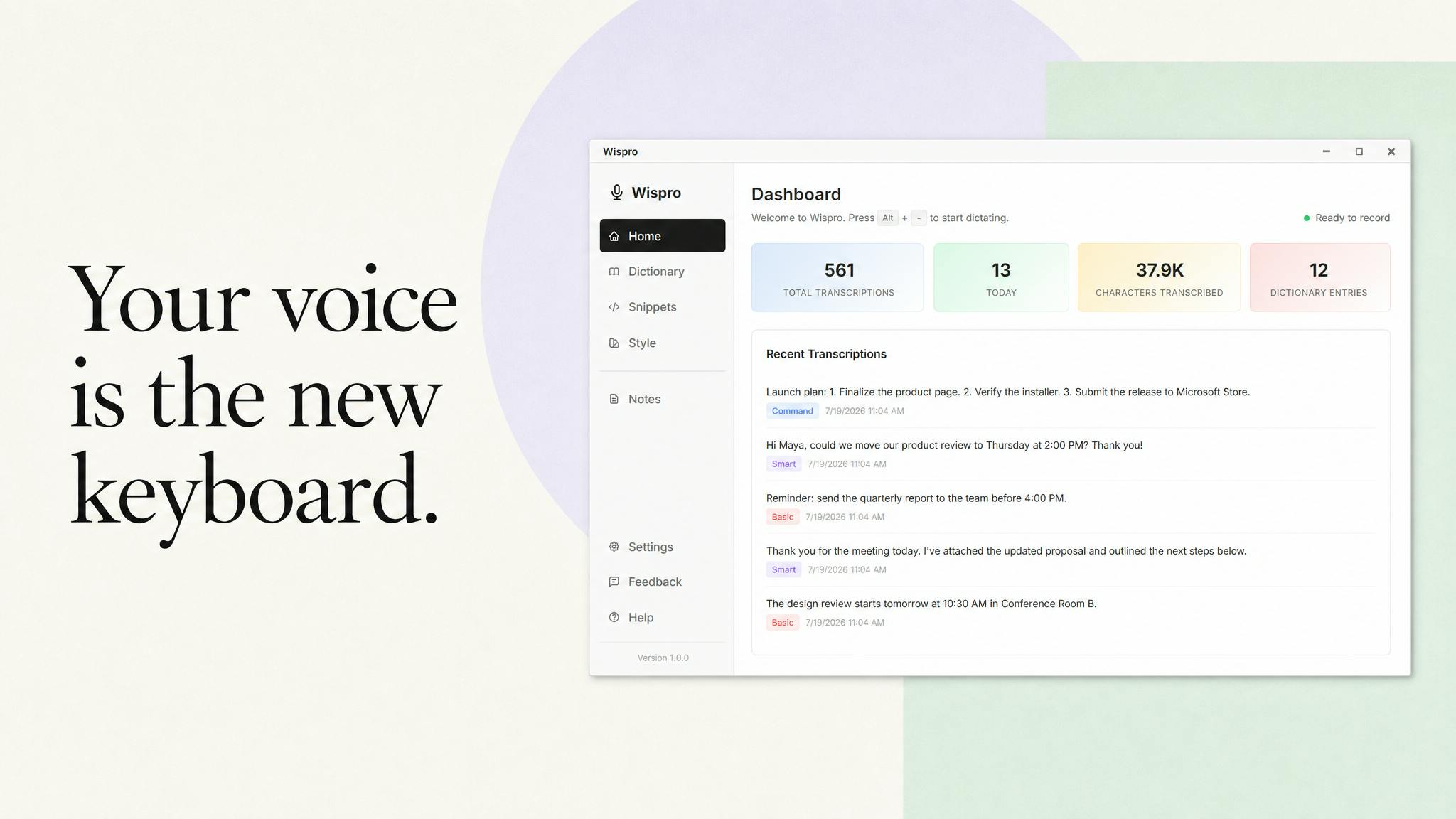
From Spoken Word to Polished Prose
The friction between thought and written output is a persistent challenge for many. We speak at a far higher bandwidth than we typically type, a gap that can stifle creativity and productivity. Wispro aims to bridge this divide with a bold promise: stop typing, start talking, and get perfectly written text. This AI-powered tool positions itself as a direct solution to the laborious process of transcribing ideas into coherent written form.
At its core, Wispro leverages advanced speech-to-text technology, augmented by artificial intelligence, to convert spoken language into written content. The implication is a workflow where users can simply speak their thoughts, outlines, drafts, or even full pieces, and Wispro will handle the conversion and refinement. This moves beyond basic dictation; the AI component suggests a level of understanding and processing that can shape raw speech into more polished, ready-to-use text.
The tool is marketed towards a broad audience, from content creators and bloggers to professionals who need to quickly generate reports, emails, or presentations. The core value proposition is time-saving and efficiency. Instead of spending hours typing, editing, and formatting, users can theoretically capture their ideas as they flow and have a well-structured output within minutes. This could be particularly impactful for those who find typing cumbersome, slow, or a barrier to expressing their ideas effectively.
The AI-Powered Refinement Process
What separates Wispro from a standard dictation tool is its AI-driven refinement. While the initial conversion from audio to text is foundational, the real power lies in what happens next. The AI likely analyzes the transcribed text for clarity, coherence, grammar, and style. This means it's not just a word-for-word transcription but an intelligent interpretation and enhancement of the spoken content. For instance, if a user rambles or uses filler words, the AI could potentially clean these up. If a thought is expressed imprecisely, the AI might suggest clearer phrasing, drawing on its understanding of natural language and effective writing conventions.
Consider the process of writing a blog post. A creator might speak their initial ideas, key points, and supporting anecdotes. Wispro would then transcribe this, not just as a block of text, but as a structured draft. The AI could identify section breaks, suggest topic sentences, ensure consistent tone, and even propose headings. This makes the output immediately more actionable than a raw transcript, reducing the editing burden significantly.

The technology behind Wispro likely involves sophisticated Natural Language Processing (NLP) and Natural Language Generation (NLG) models. NLP allows the system to understand the nuances of spoken language, including context, intent, and sentiment. NLG then enables it to generate human-like text that is grammatically correct, stylistically appropriate, and logically structured. The effectiveness of Wispro hinges on the sophistication of these models and their ability to accurately interpret and improve upon user input.
Potential Impact on Content Creation Workflows
The implications for content creators are substantial. For writers who face writer's block, the ability to simply talk through their ideas could be a powerful way to overcome inertia. For those who produce high volumes of content, such as social media managers or SEO specialists, the speed at which they can generate drafts could increase dramatically. This frees up mental energy and time that can be redirected towards strategy, creativity, and deeper engagement with their audience.
Think of Wispro less like a simple transcription service and more like an AI writing assistant that starts from your voice. Instead of sitting down at a keyboard and wrestling with sentence structure, you can have a conversation with the tool, outlining your points. It’s akin to having a very efficient, always-on editor who takes your spoken notes and turns them into a coherent narrative. This shift could fundamentally alter how many people approach the initial stages of writing.
However, the success of such a tool also raises questions about the future of traditional writing skills. If AI can reliably transform spoken thoughts into polished prose, what is the role of the human writer in the drafting process? It suggests a move towards a more collaborative model, where humans provide the core ideas and direction through speech, and AI handles the heavy lifting of composition and refinement. This could democratize content creation, allowing individuals with great ideas but less developed writing skills to produce high-quality content.
Challenges and Future Directions
Despite the promise, challenges remain. Accuracy in transcription, especially with diverse accents, background noise, or technical jargon, is paramount. The AI's ability to capture nuance, tone, and specific authorial voice will be critical. If the AI's output is too generic or misses the subtle intent of the speaker, its value diminishes. Furthermore, the ethical considerations of AI-generated content, including issues of originality and potential for misuse, will need to be addressed as these tools become more prevalent.
What nobody has fully addressed yet is how these voice-first content generation tools will integrate with existing content management systems and publishing workflows. Seamless integration, allowing for direct export and editing within familiar platforms, will be key to widespread adoption. The long-term impact on the demand for specific writing roles and the evolution of writing education also represent significant areas for future discussion.
Wispro represents a significant step toward a more intuitive and efficient content creation paradigm. By focusing on the power of voice, it seeks to remove a major bottleneck, enabling ideas to flow more freely from mind to page. Its success will depend on the precision of its AI and its ability to truly understand and enhance human expression.