An Unconventional Approach to PC Cooling
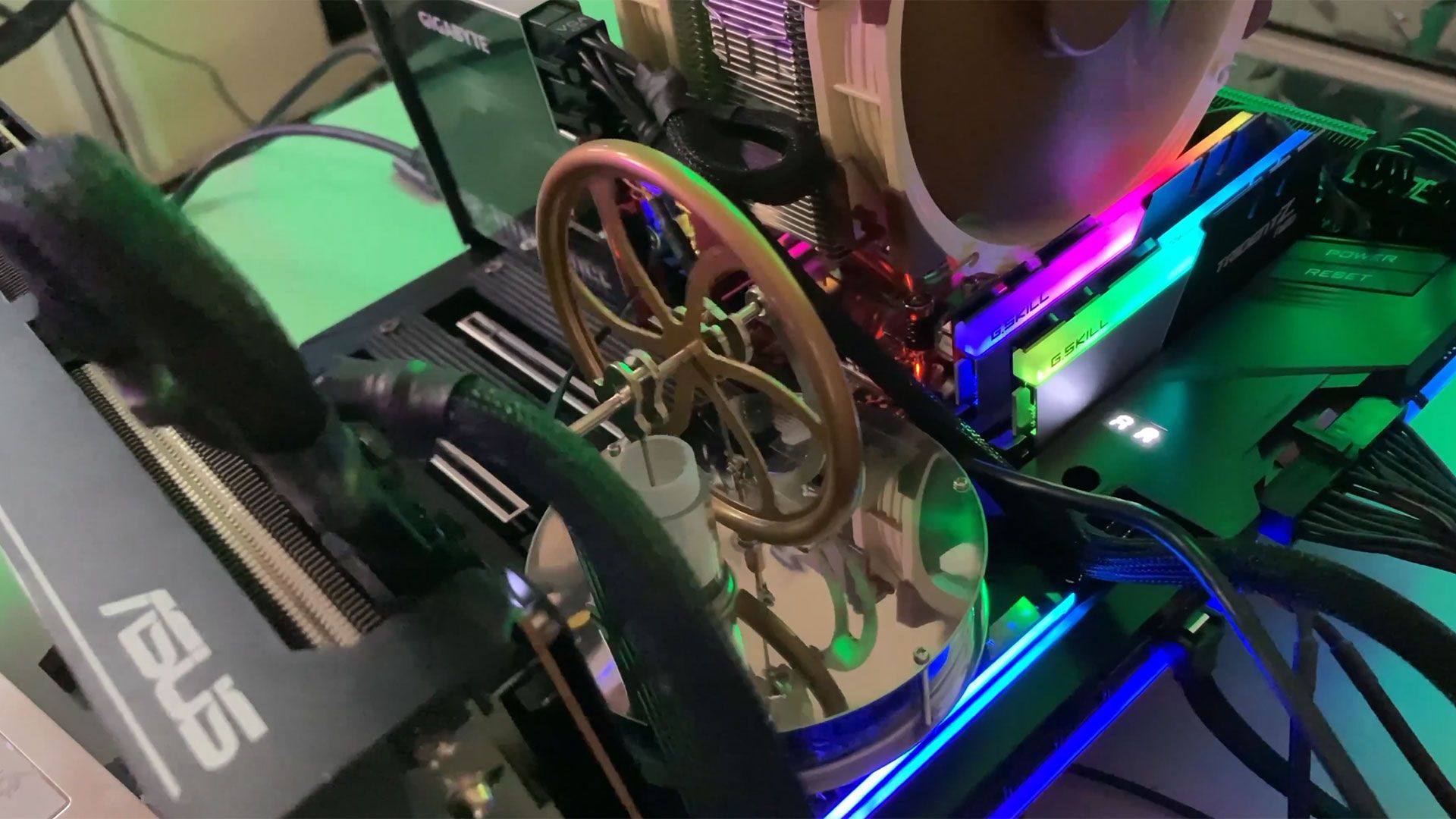
Dave W. Plummer, a prominent figure in the Windows development community, has unveiled a unique and surprisingly effective auxiliary cooling solution for his high-performance AMD Threadripper 3970X system. Eschewing conventional liquid or air cooling methods for this specific task, Plummer has turned to a 19th-century marvel of engineering: the Stirling engine. This demonstration, shared via a brief video, showcases how waste heat from the powerful CPU can be harnessed to power a small, inexpensive Stirling engine, which in turn contributes to the system's overall thermal management.
The core idea is elegantly simple: capture the significant amount of heat that a high-end CPU like the Threadripper 3970X dissipates and use it as the energy source for a heat engine. A Stirling engine operates on a thermodynamic cycle that converts thermal energy into mechanical work. It requires a temperature differential to function – one side is heated, and the other is cooled. In Plummer's setup, the CPU's waste heat provides the hot side, while ambient air or a separate cooling mechanism serves as the cold side. The engine's mechanical output, in this case, the spinning of its flywheel, is then leveraged for cooling, though the exact mechanism of how this flywheel spinning aids cooling beyond providing a visual demonstration of energy conversion is not detailed in the initial sharing.
The Science Behind the Stirling Engine
Invented by Scottish physician Robert Stirling in 1816, the Stirling engine predates the internal combustion engine and was once a contender for power generation. Its fundamental principle relies on the expansion and contraction of a working gas (typically air, helium, or hydrogen) within a sealed cylinder. A temperature difference between two ends of the cylinder causes the gas to expand when heated and contract when cooled. This expansion and contraction drives a piston, which can then be used to perform work, such as spinning a flywheel or generating electricity.
What makes the Stirling engine particularly interesting for this application is its potential for quiet operation and its ability to run on any heat source. Unlike internal combustion engines, it has no valves or explosions, leading to less noise and vibration. For Plummer, the $40 price point of the small, pre-built Stirling engine model is also a significant factor, making it an accessible and experimental addition to his PC build. The engine's ability to continuously operate as long as a temperature gradient is maintained means it can passively work to dissipate heat, turning a byproduct of computing into mechanical motion.
Why This Setup is Surprising
The surprising detail here is not the ingenuity of using a Stirling engine, which has been explored for various niche applications, but its application specifically to PC component cooling by a prominent software developer. While enthusiasts have experimented with thermoelectric coolers (Peltier devices) and advanced custom loop liquid cooling, a mechanically driven engine powered by CPU heat is an entirely different category of experimental cooling. It represents a fundamental shift from simply moving heat to a radiator, to actively converting that heat into a different form of energy. This approach taps into the concept of waste heat recovery, a field gaining traction in industrial and energy sectors but rarely seen in consumer PC hardware.
The AMD Threadripper 3970X is a 32-core, 64-thread processor known for its immense computing power and, consequently, its substantial heat output. Under heavy load, it can easily exceed 200W of thermal design power (TDP), requiring robust cooling solutions. Plummer's setup suggests that even a portion of this dissipated heat can be effectively utilized by a Stirling engine. The visual of the engine's flywheel spinning, driven solely by the heat radiating from the CPU, is a compelling demonstration of thermoelectric conversion in a consumer computing context.
Potential Implications and Future Considerations
While this is currently a bespoke, experimental setup, it opens up intriguing possibilities for future PC cooling technologies. Imagine future CPUs or GPUs designed with integrated heat exchangers that could more efficiently drive small, embedded Stirling engines. These engines could then power micro-fans or other active cooling elements, reducing the reliance on traditional power-hungry fans and pumps. This could lead to quieter, more energy-efficient high-performance computing systems.
However, significant challenges remain. The efficiency of small Stirling engines, especially those powered by relatively low-grade heat sources like a CPU, is often limited. The mechanical work generated might be minimal compared to the heat input. Furthermore, integrating such a system reliably into a standard PC case would require careful design to ensure the engine's hot side maintains sufficient temperature and the cold side has adequate airflow. The long-term durability of these small engines under constant thermal stress also needs consideration.
For developers and hardware enthusiasts, Plummer's project serves as a powerful reminder that innovative solutions can emerge from unexpected places. It encourages thinking beyond established paradigms and exploring the potential of thermodynamic principles in areas we typically consider solely within the realm of electronics and fluid dynamics. The question remains: can this 19th-century technology be scaled and refined to become a practical component in 21st-century computing, or will it remain a fascinating, albeit niche, demonstration of physics in action?