
The Database Security Misconception
Many development teams, particularly those new to API management or operating under tight deadlines, often fall into the trap of storing API keys directly within their primary databases. This practice, while seemingly convenient for quick retrieval and integration, represents a fundamental misunderstanding of database capabilities and security best practices. Databases are optimized for structured data storage, querying, and transactional integrity. They are not, however, built to be secure vaults for sensitive credentials like API keys. This approach creates a single point of failure, exposing a company's critical access tokens to a much wider attack surface than necessary.
The allure of storing API keys in the database stems from its simplicity. Developers can often write straightforward SQL queries or use ORM methods to fetch these keys alongside other application data. This can feel efficient during initial development or for small-scale applications. However, as applications grow and the stakes for security increase, this convenience quickly becomes a dangerous liability. The underlying architecture of most databases, even those with robust access control mechanisms, is not designed to protect secrets from threats that target the database itself. This includes SQL injection attacks, unauthorized database access, insider threats, or even accidental data dumps. When an API key is compromised through any of these vectors, it can grant attackers unfettered access to third-party services, leading to data breaches, financial loss, and reputational damage.
The Database's Role vs. Secret Management
A relational database's core strength lies in its ability to manage structured information, enforce relationships between data entities, and ensure data consistency through transactions. Think of it less like a bank vault and more like a highly organized library. It's excellent at cataloging and retrieving books (data) efficiently, but it's not designed to safeguard the rare, priceless manuscripts (secrets) from determined thieves. The security features present in databases, such as user roles, permissions, and encryption at rest, are primarily geared towards protecting the data *within* the database from unauthorized access or modification by database users. They are not inherently designed to protect specific, high-value secrets from compromise, especially if the attacker gains access to the database itself.
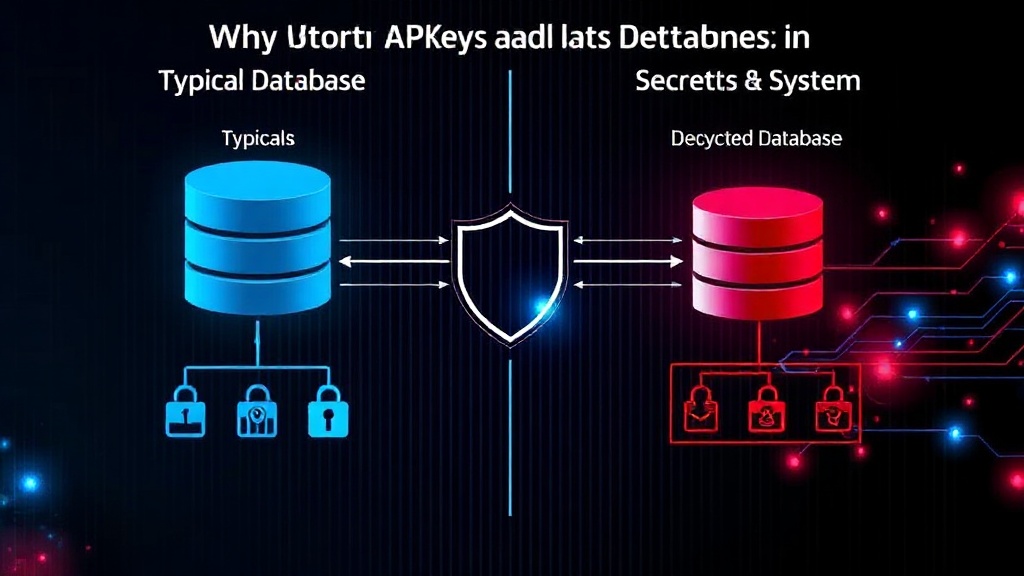
When an attacker successfully breaches a database, they often gain access to all the data stored within it, including any API keys or credentials that have been carelessly placed there. This is fundamentally different from a dedicated secrets management system. Secrets managers, like HashiCorp Vault, AWS Secrets Manager, or Azure Key Vault, are purpose-built for securely storing, accessing, and rotating sensitive information. They employ advanced encryption techniques, fine-grained access control policies, audit logging, and often integrate with hardware security modules (HSMs) to provide a much higher level of protection for secrets. These systems are designed to isolate secrets and control access with extreme precision, ensuring that only authorized applications or users can retrieve them, and only for a specified duration or purpose.
Inherent Vulnerabilities in Database Storage
Several inherent vulnerabilities make databases poor choices for storing API keys:
- SQL Injection: This classic attack vector allows attackers to insert malicious SQL code into queries, potentially allowing them to read sensitive data, including API keys, from the database. Even with parameterized queries, complex application logic can sometimes introduce exploitable flaws.
- Database Compromise: If an attacker gains administrative access to the database server, either through exploiting a vulnerability in the database software itself or through compromised credentials, they can typically access all data stored within. This includes plain text or easily decryptable API keys.
- Insider Threats: Malicious or negligent insiders with database access can easily exfiltrate API keys. While database permissions can restrict access, a sufficiently privileged user can bypass many safeguards.
- Accidental Exposure: Developers might accidentally expose database credentials through misconfigurations in cloud environments, public code repositories, or insecure logging practices, leading to a domino effect of compromises.
- Lack of Rotation and Auditing: Databases generally lack sophisticated features for automated key rotation or granular auditing of secret access, which are critical for maintaining security hygiene.
The surprise here is not that databases can be compromised, but how often this seemingly obvious risk is overlooked in favor of perceived development speed. Many teams assume their database security is sufficient, failing to recognize that it's designed for a different threat model than secrets management.
The Correct Approach: Dedicated Secrets Management
The industry standard for managing API keys and other sensitive credentials is to use a dedicated secrets management system. These systems provide:
- Centralized Storage: A single, secure location for all secrets.
- Encryption: Strong encryption for secrets at rest and in transit.
- Access Control: Fine-grained policies to control who and what can access specific secrets.
- Auditing: Detailed logs of all secret access attempts, successful or otherwise.
- Dynamic Secrets: The ability to generate temporary, short-lived credentials that are automatically revoked.
- Automated Rotation: Mechanisms for automatically rotating secrets on a schedule or after a certain period.
Integrating with these systems typically involves applications authenticating themselves to the secrets manager (often using platform-specific identity mechanisms like IAM roles or service accounts) and then requesting the specific secret they need. This decouples secret management from the application's primary data store, significantly reducing the attack surface.
The Unanswered Question: Transitioning Legacy Systems
While the benefits of dedicated secrets management are clear, the practical challenge for many organizations lies in migrating existing applications that have API keys embedded in their databases. What is the most effective and least disruptive strategy for retrofitting these legacy systems with proper secrets management? Simply extracting keys and placing them into a secrets manager is often just the first step; re-architecting application code to interact with the secrets manager securely, managing the transition without downtime, and ensuring all historical data access points are secured present significant engineering hurdles that are frequently underestimated.
Adopting a dedicated secrets manager is not merely an IT security recommendation; it's a critical architectural decision that underpins the security posture of any application handling sensitive data or relying on external services. The convenience of database storage is a siren song that leads to significant, often insurmountable, security debt.