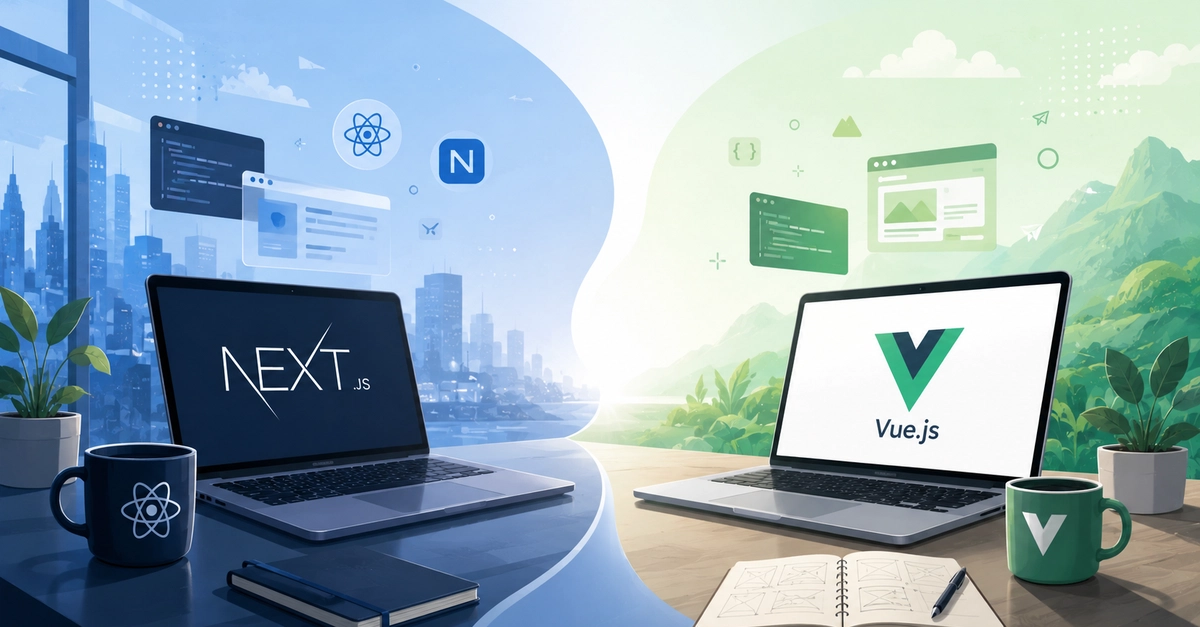
The Dichotomy in Framework Choices
Discussions with frontend developers frequently reveal a nuanced approach to framework selection. The common refrain, "It depends on the project," is accurate but masks deeper patterns. As conversations progress, a clear divergence emerges: Next.js is the go-to for professional work, while Vue.js often captures the heart for personal projects. This isn't about one framework being universally superior; it's about aligning toolsets with distinct project goals, team dynamics, and developmental philosophies.
Next.js, built on React, brings a robust ecosystem and a structured approach that professional environments demand. Its batteries-included philosophy, server-side rendering (SSR) capabilities, static site generation (SSG), and strong community support make it a safe and efficient choice for enterprise-level applications. Companies often standardize on Next.js for its performance optimization features, SEO benefits, and the sheer availability of developers familiar with its conventions. The framework's opinionated structure streamlines development, reduces decision fatigue, and enforces best practices, which are critical for team collaboration and long-term maintainability in a corporate setting. When a project needs to scale, integrate with complex backend systems, or meet stringent performance benchmarks, Next.js provides a solid foundation.
Consider a large e-commerce platform. Here, SEO is paramount. Next.js's SSG and SSR capabilities allow for pre-rendering pages, ensuring search engines can easily index content, leading to better visibility and higher conversion rates. Furthermore, its built-in routing, API routes, and image optimization features reduce the need for numerous third-party libraries, simplifying dependency management and security audits. The ability to deploy seamlessly to platforms like Vercel, which are tightly integrated with Next.js, further accelerates development cycles and deployment pipelines. For developers in these settings, the familiarity and widespread adoption of Next.js mean less time spent on setup and more time focused on feature development and business logic.

The Appeal of Vue.js for Personal Endeavors
Conversely, Vue.js often shines in the realm of personal projects. Its core philosophy emphasizes approachability, flexibility, and a gentler learning curve. For hobbyists, side projects, or experimental endeavors, Vue.js offers a less opinionated structure that allows for greater creative freedom and faster iteration. Developers can often get a Vue.js project up and running with minimal boilerplate, making it ideal for quick prototypes or personal explorations where the overhead of a full-fledged framework like Next.js might feel like overkill.
Vue.js's progressive nature means developers can adopt its features incrementally. This is particularly appealing for personal projects where the scope might evolve organically. Whether it's a simple single-page application, a small content site, or a more complex interactive tool, Vue.js can adapt. Its excellent documentation and clear API design contribute to a delightful developer experience, fostering a sense of joy and exploration that is often the driving force behind personal coding projects. Unlike the corporate-driven imperative for standardization and performance that often dictates Next.js adoption, personal projects are frequently about learning, experimenting, and building something purely for the satisfaction of creation.
Think of building a personal blog or a portfolio website. With Vue.js, a developer can quickly scaffold a project, integrate a simple markdown parser, and deploy it as a static site. The ease of understanding its template syntax and component-based architecture means that even if a developer primarily uses Next.js at work, they can pick up Vue.js for a personal project without a significant mental context switch. The framework feels less like a rigid tool for delivering business value and more like a playground for ideas. This freedom from the constraints of client requirements, performance SLAs, and team conventions allows for a more experimental and enjoyable development process.
Bridging the Gap: When Work and Personal Align
While the distinction is common, it's not absolute. Some developers might find their personal projects align perfectly with the strengths of Next.js, especially if they are exploring advanced web technologies or building something that mirrors their professional work. Similarly, smaller, less complex business applications might benefit from the agility of Vue.js. The choice ultimately reflects a developer's priorities at a given moment: efficiency, scalability, and maintainability for work; versus flexibility, expressiveness, and sheer enjoyment for personal pursuits.
The underlying reason for this split often boils down to the differing objectives. Work projects prioritize delivering business value, meeting deadlines, and ensuring long-term support within a team. Personal projects, however, are often driven by curiosity, a desire to learn new technologies, or simply the pursuit of a creative vision without external pressures. This fundamental difference in motivation naturally leads to different tool choices, even for the same developer.
The surprising detail here is not that developers use different tools for different contexts, but the *degree* to which this separation has become a norm. It suggests a mature developer landscape where tools are evaluated not just on technical merit, but on their alignment with specific project goals and even emotional fulfillment. For developers, this isn't about picking a favorite; it's about strategic tool selection to maximize effectiveness and satisfaction across diverse coding environments.