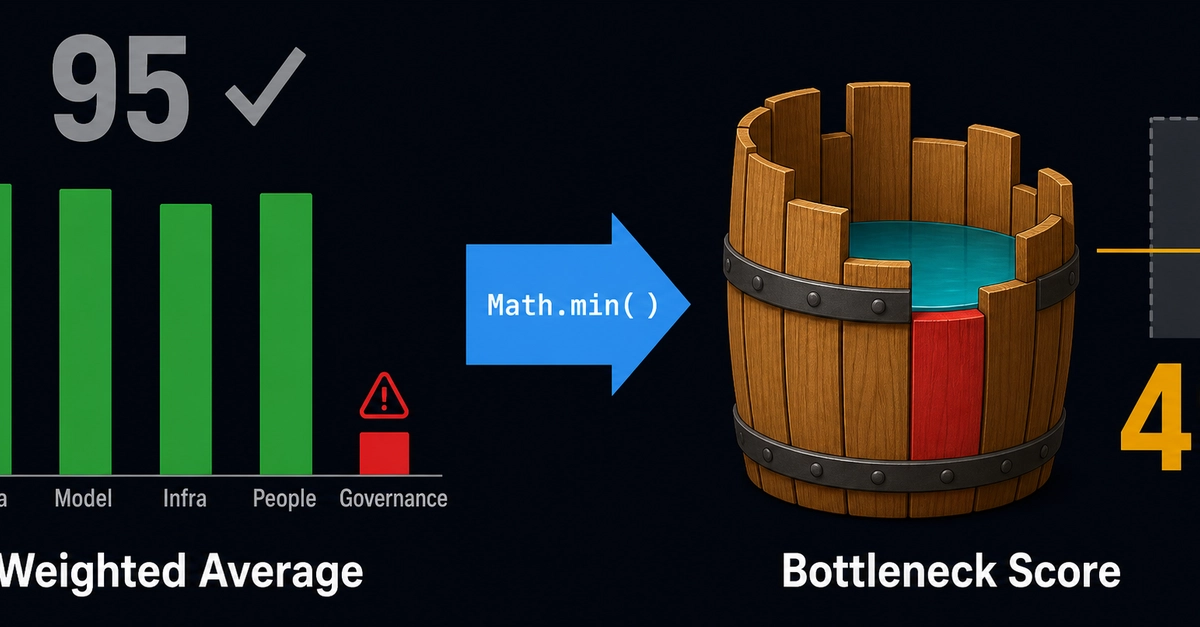
The Flaw in the Honor Student Model
Traditional self-assessment tools for AI readiness often rely on a simple, additive scoring model. Users answer a series of questions, each weighted, and the total score indicates their readiness. The higher the score, the more prepared the team or organization is deemed to be. This approach, however, suffers from a critical structural flaw: it rewards averages and overlooks single points of failure. Consider a team that meticulously documents its AI policy, ensures project fit, and even uses AI for code generation. They might score exceptionally high on a typical assessment. Yet, if this same team does not use version control like Git, a single large, AI-generated change could lead to an irreversible overwrite of critical work. No amount of excellence in other areas can compensate for this foundational weakness. This is the 'honor student problem' – a student can get perfect scores across the board but might lack a fundamental skill that renders their overall achievement precarious.
Introducing Bottleneck Scoring
The core idea behind bottleneck scoring is to acknowledge that in complex systems, particularly those involving AI-assisted development, readiness is not simply an aggregation of strengths. Instead, it is determined by the weakest link. A fatal precondition, if missing, can nullify all other advancements. This is analogous to a manufacturing assembly line where the slowest station dictates the entire output rate. In AI readiness, a missing crucial element – like version control for AI-generated code, a clear AI usage policy, or adequate data privacy safeguards – acts as a bottleneck. The entire system's effectiveness is capped by this single deficiency, regardless of how robust other components are.
Designing a Bottleneck Scoring Mechanism
Designing a scoring model that accounts for these critical dependencies requires a shift from additive logic to a more constrained approach. Instead of summing up points, the model must identify these fatal preconditions. When such a precondition is identified as unmet, the total score for readiness should be capped or effectively rendered zero, regardless of other positive indicators. This mechanism can be implemented by structuring the scoring logic around a series of conditional checks. For example, if the assessment includes questions about data security protocols, and the answers indicate a significant deficiency, the system should not proceed to sum up other scores. Instead, it should flag this as a critical failure point.
The mathematical representation of this concept is surprisingly simple: it collapses into a Math.min() operation. Imagine a set of critical factors, each with a maximum possible score. The overall readiness score would be the minimum of these critical factor scores. For instance, if factors are 'Version Control,' 'AI Policy,' and 'Data Security,' and a team scores 100/100 on Version Control, 100/100 on AI Policy, but only 20/100 on Data Security, their overall readiness score would be 20. This is because the data security issue is the bottleneck. This approach ensures that critical, non-negotiable requirements are met before other strengths are even considered fully valuable. It moves away from rewarding a balanced mediocrity towards ensuring a baseline of fundamental preparedness.

Why This Matters for AI-Assisted Development
AI is rapidly integrating into development workflows, from code generation and debugging to testing and deployment. Tools like GitHub Copilot, Amazon CodeWhisperer, and others are becoming ubiquitous. While these tools promise increased productivity, they also introduce new risks and complexities. AI-generated code can be prone to subtle bugs, security vulnerabilities, or deviations from established coding standards. Without proper governance and safeguards, the rapid pace of AI assistance can lead to unmanageable technical debt or security breaches. A weighted average model might show a team as 'ready' simply because they are using these tools extensively, even if they lack the necessary controls to manage the output effectively. Bottleneck scoring directly addresses this by ensuring that essential controls – like robust versioning, clear AI usage policies, and security reviews – are in place before other advancements are counted. This is crucial for maintaining code quality, security, and project integrity in an AI-augmented development environment.
Practical Applications and Target Audience
This bottleneck scoring methodology is particularly relevant for developers and tech leads who are tasked with evaluating or building readiness and maturity assessments for AI-assisted development. It is also valuable for anyone involved in designing scoring, ranking, or evaluation logic, especially when dealing with systems where interdependencies are critical. The practical application involves re-evaluating existing assessment frameworks. Instead of simply asking 'Do you use AI tools?' and assigning points, the assessment must ask 'Do you have a process for reviewing AI-generated code for security vulnerabilities?' and treat a negative answer as a critical failure that caps the overall score. This shift in perspective is essential for creating assessments that accurately reflect an organization's true preparedness for adopting AI technologies responsibly and effectively.
The target audience includes development teams, engineering managers, CTOs, and anyone responsible for setting standards and evaluating the technical maturity of their organization. By adopting bottleneck scoring, teams can move beyond superficial metrics to identify and address the most critical gaps in their AI readiness, ensuring that their adoption of AI tools is both productive and secure.