Weft: An Internet Sans Bloat
Thomas Verhave, a developer who evidently thrives on ironic inspiration, has launched Weft, a project that started as a sarcastic response to the idea of building a new internet. The result is not a metaphor or a framework, but a functional, albeit small-scale, alternative network. Weft operates on a simple, line-based protocol over raw TCP, featuring its own addressing scheme, a custom markup language, and a terminal-based browser.
The entire Weft system is implemented in pure Python, relying solely on the standard library. This means zero external dependencies, a significant departure from the typical web stack. The codebase is remarkably concise, spanning only a few hundred lines of Python. This minimalist approach is intentional; Verhave explicitly states that Weft will never scale to billions of users, and that’s precisely the point. The project is a deliberate counter-bet against the complexity and invasiveness of the modern web.
The current web, Verhave argues, is unnecessarily heavy. Pages often require megabytes of JavaScript to render simple text, and user activity is constantly being monitored. Weft aims for the opposite: simplicity, privacy, and a return to basic communication. The design philosophy is rooted in four core rules, though the excerpt only details the first two implicitly: speed, simplicity, privacy, and a lack of dependencies.
Core Components of Weft
Weft is not a single monolithic application but a collection of interconnected components designed to function as a network. At its heart is the protocol itself, a line-based system that runs over raw TCP connections. This eschews the overhead associated with higher-level protocols like HTTP, offering a more direct and lightweight communication channel.
The network utilizes its own distinct address scheme. This is crucial for routing and identifying nodes within the Weft ecosystem, independent of existing internet protocols. Coupled with the protocol is a custom markup language. This language is designed to be simple and efficient, intended for displaying text-based content within the Weft environment, avoiding the heavy rendering engines and scripting languages common on the web.
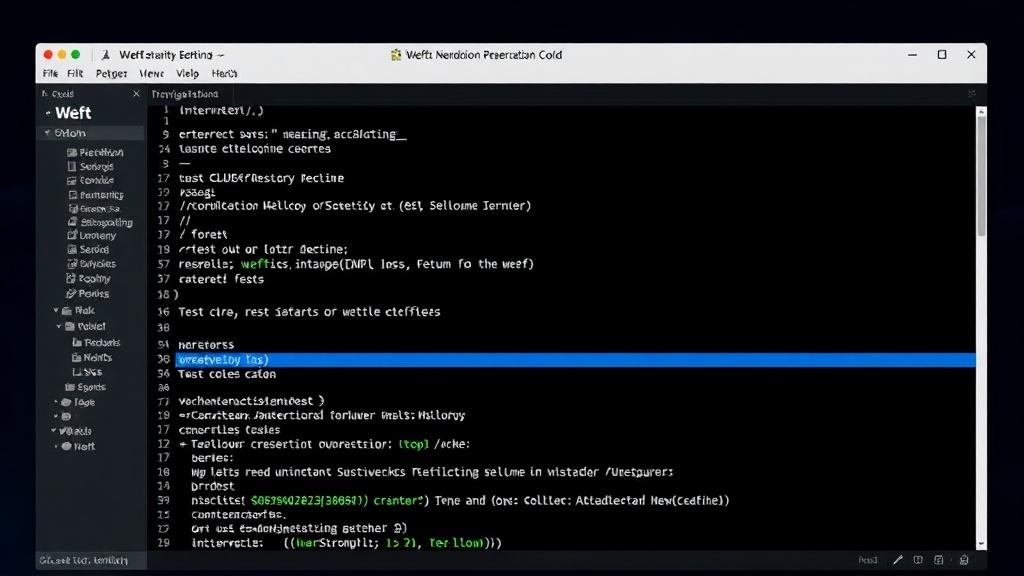
A key user-facing component is the terminal browser. This application allows users to navigate and interact with content served over the Weft network directly from their command line. It speaks the Weft protocol natively, rendering the custom markup in a text-based interface. This provides a stark contrast to graphical web browsers, offering a focused and distraction-free browsing experience.
Furthermore, Weft includes an application-layer firewall that can be controlled through the terminal browser. This adds a layer of security and control over network traffic within the Weft network, managed directly by the user via the browser interface. The entire system is orchestrated by three small servers that interlink to form the network fabric. This distributed, yet minimal, architecture underpins Weft's design principles.
The Philosophy: A Deliberate Rejection of Web Bloat
The driving force behind Weft is a clear dissatisfaction with the current state of the World Wide Web. Verhave’s project is a statement against the megabytes of JavaScript, the pervasive tracking, and the general complexity that has come to define online experiences. Weft is built on the premise that the web can and should be simpler, faster, and more private.
The choice to build with pure Python and standard libraries is a direct manifestation of this philosophy. It eliminates the need for users to install numerous packages or manage complex build processes. This makes Weft highly portable and easy to set up, aligning with its goal of simplicity. The small codebase is a testament to this, demonstrating that a functional network protocol and associated tools can be created with minimal complexity.
The explicit decision to forgo scalability for billions of users is perhaps the most radical aspect of Weft. It positions the project not as a replacement for the internet, but as an alternative for specific use cases where its minimalist principles are advantageous. This could include private networks, niche applications, or educational purposes where understanding network fundamentals is key.
Weft’s design, dictated by its core rules, prioritizes a lean and efficient user experience. It’s an internet designed for content, not for advertising, analytics, or complex dynamic applications that often bog down traditional web browsing. The project invites developers and users to reconsider what an online network can be, prioritizing core functionality and user control over the features that have led to the current web’s bloat.
Implications and Future
While Weft is a personal project and not intended for mass adoption, it serves as a powerful demonstration of alternative network design principles. It highlights the possibility of building functional, albeit limited, network systems with extreme simplicity and minimal dependencies. For developers, it offers a unique environment to explore network protocols and terminal-based applications.
The project raises questions about the future of the web and the potential for smaller, more focused networks. As concerns about privacy, data usage, and online tracking grow, minimalist alternatives like Weft, even as conceptual or niche projects, become increasingly relevant. They challenge the status quo and encourage innovation in areas often overlooked by mainstream development.
The success of Weft, measured not by user numbers but by its elegant execution of a specific vision, lies in its purity. It’s a clean implementation of an alternative internet, proving that building something functional and meaningful doesn't always require massive infrastructure or complex dependencies. It’s a testament to the power of focused design and the enduring appeal of simplicity in a complex digital world.