
Pushing Browser Compute Limits with WebGPU
WebGPU is a new web standard that provides the browser with direct access to modern GPU capabilities. This isn't just for graphics rendering; it unlocks general-purpose computation through compute shaders. This opens up possibilities for complex simulations and computations that were previously confined to native applications.
The question arose: how far can we truly push these capabilities? What happens when we move beyond small compute demos and attempt a full-scale simulation involving tens of millions of active objects? This is precisely what one developer set out to explore.
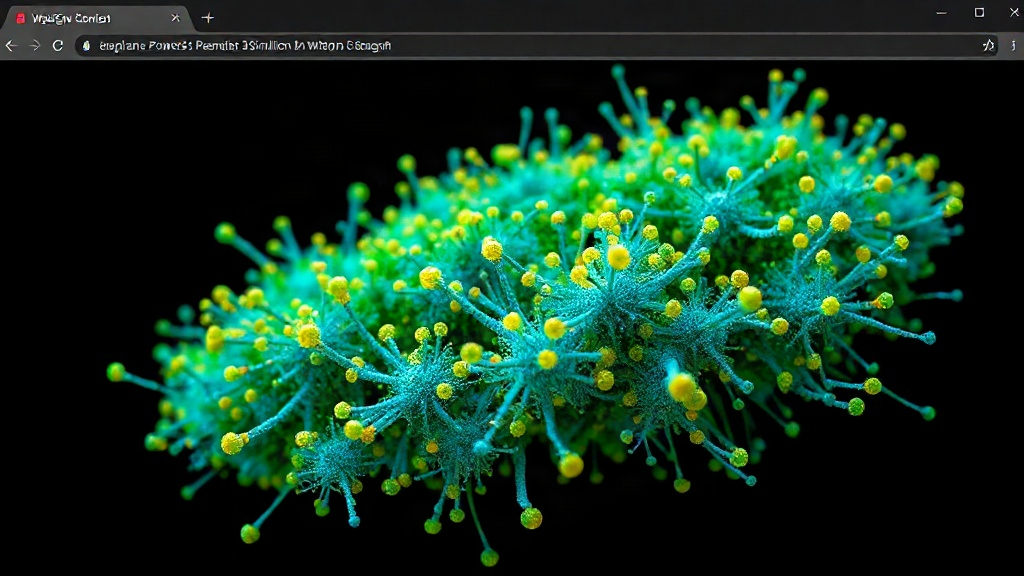
The Simulation Architecture
The core of this ambitious project lies in its architecture, designed to handle an immense number of entities. Simulating 30 million microbes requires an efficient approach to managing their states, interactions, and movements. This typically involves breaking down the simulation into discrete time steps. In each step, the position, state, and behavior of every microbe are updated based on a set of rules and environmental factors.
For a simulation of this scale to run in a browser, performance is paramount. Traditional JavaScript-based simulations would quickly become computationally prohibitive. This is where WebGPU and its compute shaders become indispensable. Instead of running computations on the CPU, which has limited parallel processing power, the GPU can handle these tasks in parallel across thousands of its cores. This dramatically accelerates the simulation, making it feasible within the constraints of a web environment.
The simulation itself likely models various aspects of microbial life, such as reproduction, movement, resource consumption, and interaction with other microbes or environmental elements. The sheer number of agents means that even simple individual behaviors, when scaled up, create complex emergent phenomena. This complexity is what makes such simulations valuable for research and educational purposes, allowing users to observe ecological dynamics in a dynamic, interactive way.
Leveraging Compute Shaders for Mass Parallelism
Compute shaders are a fundamental component of WebGPU that enable general-purpose computation on the GPU. Unlike vertex or fragment shaders, which are designed for graphics rendering pipelines, compute shaders are designed for arbitrary parallel computation. This makes them ideal for tasks like physics simulations, data processing, and, in this case, agent-based modeling.
In this microbe simulation, each microbe can be thought of as an independent thread of computation. The compute shader would define the logic for updating a single microbe's state. When executed, the GPU can run this shader concurrently for millions of microbes. The data for each microbe (e.g., position, energy, age, type) is stored in buffers accessible by the shader.
The process typically involves:
- Data Preparation: Initializing microbe data and storing it in GPU buffers.
- Dispatching Compute: Launching the compute shader, specifying the number of workgroups and threads to execute. This is where the 30 million microbes come into play – the shader is instructed to run for each of them.
- Shader Execution: The compute shader runs in parallel across the GPU, updating each microbe's properties based on simulation rules and potentially interactions with neighbors.
- Data Retrieval: The updated microbe data is read back from the GPU buffer to the CPU for rendering or further processing.
The efficiency of this process hinges on minimizing data transfer between the CPU and GPU, and maximizing the parallel computation performed on the GPU. The ability to perform these calculations directly in the browser, without requiring users to download specialized software or have high-end hardware (beyond a reasonably modern GPU), is a significant advancement.
Challenges and Performance Considerations
Simulating 30 million objects, even with the power of a GPU, presents substantial challenges. One of the primary hurdles is memory management. Storing the state for each of the 30 million microbes requires significant GPU memory. If the simulation includes many parameters per microbe, this can quickly exceed available VRAM, leading to performance degradation or outright failure.
Another challenge is the complexity of interactions. If each microbe needs to check for interactions with many other microbes, the computational cost can skyrocket. Techniques like spatial partitioning (e.g., using grids or quadtrees) can help optimize neighbor searches, but implementing these efficiently within a compute shader framework adds another layer of complexity.
Furthermore, the simulation needs to be stable and predictable. Numerical precision issues can arise in simulations, especially with a large number of agents over extended periods. Debugging such large-scale, parallel computations can also be more difficult than debugging traditional single-threaded code. The developer had to carefully tune parameters, optimize shader code, and manage data structures to achieve the desired scale and performance.
What This Means for the Future of Web-Based Simulation
This achievement demonstrates that the browser is rapidly evolving into a powerful platform for computationally intensive tasks. WebGPU is not merely an incremental upgrade; it's a paradigm shift that allows web applications to leverage hardware acceleration on par with native applications for certain workloads.
For developers, this opens up new avenues for creating interactive educational tools, scientific visualizations, and even complex games that were previously out of reach for web technologies. Imagine interactive biology lessons where students can tweak environmental parameters and observe the cascading effects on a vast microbial population, all within their browser. Or complex physics engines for web-based games that run with unprecedented fidelity.
The success of simulating 30 million microbes also points towards a future where complex simulations are more accessible. Users won't need powerful dedicated machines; a modern laptop with a decent GPU could potentially run simulations that previously required supercomputing resources. This democratizes access to powerful computational tools and makes them available to a much wider audience. The line between what can be done in a desktop application and what can be done in a web browser is blurring, thanks to advancements like WebGPU.