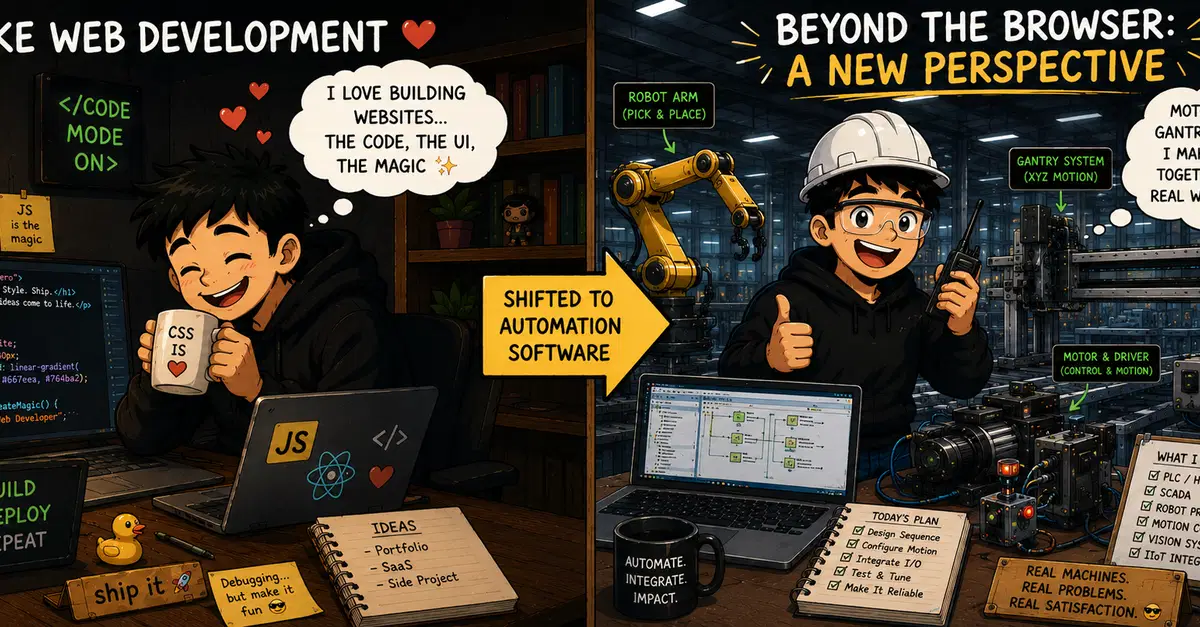
The Unexpected Pivot: From Git to Gears
The digital world often feels self-contained. Developers wrestle with Git repositories, server configurations, and deployment pipelines, believing their domain is purely abstract. But for one developer, a career shift into industrial automation revealed a fundamental truth: the physical world, particularly the realm of motors and machinery, is deeply reliant on sophisticated software. This isn't about simple on/off switches; it's about precise control, complex logic, and the seamless integration of code with hardware to drive real-world actions. The transition from managing lines of code on a screen to orchestrating the movements of physical systems is a journey marked by surprise and a redefinition of what 'software development' truly means.
Automation, at its core, is the art of making machines perform tasks automatically. It's where software, sensors, motors, and controllers converge. Think of it less like updating a website's user interface and more like programming a robot arm on an assembly line to pick and place components with micron-level accuracy. The code written doesn't just change what a user sees; it dictates physical movements, operational sequences, and the overall efficiency of a production process. This blurring of lines between the digital and physical is at the heart of modern industry, transforming factories into intelligent, responsive environments.
Redefining 'Real-World' Control
The author’s initial foray into automation brought back childhood memories of tinkering with motors for a windmill project. This personal connection underscores a common misconception: that motors are purely mechanical devices. The reality, as discovered, is that modern motors, especially in industrial settings, are driven by complex electronic control units (ECUs) that run embedded software. These ECUs interpret commands from a higher-level controller or system, manage motor speed, torque, position, and execute intricate operational sequences. The 'software' here isn't a desktop application; it's firmware, real-time operating systems, and control algorithms optimized for performance and reliability in demanding environments.
This realization challenges the traditional developer's perspective. Instead of debugging a JavaScript framework or optimizing a SQL query, the focus shifts to understanding motor control theory, sensor integration, and the deterministic nature of real-time systems. A web developer accustomed to the relative flexibility of web technologies faces a new paradigm where timing is critical, and a missed deadline in code execution can lead to physical malfunctions, safety hazards, or costly production downtime. The development cycle itself changes, involving not just coding but also hardware testing, calibration, and integration with physical machinery.
The Automation Stack: Beyond the Frontend
The automation 'stack' is a multi-layered entity. At the lowest level are the physical components: motors, actuators, sensors, and the embedded hardware. Above this sits the firmware and real-time operating systems that directly control these components. Higher still are the control logic and application software, which dictate the overall process flow and decision-making. This application layer is where many of the principles familiar to software developers come into play, but adapted for the unique constraints of industrial control. Instead of HTTP requests, systems communicate via industrial protocols like Modbus, EtherNet/IP, or PROFINET. Instead of user interfaces, developers might create dashboards for SCADA (Supervisory Control and Data Acquisition) systems or HMI (Human-Machine Interface) panels.
The skills required are a blend of traditional software engineering and specialized knowledge. Understanding control loops (like PID controllers), state machines, and event-driven architectures becomes paramount. Debugging involves not just code inspection but also analyzing sensor readings, motor feedback, and system logs in real-time. The author's experience highlights the need for a different kind of problem-solving, one that bridges the gap between the abstract logic of software and the tangible reality of physical processes. It’s about ensuring that the software's intent is perfectly translated into physical action, reliably and efficiently.
Implications for the Modern Developer
For developers currently immersed in web, mobile, or cloud development, the field of industrial automation presents a significant, albeit challenging, opportunity. The world's infrastructure – from manufacturing plants and logistics networks to energy grids and transportation systems – is increasingly digitized and automated. This digital transformation demands a workforce capable of building and maintaining the software that governs these critical systems. The skills acquired in traditional software development are transferable, but require adaptation and augmentation with domain-specific knowledge.
The surprise that 'motors need software too' is a powerful reminder that software's influence extends far beyond screens and servers. It is the invisible engine driving much of the physical world. As industries continue to embrace Industry 4.0, the demand for engineers who can bridge the hardware-software divide will only grow. This pivot isn't just a career change; it's an expansion of the developer's purview into a domain that is as critical as it is complex, offering a chance to build tangible, impactful systems that power the modern economy.