The Rise of Self-Hosted AI Voice Generation
For developers and businesses relying on text-to-speech (TTS) APIs, the cost per character can quickly become a significant operational expense. Traditional hosted solutions, while convenient, tie users to per-word or per-character billing and send sensitive customer data off-network. This landscape is shifting with the emergence of powerful open-source alternatives. VoxCPM2, released in April 2026 by OpenBMB, represents a significant leap forward in self-hosted AI voice capabilities, directly challenging established players like ElevenLabs.
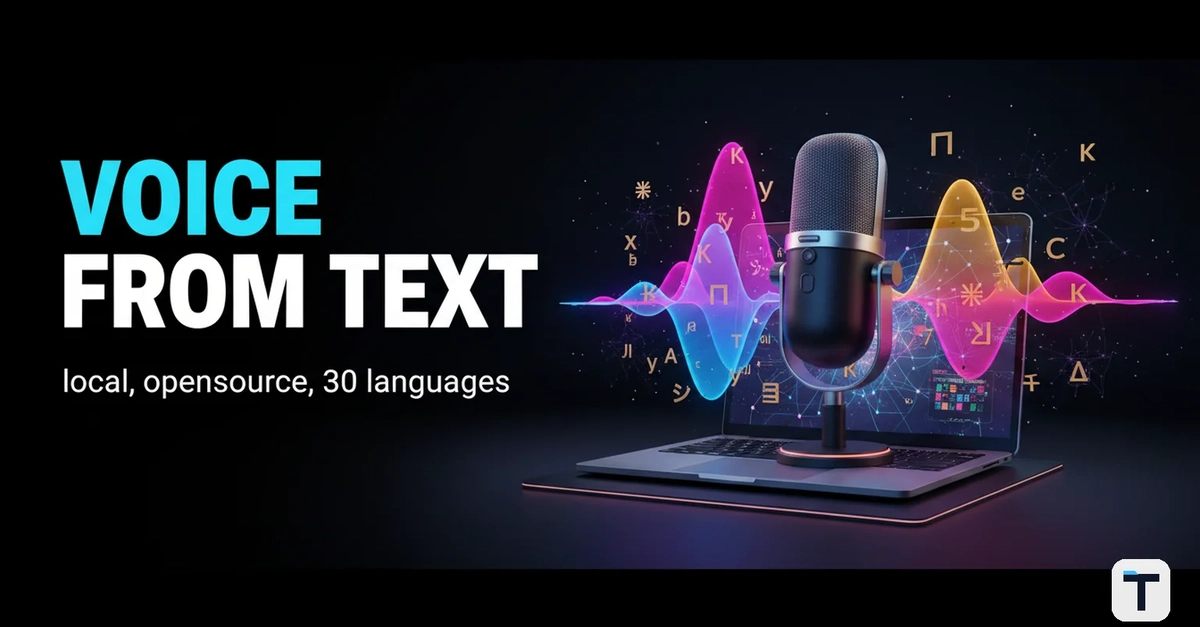
VoxCPM2 is a 2-billion-parameter model licensed under Apache-2.0. Its key differentiator is its comprehensive feature set within a single checkpoint. It offers voice cloning from just a few seconds of audio, the ability to design entirely new voices based on textual descriptions, and support for 48 kHz speech output across 30 languages. Crucially, it operates entirely on a user's own GPU, eliminating per-character costs and keeping customer data within the user's network boundaries.
VoxCPM2's Core Capabilities
The model's versatility is its primary strength. For developers integrating voice into applications, VoxCPM2 provides:
- Voice Cloning: Users can upload short audio samples (reportedly just a few seconds) to create a synthetic voice that mimics the original speaker. This is invaluable for personalized user experiences or maintaining brand voice consistency.
- Voice Design: Beyond cloning, VoxCPM2 allows for the creation of novel voices through text prompts. This means users can describe the desired vocal characteristics – such as tone, age, accent, or emotion – and the model will generate a corresponding voice. This opens up creative possibilities for content generation and character development in games or virtual assistants.
- Multilingual Support: With support for 30 languages, VoxCPM2 addresses a broad global market. Generating high-quality speech in multiple languages from a single model simplifies development and deployment for international applications.
- High-Fidelity Output: The model outputs audio at 48 kHz, a standard for professional audio production, ensuring a high degree of clarity and naturalness.
The open-source nature, under the permissive Apache-2.0 license, means developers can inspect, modify, and deploy the model freely, fostering innovation and community contributions. The tokenizer-free design also simplifies the integration process.
Self-Hosting vs. Hosted Solutions: The Trade-offs
The decision to self-host AI models like VoxCPM2 involves a distinct set of considerations compared to using cloud-based services such as ElevenLabs. The primary advantage of VoxCPM2 is the potential for significant cost savings. For applications with high volumes of text-to-speech generation, the per-character fees from hosted services can accumulate rapidly. By running VoxCPM2 on local GPUs, these ongoing costs are replaced by the upfront investment in hardware and the operational overhead of managing the infrastructure.
Furthermore, self-hosting offers enhanced data privacy and security. When using hosted TTS APIs, the text input and generated audio are processed on third-party servers. For applications dealing with sensitive information, proprietary content, or personal user data, this can be a major concern. VoxCPM2 keeps all processing within the user's controlled environment, ensuring that customer text never leaves their network.

However, self-hosting is not without its challenges. It requires significant technical expertise to set up, optimize, and maintain the model and its underlying infrastructure. The computational resources needed, particularly powerful GPUs, represent a substantial capital expenditure. Moreover, while VoxCPM2 aims to cover about 80% of routine generation needs effectively, hosted services like ElevenLabs may still offer superior quality or more nuanced emotional range for highly specific or critical use cases. The cutting edge of AI research often sees rapid improvements in hosted models, and ElevenLabs is known for its high-quality, natural-sounding outputs that are continuously refined.
The Market Impact and Future Outlook
VoxCPM2's arrival signals a potential paradigm shift in the TTS market. It democratizes access to advanced AI voice capabilities, enabling smaller teams and startups to leverage sophisticated features without prohibitive recurring costs. This could lead to a proliferation of voice-enabled applications, particularly those where cost-effectiveness and data privacy are paramount.
The model's ability to serve 30 languages from a single checkpoint is a substantial advantage for global product strategies. It simplifies the localization and internationalization process for voice features, allowing companies to reach broader audiences more efficiently. The